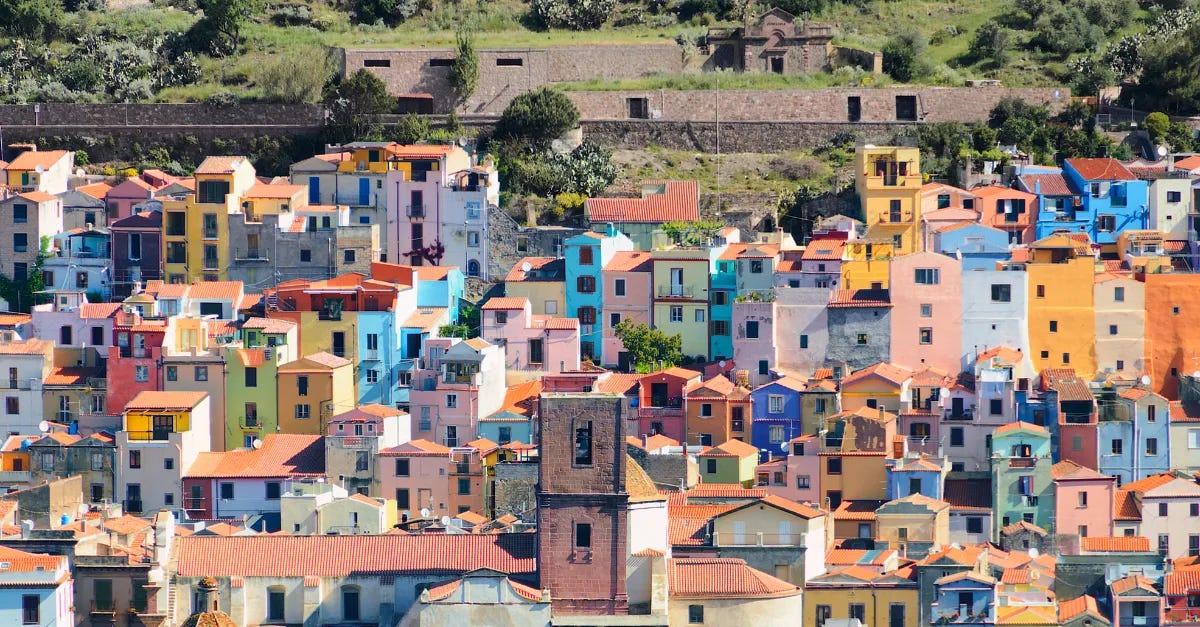
€150 million for Sardinia’s small towns: a serious measure, and some uncomfortable questions
150 milioni per i piccoli comuni sardi: molti soldi e molte domande aperte
Original article, in Italian, published here (Esco quando voglio) 👇
Between allowances, depopulation, and what is already quietly happening on the ground
I’ve already written and spoken about this topic several times. Not because it suddenly became fashionable again, but because it is one of those structural issues that Italy—and Sardinia in particular—keeps returning to in cycles, often with new tools and larger budgets, yet without fully clarifying where real change is supposed to begin.
In recent days, Il Sole 24 Ore reported on a significant measure approved by the Sardinian regional government: €150 million over three years aimed at countering depopulation and declining birth rates in municipalities with fewer than 5,000 inhabitants.
The mechanism is relatively straightforward. Regional funds will be transferred to local municipalities, which will then distribute monthly allowances to families who already live in—or who move their residence to—small towns. The allowance amounts to €600 per month for a first child and €400 for a second, paid for five years. The support is not means-tested and is proportional to the actual months of residence.
According to the President of the Region, Alessandra Todde, the measure is part of a broader strategy that aims to revive local economies through investment in transport, education, connectivity and public services, alongside direct support for families. The results, at least in intention, will be monitored over time by observing changes in population levels, services, employment and local economic activity.
On paper, this is a serious and structured policy. It attempts—rightly—not to stop at a single announcement, and that deserves recognition.
The real issue, however, is not whether such allowances can work in isolation. The issue is the context in which this measure sits, and the way depopulation has been framed and addressed for years.
In Italy, and especially in Sardinia, public policy, media narratives and symbolic expectations often blur into one another. Very different tools and experiences are placed on the same level: long-term policies, early-stage experiments, genuinely rooted local initiatives and far more episodic projects. Everything risks being presented as “the solution”, until—inevitably—time reveals that the numbers have barely shifted.
This confusion is partly journalistic, but, I suspect, also institutional. Certain local examples are repeatedly referenced as models, even when their long-term outcomes remain debatable. I’ve written about this more than once in the past, precisely because it highlights how easily a local experience can be turned into a replicable format, without asking hard questions about what actually lasted, what scaled, and what mainly produced visibility.
The problem is not any single case. It is the effect of the narrative itself. When everything is framed as a “best practice”, it becomes difficult to distinguish between structural policy, fragile experimentation and initiatives that function better symbolically than materially.
Meanwhile, while public debate focuses on allowances and incentives, many interesting things are already happening on the ground in Sardinia, often well outside the spotlight and frequently before any funding becomes available. These initiatives tend to emerge from below: from people who choose to stay or return, from local entrepreneurship, from attempts to build more mature forms of tourism, contemporary agriculture, distributed hospitality, and real, everyday services.
Sometimes these projects manage to access regional or national funding. Sometimes they find public administrations capable of supporting them. Very often, however, they exist before the money, and occasionally even in spite of it.
This is where another, less discussed risk emerges. If public resources do not amplify what already exists, if they fail to help maintain, consolidate and develop what is already working, the danger is that funding will instead trigger new, disconnected initiatives—often temporary, sometimes opportunistic—that absorb attention and resources without reinforcing the underlying fabric of the territory.
In other words, public funding can end up not only failing to strengthen what works, but actually weakening it, by dispersing energy across newly created projects that lack roots and continuity, even if they are well presented and well communicated.
This is why I see these €150 million as both a powerful and delicate lever. Public money does not create development on its own. It amplifies what is already there. When there is human capital, vision and long-term commitment, funding can make a real difference. When those elements are missing—or ignored—the void simply expands.
Perhaps, then, the most useful question is not whether small towns will manage to access these funds, but how public policy can start from what already works on the ground, rather than expecting territories to continuously adapt to instruments designed elsewhere.
Without accessible schools, basic healthcare, reliable transport, real employment opportunities and functioning services, no monthly allowance will truly reverse depopulation. At best, it may soften the statistics. It will not change the trajectory.
Money matters, of course. But it works after ideas, not before. It strengthens; it does not invent.
And perhaps what is most needed today is less anxiety around announcements, and more attention to the quiet, often invisible processes that are already shaping the future of these places.