The original Italian version of this article was published here 👇

Have you noticed that nobody seems to talk about small municipalities in Italy any more? They are all borghi now. I Borghi più belli d’Italia, Borghi Autentici, welcoming villages, hidden gems, places to discover, rediscover, fall in love with and, preferably, photograph at sunset.
And that’s perfectly fine. Borgo is a wonderfully romantic word. It works beautifully in tourism marketing, conjuring up cobbled streets, ancient traditions, picturesque squares and golden-hour views. Comune, on the other hand, is terribly prosaic. It brings to mind schools, buses, roads, health centres, planning permissions, municipal offices and public services. Hardly the stuff of an award-winning Instagram campaign.
There is a reason for this. You go on holiday to a borgo. You live in a municipality. And while the two can coexist perfectly well, they are certainly not interchangeable.
The problem begins when we allow tourism promotion to shape not only the story we tell about these destinations, but also the narrative surrounding their regeneration and repopulation. Because whoever defines the problem often ends up influencing the solutions. And when the narrative is largely driven by tourism operators, consultants and destination-marketing specialists, it is only natural that the proposed tools come from the tourism industry: events, advertising campaigns, experiences, accommodation and visitor attraction.
All perfectly legitimate. Often genuinely useful. But not necessarily answers to depopulation.
More tourists, fewer residents: the paradox in numbers
Tourism is growing, including in Italy’s smaller towns. According to figures released by the Italian Ministry of Tourism in January 2026, small municipalities recorded a 6.85% increase in overnight stays and a 7.86% increase in tourist arrivals in 2025, accounting for approximately 20% of the country’s overnight stays.
Italian tourism as a whole had already reached a historic record in 2024, with 466.2 million overnight stays, up 4.2% on the previous year.
Meanwhile, Italy’s national statistics institute, Istat, tells a rather different story about the people actually living in these places.
Between 2014 and 2024, Italy’s inland areas lost approximately 700,000 inhabitants, equivalent to 5% of their population. In 2024 alone, almost six out of ten municipalities with fewer than 5,000 inhabitants recorded a population decline, with a combined net loss of around 15,000 residents.
These statistics concern geographical categories and periods that do not perfectly overlap, so they certainly do not prove that tourism causes depopulation. What they do demonstrate is something rather important: the success of tourism promotion cannot be used as a proxy for the success of demographic policies.
Overnight stays can increase without the resident population growing. Tourism revenue can rise while the number of people actually living in a town continues to fall.
You can have a wonderfully successful destination and a community that is slowly disappearing. Both things can be true at the same time.
An enormous housing stock. But whom are we restoring it for?
Let’s start with housing.
According to Istat’s latest housing figures, in 2023 Italy had approximately 9.5 million dwellings not occupied by registered residents, representing more than a quarter of the country’s housing stock.
This does not mean that all these properties are empty, available or immediately habitable. Many are second homes, others are occupied by people who are not registered residents, and the circumstances vary enormously. Nevertheless, anyone who has spent time exploring Italy’s smaller municipalities will be familiar with entire buildings standing unused, apartments closed for decades and properties that could be returned to the market with relatively modest refurbishment.
We do not necessarily need to build more houses. We need ways to restore the homes we already have, make them habitable and, crucially, make them available to people who might actually live in them.
Tourism can make a significant contribution to that process. A holiday rental may provide the financial incentive to restore a property that would otherwise deteriorate. It can generate employment, income and economic activity. These are real benefits, not something to be dismissed.
But if incentives, investment opportunities and development strategies increasingly favour visitor accommodation, we should hardly be surprised when investors concentrate on precisely that market.
And what about someone looking for an apartment for a year because they have found a job locally? A family considering relocation? A young person who cannot afford to buy? A teacher, a nurse or an employee of a local business?
In many places, they will discover an extraordinarily limited residential rental market, even where apparently unused properties are everywhere.
We see this directly in Ozieri, Sardinia, where we are working on several properties. Ozieri has more than 5,000 inhabitants, but it offers an instructive example of a problem shared by many smaller communities: finding a decent apartment to rent can be surprisingly difficult, and suitable properties may be snapped up almost as soon as they become available.
Yet a modestly priced property, refurbished at a reasonable cost and rented for €400–450 a month, can provide an attractive return. In some towns, that return may even be more predictable than running a holiday rental in a destination where tourist demand is hardly guaranteed for twelve months of the year.
This is not simply a social issue. It is also a question of market dynamics, investment models and how to bring unused housing stock back into productive use.
Perhaps we should spend a little less time discussing how to create another charming holiday apartment and a little more time asking why an ordinary worker cannot find somewhere to live.
Mobility, mobility, mobility. And services.
Then there is another problem.
A tourist destination needs hospitality, restaurants, experiences, itineraries, information and transport connections for visitors. A community needs these things too, but it also needs to be able to reach schools, hospitals, workplaces, shops and public services every single day.
There is a reason why Italy’s National Strategy for Inner Areas (Strategia Nazionale per le Aree Interne, or SNAI) uses accessibility to education, transport and healthcare to identify the most vulnerable territories.
A tourist may find an isolated village wonderfully romantic. A family that needs to take children to school, reach a medical appointment or travel forty kilometres to work may have slightly less poetic priorities.
Tourism growth can help keep a café, a small shop or a restaurant open. That is an important benefit and should not be underestimated. But it can also encourage seasonal businesses, transport services designed around visitors rather than commuters, accommodation available only for short stays and additional pressure on already inadequate parking and infrastructure.
The risk is not merely that tourism fails to solve depopulation. It is that the tourism narrative may end up concealing the problems faced by those who still live there.
A little dust swept under the carpet. An exceptionally beautiful carpet, naturally, photographed by a professional and featured in a destination-marketing campaign.
And, inevitably, along come the digital nomads
Apparently, no conference on the regeneration of small Italian towns is now complete without a reference to digital nomads. You could almost believe that millions of them are waiting at airports, laptops packed and tickets ready, desperate to move to whichever borgo organises the next festival.
Digital nomads can be an asset. I have been arguing that for years.
They can bring income, expertise, spending power and international connections. Some may even decide to settle permanently. But digital nomadism, by its very definition, involves mobility. Spending a few weeks or months somewhere is not the same as making it your permanent home.
Our NOMAG research, based on 1,056 respondents, found that 58% were between 35 and 54 years old. These are often established professionals, rather different from the familiar stereotype of a twenty-something sitting on a beach with a laptop and an improbably good Wi-Fi connection.
But professional maturity does not automatically translate into a desire to settle in a small Italian municipality.
A similar distinction emerged from our work on relocals: people who have moved to Italy from abroad, who may put down roots, invest and contribute to their local communities. They are not simply visitors to attract, but potential new residents who need support, integration and practical ways to build a life.
Tourism and digital nomadism may open the door. Repopulation begins when someone finds both the reasons and the conditions to stay.
And who decides how public money should be spent?
This brings us to what I consider the most delicate question of all.
Because narratives are not just about communication. They influence priorities, funding programmes, grant applications, the expertise brought into projects and, ultimately, the results everyone expects to see.
Italy’s National Recovery and Resilience Plan (PNRR) allocated €1.02 billion to the Attrattività dei Borghi programme — literally, the attractiveness of historic villages.
This is not €1.02 billion spent on advertising. The programme includes investment in cultural, social and economic regeneration, heritage and productive activities. The Ministry of Tourism has also provided a €34 million fund for small municipalities with tourism potential, covering interventions in mobility, accessibility and environmental sustainability, among other areas.
It would therefore be misleading to throw all these resources into the same basket or suggest they are being spent exclusively on publicity and events.
But precisely because we are talking about substantial public investment, it is perfectly reasonable to ask what proportion will generate lasting, structural benefits for the people living in those communities.
And, above all, why should the ability to attract visitors remain a leading measure of success when the stated objective is to reverse depopulation?
Consider a purely hypothetical example.
With €1 million, a programme could offer fifty grants of €20,000 each to help restore fifty existing homes, requiring private co-investment and a binding commitment to make those properties available for residential rental over an agreed period.
That would not automatically create fifty new families. Nor would it solve transport or healthcare problems. But it could generate measurable new housing supply, with verifiable outcomes and potentially lasting benefits.
The same €1 million could be spent on destination marketing, events or promotional campaigns and still be money well spent — provided everyone is clear about the intended objective.
If that objective is repopulation, however, there should be a credible explanation of how the expenditure will contribute to achieving it.
Tourism promotion has its own economic value and deserves to be judged on its own merits. Personally, I tend to look favourably on privately organised events, perhaps supported by local authorities through patronage, public spaces, facilities or practical cooperation.
But when public resources are allocated to tackling structural problems, effectiveness, alternatives and opportunity costs should be central to the discussion.
Because a million euros spent on one initiative is a million euros unavailable for something else.
And the mere existence of a funding programme does not automatically make every project capable of securing that funding worthwhile.
There is, after all, a rather important distinction between identifying a problem that needs solving and identifying a grant that needs spending.
Measure the results. Don’t just tell the story.
An event attended by two hundred people can be a success. A campaign generating a hundred thousand views can work beautifully. A tourism programme that increases overnight stays may have achieved precisely what it set out to do.
But if we are discussing repopulation, we should be measuring something quite different.
How many homes have been restored for residential use? How many ordinary rental agreements have been signed? How many people have actually relocated? How many are still registered residents two or three years later? Which businesses remain operational? Which essential services have become more accessible?
And, no less importantly, how many existing residents have we helped to stay rather than leave?
We need baseline data, subsequent assessments and comparisons with similar territories, so that we do not attribute to a festival, a promotional campaign or a public grant results that may have occurred for entirely different reasons.
Reporting that an event took place is not the same as demonstrating that regeneration has occurred.
A successful press release is not an impact assessment. A ribbon-cutting ceremony is not a demographic policy. And a photograph of a smiling mayor surrounded by visitors tells us remarkably little about whether the local primary school will still be open in five years’ time.
I say this as someone who works with tourism, not against it.
I have been involved with the sector since 2014. I am among the relatively few Italians involved with the UK’s Institute of Travel & Tourism (ITT), and I helped bring three of its conferences to Italy. For four or five years, we also hosted and accompanied representatives of Italian public institutions at international presentations and meetings promoting our country.
I know how much work, professionalism and expertise goes into promoting a destination. And I firmly believe tourism can play a decisive role in reviving local economies and restoring neglected properties.
Which is precisely why I have always found it rather revealing when, on several occasions — particularly in Sicily, Sardinia and Puglia — we were encouraged to submit applications for public funding by presenting our residential property and territorial development projects as predominantly tourism-related initiatives.
In essence, the suggestion was to adjust the description of what we actually do to fit the categories of funding that happened to be available.
We chose not to.
Perhaps rather foolishly, from a financial point of view.
Not because those funding programmes were necessarily inappropriate, but because our work involves identifying, restoring and bringing properties back into use, developing economic opportunities and supporting new residents and investment in local communities.
Sometimes through tourism, certainly. But not necessarily for tourism.
And so, when I come across articles that look suspiciously like press releases, celebrating tourism events featuring tourism partners and a parade of politicians, with the obligatory references to “regeneration”, “repopulation”, “community” and, naturally, “digital nomads” squeezed between a photograph and an institutional quote, I do find myself raising an eyebrow.
Not because organising those events is illegitimate, nor because I automatically question the intentions of their promoters.
What troubles me is the casual ease with which journalism, public relations and sometimes politics transform a tourism initiative into an alleged solution to depopulation, without demanding appropriate indicators or measurable results.
And the ease with which the availability of public funding can become a sufficient reason to organise something, rather than an opportunity to ask what the territory actually needs.
One might occasionally wish that the journalist writing the story and the PR consultant promoting it were at least two different people. But perhaps that is asking too much.
Tourism can contribute to regeneration. It should not replace those responsible for designing it.
We should not stop promoting Italy’s smaller municipalities. Quite the opposite.
We should bring together tourism operators, investors, local authorities, property professionals, businesses, social organisations and, above all, residents, each contributing their own expertise and carrying their own responsibilities.
Tourism can generate economic opportunities. It can revive neglected buildings. It can even provide the first encounter between a person and a place they eventually decide to call home.
But designing a tourist destination and creating the conditions for a stable community remain two very different jobs.
Otherwise, we will continue spending public money on wonderful weekend destinations while the people who would actually like to live there struggle to find a rental home, a bus to get to work or the services they need.
A borgo is a destination. A municipality is a community. And before deciding how best to promote it, perhaps we should worry a little more about making it liveable.
Beyond the slogans: our research
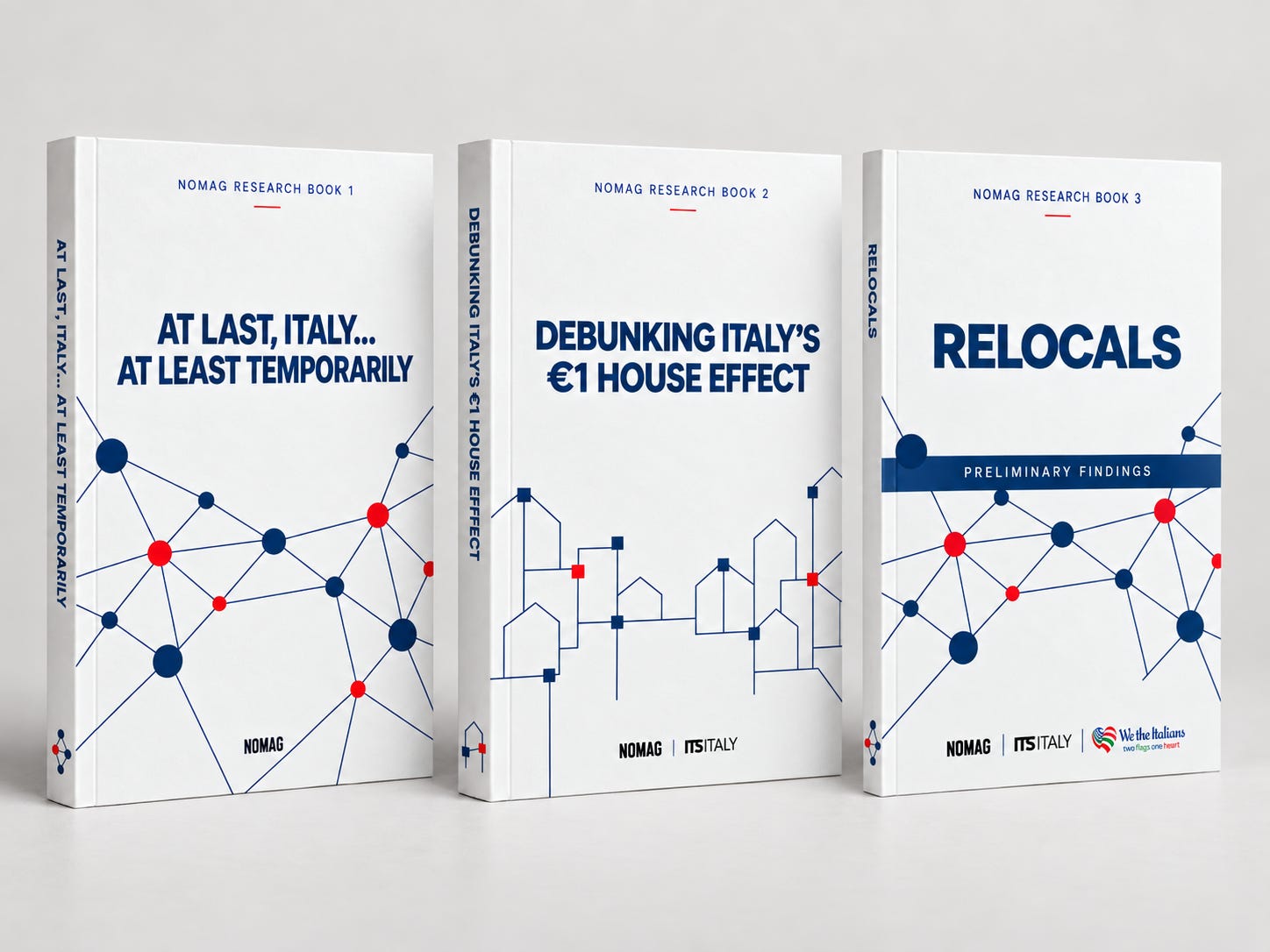
These are also some of the questions behind NOMAG Research Books, our independent research series, presented on 24 September at the Centro Studi Americani (Centre for American Studies) in Rome.
Three studies explore what actually happens when Italy tries to attract people, investment and new residents — and whether the reality lives up to the headlines.
At Last, Italy… At Least Temporarily draws on 1,056 responses to investigate who digital nomads really are, what they are looking for and whether Italy is prepared to welcome them.
Debunking Italy’s €1 House Effect goes beyond the irresistible headlines to examine actual property transactions, renovations and the impact of these initiatives on local communities.
RELOCALS — Preliminary Findings looks at people who have moved to Italy from abroad, exploring why they came, why some have stayed and what challenges they encounter when turning a destination into a home.
Three different perspectives, one underlying question: how can international interest in Italy become something tangible and lasting for its territories and the people who live there?
All three studies are available in English and Italian. Free subscribers can access the research introductions and downloadable abstracts, while paid ITS Journal subscribers can read the complete digital editions through their subscriber benefits. The books are also available on Amazon.
Explore the three NOMAG Research Books and read the free abstracts