


You can find the original version (in Italian) of this article here 👇

Travelling around Italy as a foreigner. Or, more precisely, as an undercover Italian.
After thirty years abroad, I now live a nomadic life between London and a succession of small Italian towns and villages. Wherever I’m needed, I go, accompanied by my wife - who also happens to be my boss - and a UK-registered Mini that gives me the rather wonderful opportunity to observe Italians when they are absolutely convinced I cannot understand a word they are saying.
The Mini is unbeatable when you have to drive through places built centuries before anyone had even imagined the motor car, along lanes roughly the width of a washing machine and round bends apparently designed with an unusually skinny donkey in mind.
It is slightly less unbeatable when, like mine, it is black. Leave it under the Italian sun and it rapidly stops being a car and turns into an air fryer with British number plates; the main difference is that potatoes generally enter an air fryer in pursuit of a culinary purpose, whereas I climb into mine through sheer masochism.
It has the steering wheel on the right and the innocent expression of a tourist who still hasn’t worked out where he is allowed to park. After several months of honourable service, it has become something rather more than a means of transport: it is now a sort of sociological experiment on four wheels.
Away from the road, the British number plate inspires curiosity - German and Dutch plates considerably less so, while Eastern European ones are currently at the centre of various news controversies which I shall tactfully leave alone. People want to know where I come from, what on earth I’m doing there, why the steering wheel is on the wrong side and whether it really rains every single day in London. Fake news, incidentally.
On the road, however, the effect is quite different.
The tarmac is mine
I have discovered that a certain proportion of Italians become even more impatient and aggressive than usual when they believe the person in front of them is foreign. A British number plate earns you no leniency; if anything, it seems to authorise a peculiar form of roadgoing xenophobia.
The message, even when nobody actually says it out loud, is fairly obvious: “The tarmac is mine. Take your wheels somewhere else. You don’t know how to drive here.”
You do not necessarily have to make a mistake. It is enough to drive with half a second more caution - and I invite anyone to try overtaking a tractor on a country road with absolutely no visibility - hesitate at a creatively interpreted right of way, or fail to understand immediately a rule apparently known only to the inhabitants of that particular roundabout.
An Italian driver is allowed to make a mistake; a foreign driver, by contrast, becomes living proof that foreigners simply cannot drive.
Impatience, despair, horns, hand gestures and abuse arrive with astonishing speed. It is a sort of territorial bullying in which you are no longer merely another motorist, but an intruder occupying a stretch of road that, in the mind of the person behind you, has belonged personally to his family since Roman times.
All of this continues until you return the abuse in Italian, preferably using the swear words you have picked up in the local dialect, at which point the scene changes rather dramatically. The foreigner who was expected to endure everything in silence answers back perfectly, often displaying a considerably broader local vocabulary than anticipated, and for a few seconds there is an almost perceptible hesitation from the other car: you were not quite the victim they had imagined.
The steering wheel being on the “wrong” side adds another layer of confusion, because anyone wishing to insult the driver almost invariably addresses my wife, who is sitting on the left - exactly where the driver of an Italian car ought to be.
And my wife answers, with all the supreme confidence of a fully indigenous road pirate.
From outside, the scene must look fairly surreal: a woman who appears to be driving enthusiastically participating in an exchange of vernacular pleasantries - often with both hands - despite having neither steering wheel nor pedals in front of her, while the actual driver watches from the other side.
By that stage, it is no longer entirely clear who is driving, who is foreign, or who insulted whom, but at least everybody understands that we understood everything.
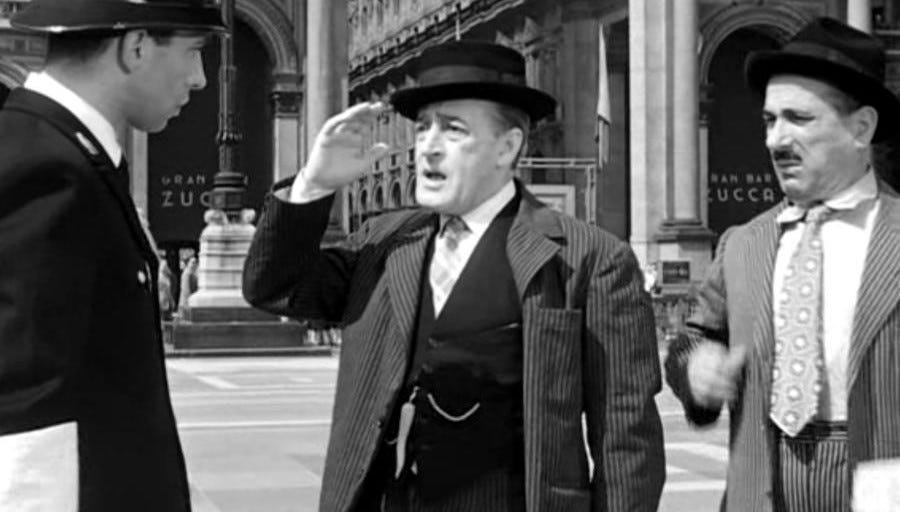
“Noio volevam savoir… l’indiriss”
Driving around Italy in a British car means experiencing the country as a foreigner, although in my case there is an extra dimension to it: I am effectively an Italian undercover, with a particular interest in the sociology of Italy as observed from the road.
One thing I have noticed is that not every police officer or carabiniere seems particularly keen to discover who is actually hiding behind the wheel of a car with a yellow number plate. Stop, say, a Belgian and it doesn’t really matter if your English is less than perfect; linguistically, you are probably starting on fairly equal terms. Stop an Englishman, on the other hand, and things have the potential to become awkward.
The English, in 99.99 per cent of cases, do not even attempt to speak Italian. They remain deeply confident that the Victorian Empire is still fully operational, has somehow been extended to the Italian peninsula and that the linguistic conversion of the natives was successfully completed some time ago. At most, they will offer you a heroic “Buongioooorno” or “Ciao” and then wait expectantly for praise of their astonishing fluency.
Sometimes I get the impression that the officer on duty has made the same calculation. He sees me approaching, notices the British number plate, registers the steering wheel on the wrong side and, for a fleeting moment, our eyes almost meet before he looks away. Suddenly the surrounding landscape becomes extraordinarily interesting; he checks his fingernails, studies his phone or acquires the contemplative expression of a man silently humming a song to himself.
He does not look distracted so much as intensely committed to not looking at me.
Perhaps he is already imagining everything that might happen if he stops us: the British documents, the British driving licence, the driver sitting on the wrong side, the wife sitting where the presumed driver ought to be and, worst of all, the risk that somebody may lower a window and begin asking him for directions in English.
Better to let us through.
The car is there and it is unmistakably foreign, but perhaps if nobody looks at it for long enough, it ceases to exist. It is a Totò sketch in reverse.
In Totò, Peppino e la… malafemmina, it is the Italians newly arrived in Milan who desperately attempt to speak a foreign language with the immortal: “Noio volevam savoir…”
Here, instead, I am the presumed foreigner who might conceivably stop and ask for directions, while the officer seems to be thinking: Noio non volevam savoir proprio niente.
So I slow down, drive past the patrol car and, for a few moments, we ignore one another with enormous professionalism: I pretend I need nothing, he pretends he has not seen the Mini, and together we avoid a considerable quantity of paperwork and embarrassment.
Driving licence and registration. But I’m not driving!
Others, of course, do decide to stop me.
The paddle goes up, I pull over and the officer automatically walks towards the left-hand side of the Mini, where my wife lowers the window.
“Driving licence and registration.”
“Good morning. I’ll ask my husband - I’m not driving.”
What follows is usually ten or twenty seconds of silent panic, during which the officer looks at my wife, my wife looks at the officer, and the officer searches for the steering wheel, fails to find it and, for one brief moment, appears to consider the possibility that the car may somehow have arrived there under its own power.
Then he looks across the cabin and discovers me sitting on the other side, behind the steering wheel, already holding my licence. There is invariably a short system reboot.
It is not their fault, because every element of the scene appears to be in the wrong place. The person they have asked for the driving licence is not driving; the person who is driving is sitting where the passenger ought to be; the car is British, the driver speaks Italian and the passenger, who looked like the driver, is also my wife, my boss and has already transferred all responsibility firmly in my direction.
I hand over the documents and the officer studies the British registration, examines my British driving licence and then looks at me. To be fair, he often seems to understand relatively little of some of the paperwork I have just given him, concentrating mainly on the licence, presumably in the hope of finding something reassuringly familiar.
The situation is, admittedly, not especially straightforward to summarise: an Italian driving a British car in Italy on a British driving licence.
Sooner or later, the inevitable question arrives: “So, are you Italian or English?”
A few times I have been tempted to answer in English, but I have always thought better of it, partly because I have no particular desire to discover whether taking the piss out of a public official can somehow evolve into a criminal complaint and, more importantly, because they really do not deserve it.
Their confusion is perfectly understandable. In summer, with thousands of foreign cars on Italian roads, a British Mini can almost disappear into the scenery; a British Mini in Puglia in January is already rather more conspicuous, and if it appears in the middle of Salento at night it becomes virtually impossible not to stop.
Under those circumstances, I would probably pull myself over even if nobody asked, purely to make a pre-emptive declaration to the authorities.
Once the documents have been checked and it has been established that the Mini was not stolen in London a few hours earlier, Pandora’s box of curiosity normally opens. Why are we there? Do we live in England? Where are we going? Why do we have a British car in Italy? What is it like driving with the steering wheel on the right? Is overtaking difficult? And, above all, what on earth are we doing in Salento in January, at night?
At that point, the police check gradually turns into something approaching a conversation at the bar. The officers relax, we tell them an abbreviated version of our nomadic life and, within a few minutes, it begins to feel as though somebody ought to be offering a small glass of amaro, even though technically we are all still on duty: they as police officers and I as the driver.
Eventually we say goodbye warmly and set off again, at least until the next checkpoint, when another officer approaches the left-hand window, asks my wife for her driving licence and the entire process begins again.
Five tyres in six months
Police checks are not the only recurring feature of our travels: in six months, we have punctured five tyres, usually at night and preferably at the weekend. And naturally, as in every well-run family business, the blame belongs entirely to the person driving rather than to the boss who, from the comfort of the passenger seat, instructed him to take that particular road because there was something completely unnecessary she wanted to go and see.
Italian roads are not exactly ideal territory for a Mini accustomed to London’s 20mph limits. Potholes, patches, manhole covers and unexpected archaeological excavations - occasionally revealing beautifully preserved Roman roads beneath the rather less well-preserved state roads of the twenty-first-century Republic - turn every journey into a video game in which your available lives correspond roughly to the number of wheels.
The good news is that Italian tyre fitters cost a fraction of their British counterparts and, even better, they do not automatically attempt to sell you the latest Michelin model. They invariably seem to have a nearly new tyre available somewhere out the back, quite possibly torn from the lifeless body of another British Mini that passed through the area several days earlier.
Somehow, the two things balance each other out.
In Britain, you rarely puncture a tyre but practically need a mortgage to replace it; in Italy, you can destroy five and begin to feel like a valued customer. I should really suggest a loyalty card, particularly as I have now developed more stable relationships with several tyre fitters than with many of the people I have met during these months.
At the moment, I am fairly sure my Mini is wearing four different brands of tyre, with a seasonal mix reminiscent of a quattro stagioni pizza, and I no longer trouble myself too much about balancing. It is rather like driving around with four different fingerprints.
Yoga at the toll booth
For motorways, thank God, there is Telepass Grab&Go. It works at toll booths, in many car parks and even for boarding certain ferries - and no, they have not paid me for this mention.
In my case, it is not merely a technological convenience but an orthopaedic device, because with the steering wheel on the right, the ticket machine is naturally on the opposite side of the car.
There are three possible solutions: travel with a wife - ideally your own - sitting beside you, get out of the car and absorb the abuse of the entire motoring population behind you, or perform an advanced form of automotive yoga.
The last option involves stretching yourself across the cabin with half your torso resting on the gear lever, one arm reaching desperately towards the machine and your dignity abandoned several metres before the toll booth.
Fortunately, I travel with my wife, who, in addition to being my boss, has become responsible for tickets, tolls, parking and diplomatic relations with other motorists.
Telepass offers another significant advantage: it prevents you from immediately understanding how much money you have spent. The barrier rises, you hear a reassuring beep and continue your journey under the comforting illusion that everything is perfectly normal.
There is also a faint but undeniable swagger involved in having Telepass in a foreign car. Nobody expects it, and the man who was flashing his headlights at you from 300 metres away while approaching the toll booth at 150 kilometres an hour suddenly abandons all hostility and gives you a small nod of Respect, followed by a conspiratorial grin directed at all the primitives queuing for tickets.
The spectacular cost of Italian motorways will reveal itself later, when it is far too late to reconsider your route. It is madness, certainly, but at least it is contactless madness.
The compulsory London service
Then there is the administrative paranoia.
Every few months we have to get back on the road and head towards London, lest spending too long on one side or the other trigger some mysterious alert connected with residency, the car or the insurance.
The general impression is that Italy and the United Kingdom have arrived at a remarkably similar position regarding our existence: neither is particularly enthusiastic about insuring us, but both would be absolutely delighted to tax us.
As a result, returning to London has become something close to a compulsory maintenance stop. After a certain number of miles, you check the tyres, change the oil and temporarily return both vehicle and owners to their bureaucratic habitat of origin.
It is not really going home so much as taking ourselves in for a service.
Heading back to Britain serves to remind British computer systems that we still exist and, ideally, reassure the Italian ones that we have no intention of secretly establishing permanent residence in a car park somewhere in Salento or the Maremma.
Once the ritual has been completed, we can set off again until the next deadline, the next police check or the next letter beginning with “Dear Customer” and ending with a request that we prove where we actually live — a question which, by now, even we would struggle to answer.
‘Groundhog Day’ at the petrol station
The best part of the week comes when I stop for petrol in small towns and villages.
There is almost always a tiny bar beside the petrol station, and outside it sits a group of elderly men whose principal occupation appears to be observing passing traffic. At petrol stations they are invariably old men; outside houses, on little chairs, you find the elderly ladies instead, operating a sort of human ZTL - Italy’s low-traffic zone system, only with more effective enforcement.
The black Mini with British plates immediately enters the day’s programming.
As soon as I stop, they begin discussing “the backwards car”. One points out the steering wheel on the wrong side, another explains to the group how driving works in Britain, and from there the conversation inevitably expands to London, rain, fog and their absolute certainty that nobody in the United Kingdom has seen the sun since approximately 1973.
I fill up while listening silently, then, just before leaving, I say goodbye to them in Italian.
For a few seconds, nobody says anything. They stare at me as though the Mini itself has suddenly spoken, because the man who, until a moment earlier, was simply an English tourist has unexpectedly turned into an Italian who has heard absolutely everything.
The truly extraordinary part is that I can return to the same petrol station three days later and the entire scene will begin again: the backwards car, London, the rain, the English weather, me filling up, the farewell in Italian and the astonishment.
It is Groundhog Day, except set at a village petrol station.
I still cannot work out whether they simply do not remember me, whether they believe all British Minis look identical or whether they just prefer to restart the story from the beginning each time. Perhaps, in their minds, I am not always the same foreigner.
Perhaps I am a series.
Foreigners are allowed a little leeway
My variable identity works particularly well in small towns and villages.
If I am foreign, even the most obvious question tends to be met with patience; if I am Italian and ask exactly the same thing, the expression changes and what was curiosity becomes something closer to moral judgement.
How can you possibly not know a rule nobody has ever explained to you and which, apparently, everyone else has always known?
A foreigner is allowed not to know; an Italian should have found out in 1997, although in my defence I had already emigrated by then and therefore had no reasonable way of knowing.
Pretending to be foreign can consequently prove rather useful from time to time.
I am not talking about major offences, but those tiny everyday transgressions which, when committed by an Italian, immediately provoke a moral verdict, whereas in the case of a foreigner they can be attributed to confusion, language difficulties or a particularly imaginative satnav.
At some point I intend to write an entire article about enormous cars becoming wedged in tiny village lanes because “the satnav told me to come this way”, but I shall save that for another occasion.
The foreigner is not necessarily innocent; he is simply spaesato - disorientated, out of place, slightly lost, although the Italian word captures it rather better.
British number plates, a steering wheel on the right and a sufficiently bewildered expression can buy you a few extra seconds of understanding. Sometimes all you have to do is point towards the road, stare thoughtfully at the sign and adopt the expression of someone who has only just discovered that Italy operates according to rules entirely different from those governing the rest of the planet.
Then there is the great urban myth that Italian fines sent abroad almost never arrive and, so far, I have to admit that the myth appears to be holding up rather well.
I would nevertheless prefer not to test it too enthusiastically, because urban myths are charming things until they all materialise simultaneously in your London letterbox, complete with interest and notification charges.
Foreign, but not too foreign
At first, I thought pretending to be foreign might simply be convenient; eventually, I realised that there was very little pretending involved.
After thirty years abroad, you do not stop being Italian, but you do become Italian in a way that is no longer immediately recognisable in Italy.
You still know the language, although you do not always understand its social punctuation. You know perfectly well what ci sentiamo means, but every now and then you still make the rather naïve mistake of expecting an actual phone call.
You remember the rules, except that in the meantime new ones have been added - never written down anywhere, yet already treated by everybody as self-evident.
I have not moved back permanently and I am not attempting to restart the life I left behind. I move between London and Italy, between cities and villages, between the place where I live and the places where, temporarily, I am needed.
It is an odd condition: being simultaneously at home and a visitor, Italian enough to understand everything being said at the petrol station yet foreign enough still to be surprised by it.
At the bar I am Italian; faced with a form, I have only just arrived. With a tradesman, I am English and require an exact date; at a police checkpoint, I am the man sitting on the wrong side; on the motorway, I leave everything to Telepass.
And when somebody insults the driver, my wife answers from the passenger seat.
Which is fair enough, really.
She is the boss.
Satnav tried to send me down a road that turned rather abruptly into a staircase. I only noticed because there was suddenly only blackness in the headlights. Also my wife yelled.
Had I had a rental of the size typical for an American I would have avoided the situation altogether. But in this case I had the joy of reversing back up a road that should have been a staircase from the beginning, with 6” of clearance either side. If I hadn’t awakened the entire neighborhood with the whine of the reverse gear, the smell of burning clutch or my nervous flop sweat would have done the trick.
From that point on if a route seemed to good to be true we got out and scouted ahead first.
Same story but with a Hun license and tinted window black honda, interestingly all the police stops and annoyances stopped when I chamged my license plate to italian :D