


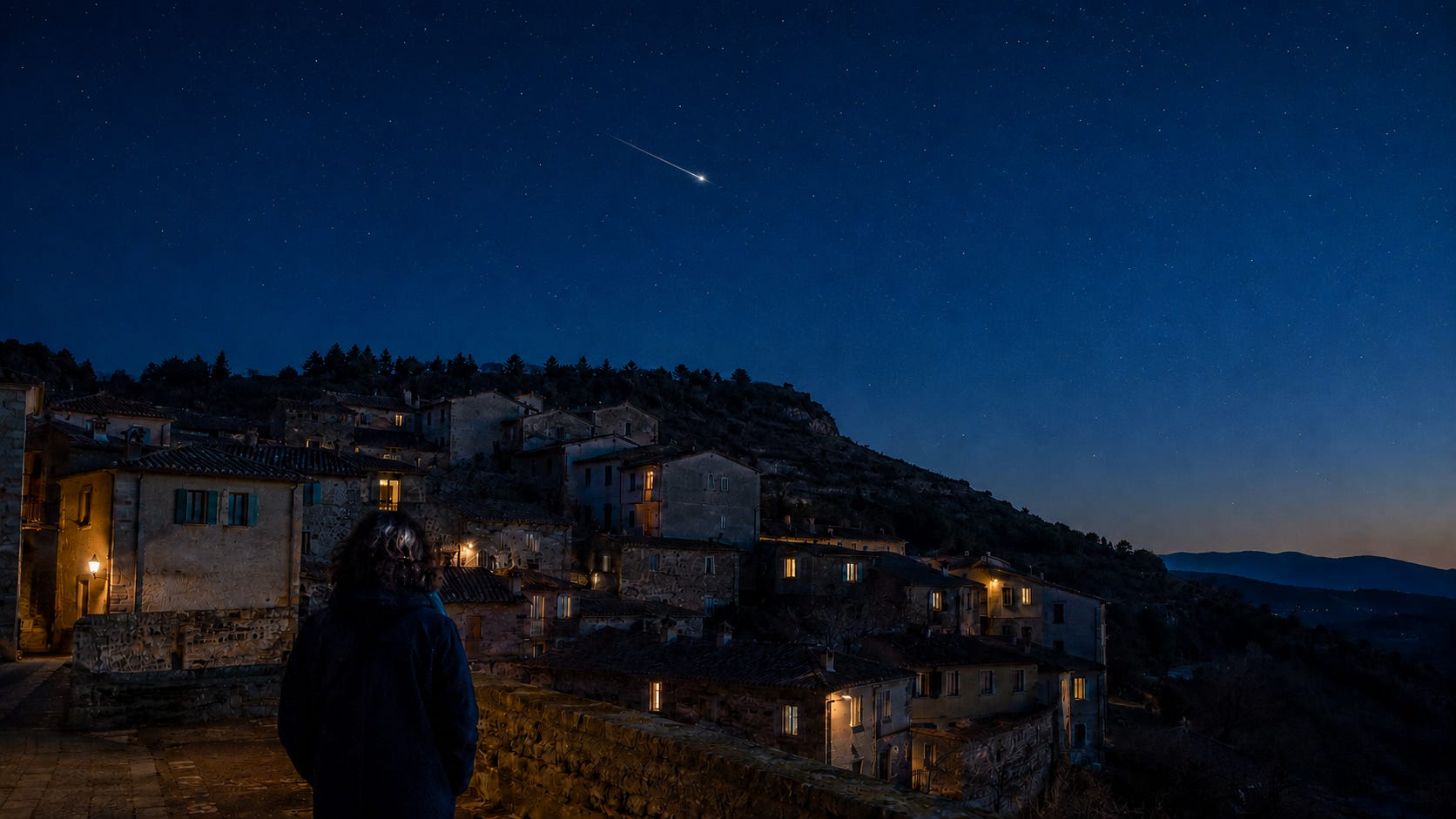
This summer, you may have wished for a different life.
A stone house. A small piazza. Coffee served by someone who remembers your order. Neighbours who bring tomatoes instead of sending calendar invitations. No traffic, no rush, perhaps no need to wear proper shoes before lunch.
Then you arrive.
The church bells ring earlier than advertised. The bar closes on the one morning you desperately need coffee. The nearest supermarket is 18 kilometres away, the bus appears to exist mainly as a historical concept, and everyone already knows that you have bought the old house near the fountain — including how much you paid for it and what they think you should do with the roof.
Welcome to village life in Italy.
It can be wonderful. It can also be lonely, inconvenient, surprisingly expensive and socially more complicated than living anonymously in a city. Usually, it is several of these things before breakfast.
The first mistake is to talk about “the Italian village” as if it were a single product.
It is not.
A village outside Florence, used by commuters and second-home owners, is not the same as a shrinking settlement in inland Sicily. A well-connected town in Emilia-Romagna is not the same as a mountain community where the last grocery shop closed three winters ago. A postcard-perfect place in Tuscany may have restaurants, international residents and property prices built around tourism. Another village, equally beautiful in photographs, may have no pharmacy, unreliable internet and very few people under 50.
They may look similar on Instagram. They operate like completely different countries.
There are tourist villages that appear lively but become almost empty after October. There are commuter villages where people sleep but rarely socialise. There are deeply rooted communities with functioning schools, shops and associations. There are places actively trying to attract new residents — and places that like the idea of newcomers more than the daily reality of accommodating them.
There are also villages where regeneration has become a performance: a festival, a property scheme, a newspaper headline and perhaps a ribbon-cutting ceremony. These can generate attention without necessarily producing the services, jobs and permanent population required to sustain everyday life.
Buying a house is therefore the easy part. Finding a village in which you can actually live is the real project.
Foreigner, but not quite
The word “foreigner” also becomes unreliable very quickly.
You may be British but have lived in Italy for 20 years. You may have an Italian passport but have grown up in Toronto. You may speak excellent Italian but misunderstand every local alliance. Or you may be Italian, born 40 kilometres away, and still be regarded as an outsider because your grandparents came from the wrong side of the valley.
In a small community, belonging is not determined only by nationality. It is built through repetition.
You go to the same bar. You learn who can repair a shutter and who merely says he can. You attend the village dinner even though it starts two hours later than expected. You stop referring to everything as “authentic”, because for the people living there it is simply Tuesday.
This takes time. Property ownership does not automatically produce membership.
Nor should a newcomer expect the village to perform village life on demand. The baker is not part of an immersive cultural experience. The elderly man sitting outside the bar is not local colour. The community existed before your renovation project and will continue while you are away in January.
At the same time, villages cannot invite new residents, remote workers and foreign buyers and then treat them only as wallets with unusual accents. Integration works in both directions. Newcomers must participate, but local institutions also need to explain procedures, provide information and accept that the new resident may ask why things are done in a particular way.
“Because we have always done it like this” is culturally fascinating. It is not always an adequate administrative policy.
Summer is a terrible estate agent
The village you meet in July may not be the village in which you will live in February.
Summer supplies open restaurants, festivals, visiting families, outdoor tables and enough human activity to disguise structural problems. Winter reveals the actual operating system: transport, healthcare, shops, heating costs, internet reliability and the number of people who are genuinely present.
Before moving, spend time there out of season. Try to complete ordinary tasks.
Can you buy food without driving? Can you work online for an entire day? How far is the nearest doctor, railway station or hardware shop? What happens when your boiler fails on a Sunday? Are there children, working-age adults and permanent residents, or mainly holiday homes and very determined cats?
Speak to local people, but also to someone who moved there three or four years ago. The mayor may tell you what the village intends to become. The newcomer can tell you what happened when the water stopped.
And be honest about yourself. Do you want silence, or do you merely want less noise? Do you want community, or friendly people available when convenient? Are you prepared to drive, learn Italian, renovate slowly and be visible in a place where anonymity is scarce?
There is no shame in deciding that you need a small town rather than a tiny village. A railway station, a pharmacy and a choice of two bars do not make your Italian experience less authentic. They may simply make it sustainable.
Village life is not the reward at the end of an escape from modern life. It is another version of modern life, with different advantages, different inefficiencies and a much smaller audience for your mistakes.
So yes, be careful what you wished for this summer.
More importantly, be careful where you wished for it.