
DAJE Fiumicino (and Ciampino)!
Leonardo da Vinci–Fiumicino Airport named Europe’s Best Airport for the Ninth Year Running

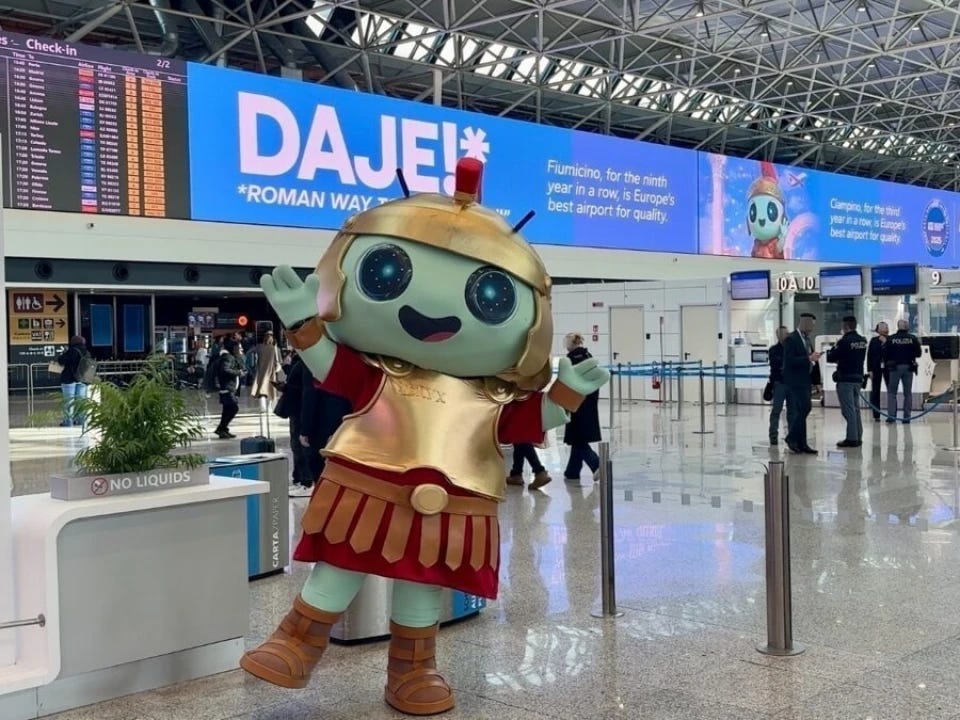
For the ninth consecutive year, Rome’s main gateway — officially known as Leonardo da Vinci Airport — has been awarded Best Airport in Europe in the category of over 40 million passengers. The recognition comes from the Airport Service Quality (ASQ) Awards by Airports Council International, which measures passenger satisfaction through hundreds of thousands of interviews conducted across more than 400 airports worldwide.
The 2025 score — 4.64 out of 5 — represents a record among the 124 European airports evaluated and places Fiumicino at the top not only in Europe but also ahead of several major North American hubs participating in the survey.
Fiumicino did not stop at the overall title. It also ranked first in multiple categories, including:
Most Dedicated Staff
Easiest Airport Journey
Cleanest Airport
Most Enjoyable Airport Experience
A result built on strategy, not coincidence
This achievement is not accidental. In recent years, Aeroporti di Roma (ADR) has invested heavily in:
Digitalisation of passenger flows
Automation of security and border controls
Infrastructure expansion
Environmental sustainability
The strategic objective is clear: position Fiumicino as a competitive intercontinental hub, strengthening Italy’s role as a Mediterranean gateway for global traffic.
In an increasingly competitive European aviation landscape — where connectivity, efficiency and sustainability define leadership — Rome is steadily consolidating its place among the continent’s reference hubs.
Ciampino also recognised
The positive momentum extends to Rome Ciampino Airport, which was named Best European Airport in the 2–5 million passenger category and also received recognition for staff dedication.
Together, Rome’s two airports handled over 55 million passengers in 2025, confirming a growth trajectory that has now surpassed pre-pandemic levels.
A broader industrial signal
Beyond the celebratory headline, the industrial data matters. Perceived quality, infrastructure investment and governance alignment are not branding exercises — they are competitive assets.
Nine consecutive years at the top is not a seasonal success. It is the outcome of long-term planning, capital expenditure and operational discipline.
For Italy’s broader economic system, it offers a tangible lesson: when governance, investment and strategic vision align, results can be sustained — not just achieved once, but repeated year after year.