



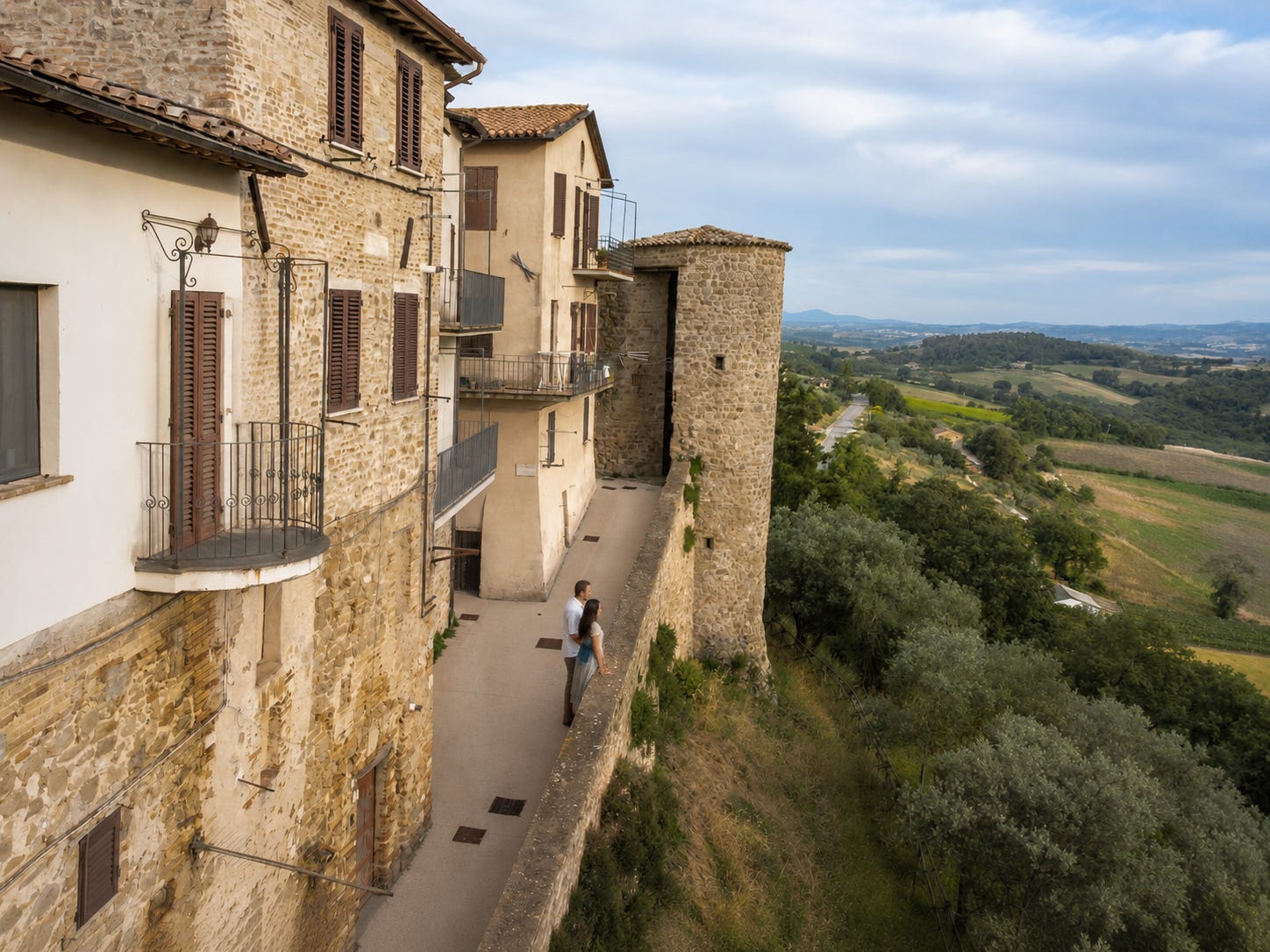
ITS ITALY wants to convince you that moving to Italy can be a genuine and positive opportunity. We believe that Italy can offer an exceptional quality of life, a stronger relationship with community and place, and access to properties and territories that remain more affordable than comparable destinations elsewhere in Europe. But we are NOT going to tell you that it is always easy, that every inexpensive house is a bargain, or that moving to Italy can be organised through an estate agent’s Instagram profile and a handful of enthusiastic videos.
Italy is not a thirty-second Reel. It is not automatically a one-euro home, a ruined farmhouse photographed at sunset or an “unmissable opportunity” discovered by a local agent who has never asked what you actually want to do with the property. It is not a grant that someone’s cousin has heard about, supposedly available if you open a tourism business in Southern Italy. Nor is it enough to be a foreign pensioner, establish a company or announce that you intend to create employment to qualify automatically for favourable taxation or public funding.
Many of these opportunities are real, but they are real for particular people, in particular places, under particular conditions. They are rarely universal, automatic or as simple as they appear online. A theoretically available incentive is not necessarily available to you. A low purchase price is not the same as a low total investment. A house that looks perfect in a photograph may be wrong for your life, your budget or your plans.
Our motto is Don’t just visit, belong. We are not interested only in helping people visit Italy, consume it during a holiday or reproduce an idealised version of Italian life. We want to help people understand where they could genuinely belong, how they could establish a sustainable relationship with a place and what kind of home, investment or personal project would allow them to remain part of it.
Belonging somewhere is very different from spending a week there. It means understanding its seasons, rhythms, connections, services, practical limitations and local community. It means knowing what happens in January, not only what the main square looks like in August. It means building a project that can survive after the initial excitement has disappeared.
The Italy of effortless bargains mostly exists online
Over the past few years, an enormous industry has developed around the promise of an inexpensive new life in Italy. One-euro homes, abandoned villages, grants for tourism businesses, incentives for moving to small towns, special tax regimes for pensioners and historic buildings available for negligible sums are regularly presented as though they were interchangeable opportunities available to almost anyone.
Much of what is being reported is based on something real. The problem is what is left out.
A one-euro home may require financial guarantees, mandatory renovation deadlines, extensive structural work and a total investment many times greater than its symbolic purchase price. A public grant may cover only certain expenses, in certain areas, for certain applicants, and may require the creation of a genuine and sustainable business. It is not free money for pretending to operate a tourism company. And it requires time, patience, guts.
A favourable tax regime may be highly beneficial, but only when a person satisfies precise residence, income, pension, employment or territorial requirements. A property marketed as a bargain may have planning irregularities, incomplete cadastral records, shared ownership, succession complications, access problems, structural defects or restrictions that radically change the feasibility and cost of the project.
Most of online contents comes from people who copied a press release or heard about one successful case. They may know that a scheme exists, but not how it works in practice. They may be able to show you a house, but not determine whether the proposed alteration is legally possible. They may say that a property could generate an income without knowing which contracts can be used, what taxation applies, what licences may be required or whether there is any realistic demand.
Reading a grant announcement does not make someone capable of preparing an eligible business. Publishing a property listing does not amount to conducting technical due diligence. Producing an attractive renovation rendering does not mean that the project can be authorised, financed or completed within the suggested budget.
The social media post eventually ends. The buyer is then left with the notary, the architect, planning permissions, cadastral plans, contractors, utilities, tax implications, construction delays and unexpected costs. Most importantly, the buyer is left with the question that should have been asked at the beginning: what am I actually trying to achieve?
Before choosing the house, choose the place and the project
The conventional property journey usually begins in the wrong place. A buyer opens a platform, chooses Tuscany, Puglia or Sicily, establishes a maximum price and starts looking at photographs. A terrace, a stone façade, a vaulted ceiling or a view of the sea creates an emotional connection, and the property gradually becomes the project.
Only later does the buyer begin asking whether the town remains active throughout the year, how far away the airport is, whether an acceptable hospital can be reached easily, whether a car is essential, whether the internet connection is reliable and whether the property can legally be used in the way imagined.
We suggest reversing the process.
Before searching for a property, decide what kind of life or investment you are trying to create. Do you want to move permanently, spend part of the year in Italy or test the possibility before committing? Are you looking for a home, an investment or a combination of the two? Do you need an active international community, a traditional Italian town or a more isolated rural setting? Do you intend to manage the renovation yourself, or do you need someone to coordinate the technical, administrative and operational work?
You should also establish how much uncertainty you are genuinely willing to accept. Italy is big on uncertainty. Italians are unhappily used to it. Are you ready to accept it? Some people are attracted to a major renovation because they want to shape every detail. Others discover too late that they have effectively purchased a second full-time job. Some investors want the potential return associated with a complex redevelopment. Others would be better served by a completed property with a more predictable cost and use.
The right Italian destination is not necessarily the best-known one. Famous locations can offer prestige, visibility and established demand, but the market may already have priced those advantages far beyond their practical value. The buyer may end up paying for the name of the destination rather than for space, quality of life or future potential.
ITS Italy works across more than twenty destinations, many of them positioned close to some of Italy’s most desirable and internationally recognised places, but without requiring people to pay prices that have become substantially overrated by the market.
These are not inferior copies of famous destinations. They are places with their own identity, history and community, often allowing residents to reach the coast, an important city, an airport, a national park or a major cultural destination without living inside its busiest and most expensive area.
Living close to a top destination can often be a better choice than living directly within it. You can benefit from its connections, services, reputation and attractions while retaining more space, a more authentic relationship with the community and a significantly more sustainable cost of entry.
Test the place before committing to the property
One of the most responsible recommendations we can make is also one that many property sellers do not want to make: do not always buy immediately.
Uncertainty is not necessarily a problem that must be eliminated through a rushed purchase. Sometimes it should be managed through a properly structured period of experience. Before committing a significant amount of capital, live in the area, understand how it works and test whether the lifestyle you imagined is compatible with everyday reality.
A village that is extraordinary during a summer festival may feel very different during the winter. A remote home may provide the privacy you wanted, but make every practical task unnecessarily difficult. A coastal location may be full of life for three months and almost empty for the rest of the year. Conversely, a place that appears quiet during a short visit may reveal a strong local community once you spend enough time there.
For this reason, where the property and contractual conditions allow it, ITS Italy can provide residential solutions for periods ranging from one month to eighteen months. We do not operate as a short-term holiday rental company, and we do not intend to add more anonymous tourist accommodation to already overstretched destinations.
Our temporary homes are intended for people who want to live in a place rather than simply visit it. They may be appropriate for someone who wants to test a town before buying, for a family moving gradually to Italy, for a client waiting for their own property to be completed, or for someone who needs a residential bridge while a purchase, renovation or relocation is being organised.
Some solutions may also be combined with a future possibility of purchase, under clearly defined contractual and financial conditions. In other cases, the temporary home may simply provide the time needed to understand the area before choosing another property.
Trying before buying is not indecision. It is risk management.
Finding a house is easy. Understanding what you are buying is much harder.
Italy has no shortage of properties. The real shortage is of properties presented with sufficiently complete, verified and useful information.
A conventional property advertisement generally provides photographs, a short description, an asking price and a stated floor area. Everything else is left for the potential buyer to investigate, often only after emotional and financial expectations have already been created.
Behind an apparently inexpensive property there may be outdated cadastral plans, unapproved alterations, incomplete planning procedures, inheritance complications, multiple owners, easements, unclear access rights, landscape restrictions, obsolete systems, roofing problems or structural work that was never included in the initial estimate.
Even a technically compliant property may still require months of surveys, design work, quotations, planning applications and coordination before any renovation can begin. The buyer must find architects, engineers, surveyors and contractors, explain the project repeatedly and attempt to ensure that all the professionals are working towards the same objective.
The difficulty does not end when the renovation is completed. The future use of the property also has to be planned. Can it be rented, and through which type of contract? What taxation will apply? Can it be divided, extended or used for a business? What are the operating costs? Is there a realistic resale market? Is the proposed income based on actual demand or merely on a generic assumption that “tourism in Italy is growing”?
A successful operation therefore requires a combination of property, legal, notarial, fiscal, architectural, planning, administrative, financial and operational expertise. No single professional normally covers the entire process. The real value lies in coordinating the different specialists and ensuring that the project remains coherent from the first assessment to the final use.
And then the work must actually be done. An attractive rendering is not a completed house. A preliminary quotation is not a guaranteed final cost. Contractors must be available, works must be supervised, variations must be controlled and certifications must be obtained. Someone must continue managing the project after the excitement of selecting tiles and colours has been replaced by invoices, delays and practical decisions.
Our properties do not begin with a listing
The principal difference between the ITS Italy portfolio and much of the property stock found through conventional agencies and platforms is that we do not simply present a building and leave the entire project to the purchaser.
Our properties have one owner and one decision-making centre. The client does not have to negotiate with several heirs, multiple co-owners or unrelated parties who may have different expectations and change their position during the transaction.
For properties requiring renovation, much of the work that would ordinarily begin after the purchase has already been addressed. Depending on the individual asset:
ownership, cadastral and planning documentation has been reviewed;
known irregularities, restrictions or technical issues have been identified;
the route for any required regularisation has been established;
architectural or executive proposals have been prepared;
initial cost estimates and contractor quotations are available;
the administrative and planning procedure has been identified;
technicians who already know the property are available;
documents can be prepared for submission as soon as the client approves the final project.
Projects and quotations must, of course, be reviewed before work begins. A new owner may want a different layout, specification or use, while construction prices and professional fees can change. The point is not that every decision has already been taken. The point is that the client is not starting with an unexamined listing and an empty folder.
In many cases, this preparation can save at least six to nine months compared with a purchase that begins with a standard advertisement. Italian bureaucracy does not disappear, but a substantial amount of technical investigation, coordination and preliminary design has already been carried out.
We can also provide the same independent approach for properties outside our own portfolio. In that case, our role is not to defend the seller’s asking price or persuade the client to proceed. It is to determine whether the property, territory, renovation and intended use make sense as a complete project.
One value, several ways to enter
Our flexibility does not concern the underlying value of the property. Each asset has a defined value based on its current condition, documentation, potential, available project and known costs. We are not interested in inventing a different price according to the person in front of us or negotiating endlessly as though the property were an object found in a market stall.
The value is fixed. The structure can be flexible.
A person may want to purchase immediately. Another may need time before completing. A future buyer may be prepared to finance and carry out the renovation before the final transfer of ownership, provided that both parties have adequate contractual protections. Someone else may want to live in the area before making a permanent decision. An investor may prefer to participate in one project without buying the property directly, while another may want exposure to a broader portfolio or the company developing it.
We are therefore creating a standard menu of transparent, legally recognised structures rather than improvising a different agreement for every client. Depending on the individual property and the eligibility of the parties, the alternatives may include:
For people who want to buy
immediate purchase in the property’s current condition;
purchase through a preliminary agreement followed by completion on an agreed date;
purchase with a deferred element of the price and appropriate guarantees;
early access to carry out approved renovation work before final completion;
a purchase structure under which ownership is transferred only after agreed payments have been completed;
purchase of a completed property ready for occupation or income generation.
For people who want to live in Italy before deciding
temporary residential use for between one and eighteen months;
a residential bridge while another property is being completed;
temporary use combined, where appropriate, with a future purchase option;
a legally structured pathway combining occupation and possible future acquisition.
For people who want to invest
participation in the renovation and enhancement of a specific property;
an Italian associazione in partecipazione, or profit-sharing participation agreement, connected to a defined project;
investment in a dedicated project company holding or developing a particular asset;
investment in the wider company or property portfolio;
financing of a specific project under predefined terms and guarantees;
participation in projects intended for renovation and resale;
participation in properties intended to produce medium-term residential income.
Not every formula will be offered on every property. A completed home can support different structures from a building requiring comprehensive renovation. A relatively small property may not justify the creation of a separate project company. Some payment arrangements require stronger guarantees and financial checks. Certain investment structures may only be appropriate for a limited number of identified investors or through regulated providers.
For each opportunity, the objective is to show clearly:
the fixed value of the property;
its current technical and legal status;
the available project;
the estimated renovation requirement;
ancillary, professional and notarial costs;
the expected administrative timetable;
the contractual alternatives available;
the advantages and disadvantages for each party;
the guarantees required;
the legal and financial certainty associated with each structure;
what happens if one party does not complete the transaction.
Flexibility is not free. Paying later, reserving a property, using it before buying it, obtaining an option or transferring part of the risk to ITS Italy all have an economic value. That value must be stated transparently.
The property does not become more valuable simply because a different contract has been chosen. What changes is the cost of time, risk, financing, services, guarantees and flexibility.
More than property: the complete relocation and development process
ITS Italy can begin working with a client before a property has been selected and remain involved after the purchase and renovation have been completed. The precise combination of services depends on the project, but the purpose is always the same: to coordinate a process that is otherwise fragmented between professionals who are often responsible only for their individual stage.
Our relocation, property and project support may include:
analysis of personal, family and professional requirements;
assessment of available capital and realistic total budget;
destination and territorial selection;
exploratory stays and temporary housing;
property search within our portfolio or on the wider market;
independent evaluation of an externally sourced property;
ownership, planning and cadastral due diligence;
coordination with lawyers, notaries and tax advisers;
architectural design and preparation of alternative layouts;
preliminary and executive renovation budgets;
planning and administrative applications;
identification and selection of contractors;
supervision and coordination of the works;
cost and variation monitoring;
furnishing and preparation of the property;
connection of utilities and essential services;
practical relocation assistance;
analysis of future occupation, rental or resale;
preparation and management of appropriate rental structures;
property management;
evaluation of expected income and operating costs;
structuring of individual property investments;
creation of dedicated companies or project vehicles;
participation by associates, shareholders, lenders or commercial partners;
definition of guarantees, reporting requirements and exit mechanisms.
Not every client needs every service. Some already know where they want to live and need only technical support. Some require a complete relocation journey. Some want to buy a simple home. Others want to turn a complicated property into a viable investment.
The value lies in having one organisation capable of understanding the whole project and coordinating the necessary specialists, rather than leaving the client to assemble and manage a disconnected group of agents, architects, surveyors, lawyers, accountants, notaries, contractors and property managers.
More than 150 families from around the world
Over the past years, ITS Italy has accompanied more than 150 families from around the world as they considered, tested or completed a move, purchase or investment in Italy.
Not all of them bought the first property they saw. Some changed destination after understanding their needs more clearly. Some decided to wait. Others began with a temporary home, completed a renovation or gradually transformed an initial investment into a permanent move.
Perhaps, if more than 150 international families have chosen to work with us, there is a reason.
It is not because we promise that everything will be easy. It is because we understand the difference between selling a dream and building a workable project.
We have no interest in persuading someone to purchase a home that is unsuitable for them. A poor transaction quickly becomes a problem for everyone: the buyer, the local community and the organisation that recommended it. Our long-term credibility is worth more than a hurried sale.
Experience has shown us that success rarely depends only on the beauty of the building. It depends on selecting the right territory, obtaining reliable information, anticipating problems, understanding the total cost and having someone capable of managing the process once the initial enthusiasm is replaced by real complexity.
Look around. Who else is offering all of this?
Look at the property platforms, local agencies, Instagram profiles and businesses promising you a new life in Italy. Then ask some direct questions.
Who helps you choose the territory before selling you the house? Who encourages you to experience the place before committing? Who has already examined the technical and planning position? Who can show you a realistic project and renovation budget? Who has identified the approvals required? Who can coordinate the technical, legal, fiscal, notarial and operational work? Who will still be involved after the sale has been completed?
Who offers a genuine alternative to immediate purchase? Who can provide an appropriate temporary home while you test the location or wait for your property? Who can structure participation in a specific renovation project? Who can explain clearly the difference between investing in one asset, a project company or the wider portfolio?
Who shows the ancillary and notarial costs before you sign? Who explains what could go wrong? Who provides a comparable list of advantages, disadvantages, protections and administrative times for each available structure? Who distinguishes the underlying value of the property from the additional cost of time, credit, options and flexibility?
The estate agent sells. The architect designs. The notary completes the legal transaction. The accountant advises on taxation. The contractor carries out the work. There is nothing wrong with that division of responsibilities. The problem is that the client is often left to coordinate every part of the process without the experience, language or local presence required to do so effectively.
ITS Italy intends to occupy that missing space: not merely showing properties, but constructing and coordinating the pathway that allows someone to experience, acquire, transform, manage or invest in them.
A practical note on our locations, prices and ways to begin
Our current property portfolio and active projects include locations in:
Tuscany: Buriano, within the municipality of Castiglione della Pescaia, and Roccastrada, in the Maremma area;
Puglia: Caprarica di Lecce, including residential properties and a larger redevelopment project, and other nearby locations in the Salento region;
Marche: Montedinove (and possibly new ones coming soon);
Umbria: Perugia and Todi, plus a larger redevelopment project on the border with Lazio;
Sicily: Mussomeli and Petralia Sottana, but also Salemi, Sambuca and other municipalities in the Madonie mountain park;
Sardinia: Lanusei and Ozieri;
Campania: currently working on new ideas in the Cilento and Irpinia districts
Further opportunities are being assessed or prepared in these regions, as well as in Abruzzo, Piedmont, Liguria and Veneto. Additional destinations will be announced only when the ownership, technical documentation, project and route to implementation have reached an appropriate level of preparation.
Across the portfolio, purchase opportunities currently range from approximately €10,000 to €300,000. The average value of many of our residential opportunities is around €45,000–€50,000 before renovation, although individual properties can be substantially above or below that level. For projects requiring significant work, a realistic average renovation allowance may also be in the region of €45,000–€50,000, depending on the size, specification, intended use and condition of the property.
In selected cases, it may be possible to begin a purchase pathway with an initial deposit starting from approximately €5,000, followed by a clearly defined preliminary agreement, timetable and set of guarantees. This does not mean that every property can be secured for €5,000 or that the balance can be paid without appropriate financial checks. It means that, where the structure and asset allow it, the initial entry point can be considerably more accessible than an immediate full-price purchase.
Temporary residential solutions can start from approximately €500 per month, with arrangements ranging from one to eighteen months and designed to provide the greatest reasonable flexibility permitted by the property, the client’s circumstances and the applicable contract.
The available structures, deposit, monthly cost, renovation estimate, guarantees and timetable will always depend on the individual opportunity. Not every formula is available for every property. What remains consistent is our approach: one defined asset value, transparent additional costs and a choice of standard ways to buy, live or invest.
Italy may offer an extraordinary opportunity. But opportunity is not the same as improvisation.
First, choose the place. Then test it. Understand the project, the true cost and the risks. Only then choose the property and the contractual structure that genuinely works for you.
Don’t just visit, belong.
Seriously interested? info@itsfor.it