


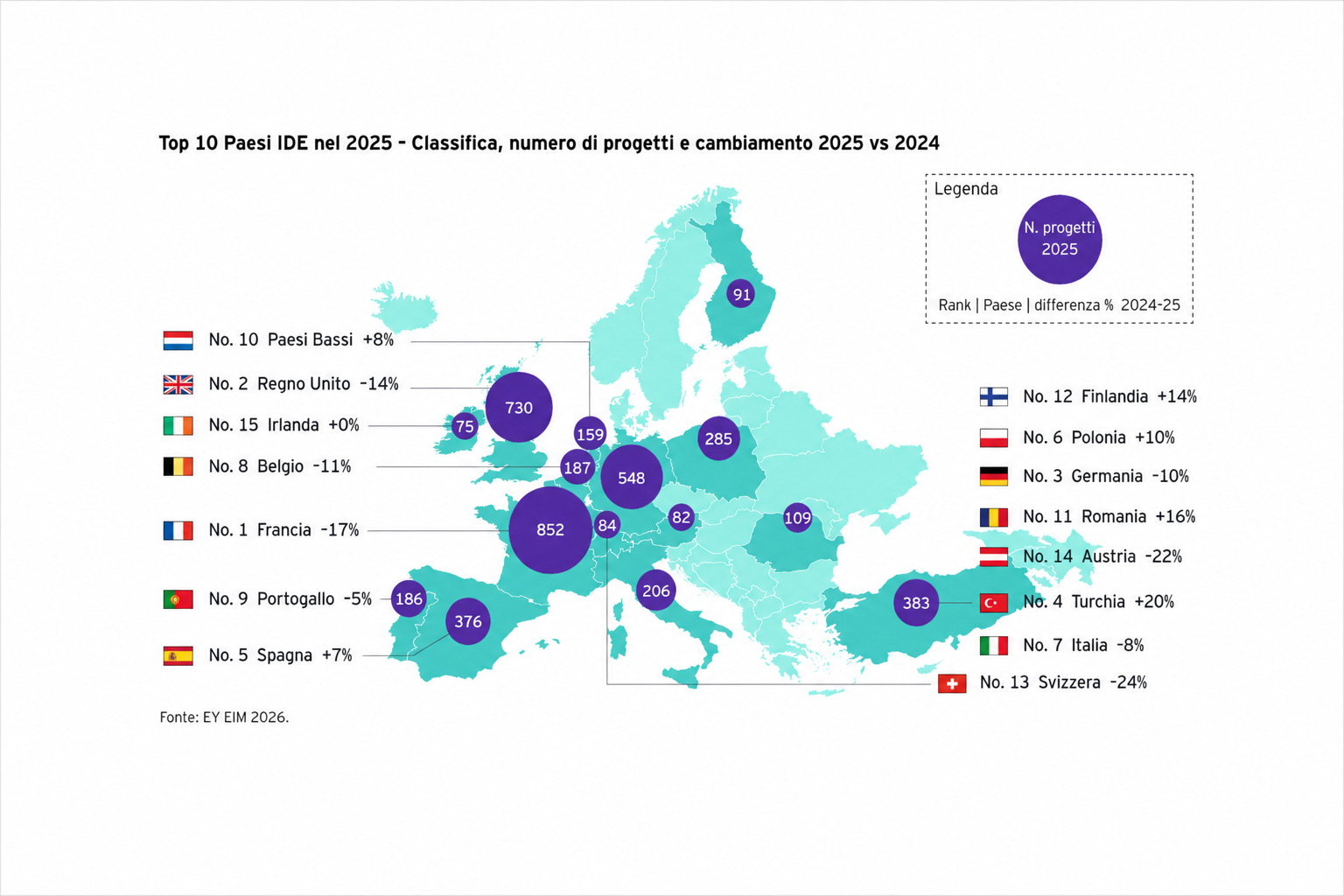
Italy attracted 206 new foreign direct investment projects in 2025, an 8% decrease compared with the previous year. Viewed in isolation, the figure might appear to represent a setback. Placed within the broader European context, however, it tells a more complex story: foreign investment is slowing across the continent and Italy, while not immune to the general decline, is showing greater resilience than Europe’s largest economies.
According to the latest edition of the EY Attractiveness Survey Italy, the overall number of investment projects announced in Europe fell by 7% in 2025. France recorded a 17% decline, the United Kingdom 14% and Germany 10%. Italy’s 8% contraction was therefore broadly in line with the European market and less severe than the falls experienced by the three countries that continue to dominate the continent’s foreign investment landscape.
This does not amount to an Italian overtaking of Europe’s leading markets. France, the United Kingdom and Germany still account collectively for 42% of all European foreign direct investment projects, a share vastly greater than Italy’s, although it has fallen from 46% in 2024 and 51% in 2023.
The more positive result for Italy is that its share of the European market remained stable at 4.1%, a level more than twice that recorded before the pandemic.
For the second consecutive year, Italy ranked seventh in Europe by number of foreign direct investment projects. This confirms a more stable positioning after years in which the country’s ability to attract international capital appeared more sporadic and frequently dependent on individual transactions or particularly favourable economic circumstances.
The foreign direct investment projects included in the survey are those through which an overseas investor establishes or expands manufacturing, commercial or service activities in a country. They therefore exclude investments involving the acquisition of existing businesses or assets, as occurs in mergers and acquisitions.
The number of projects consequently provides an indication of the willingness of international companies to create or expand an operational presence within the country.
The United States remains Italy’s leading investor
The United States remained the largest source of foreign investment projects in Italy, accounting for 18% of the total. Germany followed with 14%, unchanged from the previous year, while the United Kingdom and France each accounted for 11%, followed by Switzerland with 7%.
Italy’s relationship with US investors therefore continues to represent one of the foundations of the country’s attractiveness, despite an international environment shaped by geopolitical tensions, increasingly assertive trade policies and an extensive reassessment of global value chains.
At the same time, the geographical composition of investors is becoming more diverse. The proportion of investment originating in European countries has declined, while the contribution of non-EU economies has increased.
Japan almost doubled the number of projects launched in Italy, rising from six to eleven, while investment interest from China and Arab countries also grew.
The ability to attract capital from a broader range of geographical areas is a positive development, particularly at a time when companies are seeking to diversify their markets, reduce their dependence on individual supply chains and locate a greater share of production closer to European customers.
Industry and mobility become the leading sector
The most significant transformation concerns the nature of the projects themselves. The industrial products and mobility sector increased from 43 to 58 projects, becoming Italy’s largest category for foreign investment.
The growth reflects the strength of Italy’s manufacturing base and the presence of specialised supply chains, technical expertise and highly integrated industrial districts. As supply chains are reorganised, Italy can benefit from its ability to provide complex production capabilities, qualified suppliers and skills that cannot easily be replicated through competition based solely on labour costs.
This does not mean that Italian industry is insulated from difficulty. Energy costs, weak productivity growth, the small average size of companies and uncertainty surrounding the automotive transition remain critical issues.
Nevertheless, the rise in new projects indicates that a significant part of Italy’s manufacturing sector continues to hold international relevance.
Another notable increase involves digital infrastructure. The number of data centre projects rose from two in 2024 to eight in 2025. In absolute terms, the figures remain relatively small, but the increase shows how demand for computing capacity, cloud services and artificial intelligence applications is beginning to reshape the geography of investment.
The expansion of generative artificial intelligence requires increasingly extensive and powerful digital infrastructure. Italy is in a position to capture part of this investment, partly because of its strategic location in the Mediterranean and the development of international connectivity.
However, it must address two decisive issues: the availability of competitively priced energy and the speed of planning and approval procedures.
Data centres are energy-intensive infrastructure projects with a significant impact on local areas. Competition will therefore depend not only on geographical position, but also on the ability to provide sufficient energy, reliable connectivity, predictable approval times, suitable sites and a sustainable relationship with local communities.
Lombardy remains dominant, but loses ground
The territorial distribution of projects continues to be highly uneven. Northwestern Italy attracted 59% of total foreign investment, despite a decline compared with previous years.
Lombardy remained Italy’s principal investment hub, accounting for 44% of projects, but recorded a 22% decrease. In other words, almost one in every two foreign investment projects continued to be concentrated in the region, although its relative weight began to decline.
Northeastern Italy increased its share from 14% to 18%, driven mainly by growth in Veneto and Friuli-Venezia Giulia. Central Italy also strengthened its position, reaching 13% of the national total.
Southern Italy remained at 10% and recorded a slight decline compared with 2024.
These figures suggest a gradual rebalancing between the Northwest, Northeast and Centre of the country, but not yet a genuine nationwide redistribution of investment.
The territorial divide remains clear, particularly when measured against the potential of Southern Italy in sectors including energy, logistics, ports, tourism, agri-food production and Mediterranean connectivity.
Attracting investment to the South cannot depend on economic incentives alone. It requires infrastructure, locally available skills, predictable administrative procedures and an investment strategy capable of supporting companies after the initial decision has been made.
International perceptions of Italy improve
Alongside the analysis of projects that have actually been announced, the EY study also measures investor expectations. The survey, conducted among a panel of approximately 200 respondents, shows an improvement in perceptions of Italy.
The country rose to ninth place among Europe’s most attractive investment destinations, gaining three positions compared with the previous edition, when it ranked twelfth.
A total of 56% of respondents expect Italy’s attractiveness to improve further over the next three years, while 48% said they intend to establish or expand their activities in Italy during the coming year.
The latter figure is slightly below the 51% recorded in the previous survey, but remains significant given the greater caution with which international companies are planning new investments.
The country’s main strengths, according to respondents, include safety and quality of life, workforce quality, infrastructure and tax competitiveness.
These findings demonstrate that the attractiveness of a country does not depend exclusively on tax rates or financial incentives, but also on its ability to provide skills, retain qualified employees and offer an environment in which managers and workers are willing to relocate.
The challenge is no longer to be attractive, but attractive enough
Italy therefore appears to have moved at least partly beyond the stage in which it had to demonstrate that it could be a credible destination for international investors.
Its stable share of European investment, improved survey ranking and growth in areas including industry, mobility and digital infrastructure point to genuine consolidation.
The main weakness remains the distance between the country’s potential and its ability to convert that potential into actual investment projects.
Regulatory and administrative complexity, inadequate support for strategic sectors, limited investment in training and staff development, energy costs and fragmented incentive systems continue to discourage or delay investment decisions.
The picture is therefore stronger than it was several years ago, but it does not justify triumphalist interpretations. Maintaining a 4.1% share of a contracting European market represents evidence of resilience, rather than the achievement of a position proportionate to Italy’s economic and industrial weight.
As Marco Daviddi, EY-Parthenon Managing Partner in Italy, has observed, the challenge is no longer simply to demonstrate that Italy can be attractive. It is to make the country sufficiently competitive compared with the alternatives available elsewhere in Europe.
Making the next step will require simultaneous action on energy, approval procedures, skills and the coordination of industrial policies.
Investor confidence appears to be present. The real test will be whether Italy can transform that confidence into a larger number of projects, distribute them more evenly across the country and ensure that they generate employment, innovation and lasting economic development.