



C’è qualcosa che da tempo mi infastidisce nel modo in cui raccontiamo le aree interne, i piccoli paesi, i borghi italiani, e non è tanto il fatto che se ne parli con preoccupazione, perché i problemi esistono e spesso sono anche molto seri, quanto quella particolare miscela di compassione, nostalgia e romanticismo con cui vengono quasi sempre rappresentati, soprattutto da chi in quei luoghi non vive davvero. Il borgo da salvare, il paese che muore, l’ultimo negozio, l’ultimo artigiano, la signora che fa ancora la pasta come sua nonna, il giovane che torna dalla città e apre un forno, meglio ancora se a lievitazione naturale: la narrazione è ormai così codificata che manca soltanto la possibilità di adottare un abitante a distanza. E infatti forse il problema comincia proprio da qui, dal fatto che continuiamo a trattare questi luoghi come se fossero panda, specie protette da preservare, e non territori nei quali vivono persone normali, con qualità, limiti, conflitti, rancori, generosità, chiusure e contraddizioni esattamente come altrove.
Il privilegio di andarsene la domenica sera
Una parte del fraintendimento nasce probabilmente dal punto di osservazione. Il piccolo paese visto da chi arriva da Milano, Roma, Bologna o Torino per un fine settimana può essere magnifico: è silenzioso, il patrimonio è spesso mantenuto benissimo, il paesaggio funziona, la piazza è bella, il barista dopo due giorni sa già quale caffè prendi e la sera, invece delle sirene, senti le campane. È una forma di qualità della vita che esiste davvero e non vedo ragione di negarla. Il problema è che chi arriva per pochi giorni può permettersi di selezionare quasi esclusivamente gli aspetti positivi, perché non deve trovare un pediatra, non deve capire che cosa succede quando chiude l’asilo, non deve organizzare la giornata intorno a una corriera che passa tre volte, non deve preoccuparsi di come farà un genitore anziano quando il medico più vicino sarà a venticinque chilometri e non deve cercare un lavoro in un mercato locale che spesso offre pochissimo. Soprattutto, se la lentezza diventa troppo lenta, la domenica sera mette la valigia in macchina e riparte. La vita lenta, quando puoi scegliere quando interromperla, è decisamente più piacevole.
Io questi luoghi li ho vissuti abbastanza da avere un rapporto un po’ più ambiguo con la loro retorica. Li ho attraversati da nomade e da residente, nel senso che ci sono stato abbastanza a lungo da entrare nei loro ritmi, conoscere persone, capire le dinamiche, scoprire i vantaggi e anche le piccole o grandi seccature della quotidianità, ma non abbastanza da essere definitivamente intrappolato in esse, e questa è una posizione privilegiata di cui sono perfettamente consapevole. Posso apprezzare il silenzio senza dipendere per sempre dalla mancanza di servizi, posso entrare in una comunità senza essere obbligato a restarci, posso affezionarmi a un luogo sapendo che, se un giorno mi pesa, posso andarmene. È una libertà che cambia radicalmente il modo in cui si percepisce lo stesso territorio.
La comunità, quando smette di essere una parola carina
Uno degli equivoci più persistenti riguarda poi la famosa “comunità”, termine che viene quasi sempre utilizzato come se fosse automaticamente positivo. La comunità può essere straordinaria, naturalmente: può significare vicini che si aiutano, persone che si accorgono se hai un problema, qualcuno che ti porta della verdura senza chiedere nulla, relazioni che in una grande città richiederebbero anni per costruirsi. Ma la comunità è anche controllo, osservazione reciproca, pettegolezzo, appartenenza, reputazione, famiglie, vecchi rancori, piccoli gruppi e piccoli poteri. Un paese assomiglia spesso molto più a un grande condominio che a un presepe: ci sono persone splendide e persone insopportabili, persone disponibili e altre che, se potessi, eviteresti volentieri di incontrare nell’androne; solo che qui l’androne coincide con il bar, il Comune, il negozio, la scuola e la piazza, e non puoi cambiare pianerottolo. La dimensione ridotta ha questo effetto curioso: rende esponenziale sia la generosità sia la cattiveria, perché tutto è più vicino, più visibile e più difficile da ignorare.
Forse proprio per questo, dopo averli vissuti abbastanza, molti piccoli centri mi ricordano molto meno Instagram e molto più X o Reddit. In superficie possono essere perfetti, quasi irreali, con facciate restaurate, vicoli curati, gerani alle finestre e patrimoni architettonici che mezzo mondo ci invidia, mentre sotto quella superficie ordinata convivono solidarietà autentica, diffidenza, ironia feroce, rancori antichi, disponibilità assoluta e livelli di aggressività che la grande città, proprio perché più anonima, a volte riesce almeno a diluire. Non è una condanna dei paesi, né avrebbe senso trasformare il romanticismo in caricatura opposta; è semplicemente il tentativo di ricordare che la geografia non migliora moralmente gli esseri umani.
Non tutti sono lì per scelta
C’è però un punto ancora più importante, e molto meno raccontato, che riguarda la libertà di scelta. Non tutti quelli che vivono nelle aree interne hanno deciso di andarci perché cercavano autenticità, aria buona o una qualità di vita più semplice. C’è chi è nato lì e non ha mai avuto davvero gli strumenti economici, culturali o familiari per andarsene, chi resta perché possiede una casa ma altrove non potrebbe permettersela, chi torna dopo una separazione, un lavoro perso o una pensione insufficiente perché la città è diventata troppo cara, e chi si trasferisce in piccoli centri semplicemente perché sono tra i pochi luoghi in cui il mercato immobiliare non lo ha ancora espulso. In alcuni casi, insomma, quello che per il professionista urbano è una scelta di vita è per altri l’ultima fascia accessibile del mercato della casa. La stessa casa che qualcuno definisce “un affare nel borgo” può essere per qualcun altro l’unico posto nel quale riesce materialmente ad abitare.
Per questo il racconto dei borghi come luoghi scelti per amore rischia di diventare particolarmente distorto, perché in certi casi la perifericità non è affatto una forma di libertà, ma una forma di segregazione economica. Ci si finisce perché altrove non si riesce più a stare, perché il costo della casa espelle, perché il reddito restringe progressivamente il campo delle possibilità, perché un lavoro esiste lì e non altrove. Il piccolo centro, in questa prospettiva, non è un rifugio romantico ma l’ultima casella ancora accessibile, e può trasformarsi in qualcosa che assomiglia più a un ghetto diffuso che a una scelta di vita alternativa. Naturalmente non è sempre così, ma è abbastanza frequente da meritare almeno di essere detto.
Gli immigrati che il racconto spesso non vede
Questo diventa ancora più evidente quando si parla di immigrazione. In molti territori agricoli italiani una parte consistente dei lavori più pesanti, stagionali e meno desiderabili viene svolta da lavoratori stranieri, che non sono arrivati perché attratti dal fascino della comunità locale ma perché lì c’era lavoro, perché lì era possibile trovare o assegnare una sistemazione, o semplicemente perché quello era il punto della geografia economica nel quale erano necessari. E qui la retorica del piccolo paese accogliente andrebbe maneggiata con una certa prudenza, perché esistono esperienze bellissime di integrazione, paesi nei quali nuovi abitanti hanno riaperto scuole, mantenuto servizi, creato attività e rimesso in moto comunità altrimenti destinate a restringersi ulteriormente, ma esiste anche l’opposto, e non è affatto raro: persone tollerate perché servono, ma tenute ai margini, lavoratori che si vedono nei campi ma molto meno nei luoghi della socialità, famiglie che riescono a trovare casa proprio dove altri non vogliono più vivere e che restano comunque per anni “quelli arrivati da fuori”.
In un contesto piccolo, economicamente fragile, già convinto di essere stato dimenticato dallo Stato e dalla città, queste tensioni possono diventare persino più forti, perché la marginalità non produce automaticamente solidarietà tra marginali. Può produrre anche competizione per risorse percepite come scarse, fastidio, paura, chiusura e razzismo, soprattutto quando gli equilibri sociali sono fragili e ogni cambiamento appare sproporzionatamente grande. Una famiglia nuova in un quartiere di centomila abitanti può passare inosservata; in un paese di cinquecento persone modifica immediatamente la percezione della comunità. Anche qui sarebbe sbagliato generalizzare, ma sarebbe altrettanto sbagliato continuare a raccontare questi luoghi come laboratori spontanei di umanità solo perché sono piccoli. A volte accade il contrario: proprio perché tutti vedono tutti, puoi essere perfettamente visibile e contemporaneamente completamente escluso.
Ed è forse questo uno degli aspetti più ipocriti della narrazione urbana sulle aree interne. Chi arriva da fuori vede spesso luoghi mantenuti benissimo, patrimonio artistico e naturale eccezionale, piazze senza traffico, case in pietra, silenzio, ordine, paesaggio, e da tutto questo deduce una qualità della vita che può essere reale ma che dipende enormemente dalla posizione sociale di chi la sperimenta. Non avere negozi può sembrare una liberazione dal consumismo se hai un’auto e puoi fare quaranta chilometri quando vuoi; è una condanna se hai ottantadue anni e non guidi. Non avere un ufficio vicino può essere meraviglioso se lavori con un portatile guardando le colline; lo è molto meno se fai un lavoro che richiede presenza fisica. Non avere traffico è fantastico finché non significa non avere nemmeno un autobus. Persino il silenzio cambia significato a seconda che tu possa scegliere di interromperlo oppure no.
Quando il romanticismo diventa classismo
Da questo punto di vista il racconto romantico dei borghi rischia di essere, senza volerlo, anche piuttosto classista. Chi ha reddito, mobilità, salute, automobile e possibilità di scegliere può trasformare la perifericità in un lusso; chi non ha queste cose può viverla come una forma di segregazione. E forse dovremmo parlare anche di questo quando celebriamo la “vita semplice”, perché semplice e facile non sono sinonimi, e una condizione che per qualcuno è sottrazione volontaria può essere per qualcun altro pura privazione.
È anche per questo che trovo un po’ irritante la retorica di chi arriva dalla città, passa qualche giorno in un luogo magnifico e torna a casa spiegando che lì “si vive meglio”. Può darsi, naturalmente, ma sarebbe utile specificare meglio per chi, con quali risorse, con quale lavoro, con quale età e soprattutto con quale possibilità di andarsene. Se hai una casa in città, un reddito urbano, un’automobile, un’assicurazione sanitaria, un lavoro che puoi fare da remoto e la libertà di tornare indietro quando vuoi, il borgo può diventare un lusso straordinariamente economico. Se invece il tuo orizzonte coincide con quel territorio e da lì dipendono scuola, lavoro, sanità, mobilità e relazioni, la valutazione può essere molto diversa.
Anche i paesi sanno farsi del male da soli
Poi, naturalmente, sarebbe troppo comodo attribuire tutto allo Stato, alle città o alla globalizzazione. In molte aree interne esiste anche una notevole capacità di autosabotaggio. Ci sono paesi che chiedono nuovi abitanti e guardano con sospetto chi arriva, territori che invocano investimenti purché nulla cambi, comunità che lamentano la fuga dei giovani e contemporaneamente reagiscono male a qualsiasi idea, attività o abitudine che non assomigli a quelle di trent’anni prima. Il forestiero ideale dovrebbe comprare una casa, restaurarla, pagare le tasse, frequentare i negozi locali, partecipare alla festa patronale e avere possibilmente la delicatezza di non esprimere mai un’opinione su nulla. Se poi parcheggia male una volta, il processo di integrazione può considerarsi temporaneamente sospeso. È una caricatura, certo, ma come tutte le caricature funziona solo perché qualcosa di riconoscibile c’è.
Allo stesso modo esiste una forma di autocommiserazione territoriale che a volte diventa quasi identitaria: qui non c’è niente, qui nessuno fa nulla, qui i giovani scappano, qui siamo dimenticati, qui non succede mai niente. Spesso queste frasi descrivono problemi veri, e negarlo sarebbe sciocco; ma una comunità che si racconta continuamente come un luogo dal quale tutti vogliono andarsene non può stupirsi troppo se, a un certo punto, qualcuno le crede. Le narrazioni non risolvono i problemi, ma contribuiscono a definire ciò che un territorio pensa possibile per sé, e l’autocommiserazione prolungata può diventare una forma molto efficace di immobilismo.
Anche noi, con ITS Journal, dobbiamo stare attenti
È una dinamica dalla quale, del resto, non siamo immuni neppure noi. Con ITS Journal raccontiamo spesso questi territori e sappiamo benissimo quanto sia facile cadere nella stessa trappola: una bella fotografia, una storia di ritorno, un mestiere recuperato, una casa restaurata, un paesaggio che sembra già contenere da solo la morale dell’articolo. A volte ci cadiamo anche noi, o almeno ci avviciniamo pericolosamente a quella linea, perché il romanticismo dei luoghi belli è una scorciatoia narrativa potentissima e sarebbe poco credibile fingere il contrario. Ma altre volte è proprio il tentativo di non fermarci lì a rendere diverso ciò che facciamo, ed è anche uno dei motivi per cui continuiamo a insistere nel raccontare le aree interne.
Le amiamo, probabilmente anche molto, ma proprio per questo non vorremmo trasformarle nella romantic tale di qualcun altro: luoghi da osservare, interpretare e consumare da fuori, ridotti a scenografie dell’autenticità o a proiezioni dei desideri urbani. Vorremmo invece raccontarle per ciò che sono, comprese le contraddizioni, le durezze, le forme di esclusione, le occasioni mancate, le responsabilità locali e quelle esterne, senza togliere nulla alla loro bellezza ma senza permettere alla bellezza di diventare un alibi. Forse è questa la differenza che cerchiamo: non smettere di amare questi luoghi, ma provare a guardarli con abbastanza rispetto da non doverli necessariamente rendere romantici.
Forse non c’è niente da “salvare”
Per questo trovo sempre più irritante l’espressione “salvare i borghi”. Salvare da cosa, e soprattutto salvare chi? Un paese non è un organismo biologico e non possiede un diritto naturale a conservare per sempre lo stesso numero di abitanti che aveva nel 1951. Non è detto che ogni frazione debba essere ripopolata, che ogni casa torni a essere abitata dodici mesi l’anno o che ogni centro recuperi la struttura economica e sociale di settant’anni fa. I territori cambiano funzione, è sempre successo: alcuni diventeranno più turistici, altri residenziali, alcuni vivranno di seconde case, altri riusciranno ad attrarre nuove attività, lavoratori da remoto, immigrati, pensionati o famiglie, altri continueranno a perdere abitanti perché nessuna politica pubblica può cancellare completamente la demografia e la geografia.
Il problema, allora, non è obbligare le persone a restare, ma fare in modo che restare o andarsene siano entrambe scelte reali. È una differenza enorme, perché sposta la discussione dalla conservazione del paese come cartolina alla libertà delle persone che ci vivono. Significa chiedersi se chi vuole restare può farlo senza rinunciare a cure, istruzione, mobilità, lavoro e servizi, ma significa anche accettare che qualcuno possa voler andare via senza essere accusato di aver tradito il territorio. Significa distinguere tra chi sceglie il silenzio e chi non ha un autobus, tra chi compra una casa economica perché ha trovato un’opportunità e chi la compra perché è l’unico mercato immobiliare che può permettersi, tra chi passa tre mesi l’anno in un borgo e ne celebra la lentezza e chi quella stessa lentezza la subisce ogni mattina.
Forse le politiche per le aree interne dovrebbero partire proprio da qui, e forse anche il giornalismo dovrebbe farlo. Meno storie di salvezza, meno pietà, meno romanticismo automatico e più attenzione alle condizioni materiali, alle disuguaglianze, alle forme di esclusione, ai servizi, alla mobilità, alla casa, al lavoro e alla capacità delle comunità di accettare davvero nuovi abitanti, non solo di invocarli nei convegni. E forse anche chi vive in questi luoghi si è un po’ stancato di sentirsi spiegare da chi arriva il sabato quanto sia meraviglioso vivere così, soprattutto quando la persona che lo spiega non avrà alcuna conseguenza dalla chiusura del medico, dell’asilo o della corriera.
Io continuo ad amare molte cose dei piccoli paesi, probabilmente proprio perché li ho vissuti abbastanza da non aver bisogno di inventarmene altre. Possono essere bellissimi senza essere paradisi, le comunità possono essere generose senza essere innocenti, la vita può essere più semplice senza essere necessariamente più facile e la perifericità può essere una scelta meravigliosa oppure una forma di costrizione, a seconda di chi sei e di quanta libertà possiedi. Forse il modo più rispettoso di parlare delle aree interne è proprio smettere di trattarle come qualcosa da salvare, compatire o idealizzare e cominciare finalmente a considerarle per quello che sono: luoghi reali, abitati da persone reali, con problemi che non diventano più poetici solo perché sullo sfondo c’è un campanile.

Italy’s Villages Are Not Pandas
There is something that has bothered me for a long time about the way we talk about Italy’s inner areas, small towns and villages. It is not so much the fact that we talk about them with concern, because the problems are real and often serious, but rather that peculiar mixture of compassion, nostalgia and romanticism with which they are almost always portrayed, especially by people who do not actually live there. The village that must be saved, the town that is dying, the last shop, the last artisan, the woman still making pasta the way her grandmother did, the young man who leaves the city and comes back to open a bakery, preferably one involving sourdough. The narrative has become so codified that the only thing missing is the option to sponsor a local resident from afar. And perhaps that is precisely where the problem begins: we keep treating these places as if they were pandas, endangered species to be preserved, rather than territories inhabited by ordinary people, with virtues, flaws, conflicts, grudges, generosity, suspicion and contradictions just like anywhere else.
The privilege of leaving on Sunday evening
Part of the misunderstanding probably comes from the point of view. A small Italian town seen by someone arriving from Milan, Rome, Bologna or Turin for a weekend can be magnificent: it is quiet, the built heritage is often beautifully maintained, the landscape works its magic, the square is charming, after two days the person behind the bar already knows how you take your coffee and, in the evening, you hear bells rather than sirens. That kind of quality of life is real, and there is no reason to deny it. The problem is that those who arrive for a few days can afford to select almost exclusively the pleasant parts, because they do not have to find a paediatrician, work out what happens when the nursery closes, organise their day around a bus that runs three times, worry about what an elderly parent will do when the nearest doctor is twenty-five kilometres away, or look for work in a local economy that may offer very little. Above all, if slow living becomes a little too slow, on Sunday evening they put their bag in the car and leave. Slow living is considerably more attractive when you get to choose when it ends.
I have lived in enough of these places to have a rather more ambiguous relationship with the mythology around them. I have experienced them partly as a nomad and partly as a resident, in the sense that I have stayed long enough to fall into their rhythms, get to know people, understand the dynamics, discover the advantages and also the minor and major frustrations of everyday life, but not long enough to become permanently trapped inside those dynamics. I am perfectly aware that this is a privileged position. I can appreciate the silence without depending forever on the absence of services, enter a community without being forced to remain there, become attached to a place while knowing that, if one day it becomes too much, I can leave. That freedom changes the way you experience the exact same territory.
Community stops being such a pretty word
One of the most persistent misconceptions concerns that much-celebrated word, “community”, which is almost always used as if it were automatically positive. Community can be extraordinary, of course: neighbours helping one another, people noticing when something is wrong, someone leaving vegetables outside your door without asking for anything in return, relationships that might take years to build in a large city. But community also means scrutiny, mutual observation, gossip, belonging, reputation, family networks, old grudges, small groups and small centres of power. A village often resembles a large condominium far more than it resembles a nativity scene: there are wonderful people and unbearable people, people who will do anything for you and others you would happily avoid meeting in the hallway. The difference is that here the hallway is also the bar, the town hall, the shop, the school and the main square, and you cannot simply move to another floor. Small scale has this peculiar effect: it magnifies both generosity and cruelty, because everything is closer, more visible and harder to avoid.
Perhaps for this reason, after living in enough of them, many small towns remind me much less of Instagram and much more of X or Reddit. On the surface they can be almost impossibly beautiful, with restored façades, immaculate lanes, geraniums in windows and an architectural heritage that half the world envies, while underneath that orderly surface you may find genuine solidarity, suspicion, savage humour, ancient resentments, absolute generosity and levels of hostility that a large city, precisely because it is more anonymous, can sometimes at least dilute. This is not a condemnation of small towns, nor would it make sense to replace romanticism with an equally lazy negative caricature. It is simply a reminder that geography does not make human beings morally better.
Not everyone is there by choice
There is, however, a more important point, and one that receives much less attention: freedom of choice. Not everyone living in Italy’s inner areas has chosen to move there in search of authenticity, clean air or a simpler quality of life. Some were born there and never really had the economic, cultural or family resources to leave; some stay because they own a home there but could not afford one elsewhere; some return after a divorce, job loss or inadequate pension because the city has become too expensive; others move to small towns simply because these are among the few places from which the housing market has not yet priced them out. In some cases, what for an urban professional is a lifestyle choice is for someone else the last affordable segment of the housing market. The same house that one person describes as “a bargain in a beautiful village” may be, for another, the only place they can actually afford to live.
And this is where the idea of villages as places chosen out of love becomes particularly distorted, because peripheral living can sometimes be less a form of freedom than a form of economic segregation. People end up there because they can no longer afford to remain elsewhere, because housing costs push them outward, because income progressively narrows the range of available choices, or because the work is there and nowhere else. From that perspective, the small town is not a romantic refuge but the last square on the board that is still affordable, and it can begin to resemble a dispersed ghetto more than an alternative lifestyle. That is obviously not always the case, but it happens often enough to deserve being discussed.
The immigrants the romantic narrative does not see
This becomes even clearer when we talk about immigration. In many Italian agricultural areas, a significant share of the hardest, most seasonal and least desirable jobs is performed by foreign workers who did not arrive because they were enchanted by the charm of village life, but because there was work there, because accommodation could be found or assigned there, or simply because that happened to be the point in the economic geography where they were needed. Here again, the rhetoric of the welcoming little community should be handled with some caution, because there are extraordinary examples of integration: villages where new residents have helped keep schools open, sustain services, create businesses and revive communities that would otherwise have shrunk even further. But the opposite also exists, and it is hardly rare: people tolerated because their labour is needed but kept at the margins, workers highly visible in the fields and far less visible in the social life of the town, families who find housing precisely in places others no longer want to live and who nevertheless remain, for years, “the people from outside”.
In a small, economically fragile community that already feels abandoned by the state and ignored by the city, these tensions can become even stronger, because marginality does not automatically produce solidarity among the marginalised. It can also produce competition over resources perceived as scarce, irritation, fear, hostility and racism, particularly when social balances are delicate and every change appears disproportionately large. One new family in a district of one hundred thousand residents may go largely unnoticed; in a village of five hundred people it immediately changes the community’s perception of itself. Again, it would be wrong to generalise, but it would be equally wrong to keep describing small towns as spontaneous laboratories of humanity simply because they are small. Sometimes the opposite happens: precisely because everybody sees everybody else, you can be completely visible and yet completely excluded.
This is perhaps one of the more hypocritical aspects of the urban narrative about inner areas. Outsiders often see beautifully maintained places, extraordinary artistic and natural heritage, traffic-free squares, stone houses, silence, order and scenery, and from all of this infer a quality of life that may well be real but depends enormously on the social position of the person experiencing it. Having no shops nearby can feel like liberation from consumerism if you own a car and can drive forty kilometres whenever you want; it is quite different if you are eighty-two and no longer drive. Having no office nearby may be wonderful if you work on a laptop overlooking the hills; it is rather less idyllic if your job requires you to be physically present somewhere. Having no traffic is fantastic until it also means having no bus. Even silence changes meaning depending on whether you are free to break it.
When romanticism becomes class privilege
From this perspective, the romantic narrative of village life risks becoming, often unintentionally, rather classist. If you have income, mobility, health, a car and the ability to choose, you can turn remoteness into a luxury; if you lack those things, you may experience it as a form of segregation. Perhaps we should talk about this more often when celebrating the “simple life”, because simple and easy are not synonyms, and a condition that represents voluntary reduction for one person may represent straightforward deprivation for another.
This is also why I find the rhetoric of city dwellers who spend a few days in a beautiful place and return home announcing that “people live better there” slightly irritating. Perhaps they do, of course, but it would be useful to specify for whom, with what resources, with what job, at what age and, above all, with what ability to leave. If you have a home in the city, an urban income, a car, private healthcare, a remote job and the freedom to return whenever you want, a village can become an extraordinarily affordable luxury. If, on the other hand, your entire horizon depends on that territory for school, work, healthcare, transport and relationships, your assessment may be rather different.
Small towns can be very good at hurting themselves, too
It would, of course, be far too convenient to blame everything on the state, the cities or globalisation. Many inner areas also display a remarkable talent for self-sabotage. There are towns that ask for new residents while viewing newcomers with suspicion, places that demand investment provided nothing changes, and communities that complain about young people leaving while reacting badly to any activity, habit or idea that does not look exactly like something from thirty years ago. The ideal outsider should buy a house, restore it, pay taxes, shop locally, attend the patron saint’s festival and, ideally, have the good manners never to express an opinion about anything. If they park badly once, the integration process may be temporarily suspended. It is a caricature, certainly, but caricatures only work when there is something recognisable underneath them.
There is also a form of territorial self-pity that can become almost an identity in itself: there is nothing here, nobody does anything here, the young all leave, we have been abandoned, nothing ever happens here. Often these phrases describe very real problems, and denying that would be foolish, but a community that continually describes itself as a place everyone wants to escape from should not be too surprised when, eventually, somebody believes it. Narratives do not solve problems, but they do help define what a territory believes is possible for itself, and prolonged self-pity can become an extremely effective form of paralysis.
We have to watch ourselves at ITS Journal, too
We are not immune to this dynamic either. At ITS Journal we often tell stories about these territories, and we know perfectly well how easy it is to fall into the same trap: a beautiful photograph, a story of someone returning, a craft rediscovered, a restored house, a landscape that appears to contain the moral of the story all by itself. Sometimes we fall into it too, or at least come dangerously close, because the romanticism of beautiful places is an extraordinarily powerful narrative shortcut and it would be dishonest to pretend otherwise. At other times, however, it is precisely our effort not to stop there that makes what we do different, and it is one of the reasons we continue to insist on telling stories from the inner areas.
We love these places, probably a great deal, but precisely for that reason we do not want to turn them into somebody else’s romantic tale: places to be observed, interpreted and consumed from outside, reduced to backdrops of authenticity or projections of urban desires. We want to tell them for what they are, including their contradictions, their harshness, their exclusions, their missed opportunities, their local responsibilities and those imposed from outside, without taking anything away from their beauty but without allowing beauty to become an alibi. Perhaps that is the distinction we are trying to make: not to stop loving these places, but to respect them enough not to feel the need to make them romantic.
Perhaps there is nothing to “save”
This is why I increasingly dislike the expression “saving villages”. Saving them from what, exactly, and more importantly, saving whom? A village is not a biological organism and has no natural right to preserve forever the same population it had in 1951. Not every hamlet has to be repopulated, not every house has to return to year-round occupation, and not every town has to reconstruct the economic and social structure it had seventy years ago. Territories change function; they always have. Some will become more tourism-oriented, others more residential, some will live mainly through second homes, others may attract new businesses, remote workers, immigrants, pensioners or families, while others will continue to lose population because no public policy can completely erase demographics and geography.
The real issue, then, is not forcing people to stay but ensuring that staying or leaving are both genuine choices. That is a huge difference, because it moves the debate away from preserving the village as a postcard and towards protecting the freedom of the people who actually live there. It means asking whether those who want to remain can do so without giving up healthcare, education, mobility, work and services, but also accepting that someone may want to leave without being accused of betraying their territory. It means distinguishing between someone who chooses silence and someone who has no bus, between someone who buys a cheap house because they have found an opportunity and someone who buys it because it is the only housing market they can afford, between someone who spends three months a year in a village celebrating its slowness and someone who has to endure that same slowness every morning.
Perhaps policies for Italy’s inner areas should begin here, and perhaps journalism should too. Fewer stories about salvation, less pity, less automatic romanticism and more attention to material conditions, inequality, exclusion, services, mobility, housing, work and the actual ability of communities to accept new residents rather than merely call for them at conferences. And perhaps people who live in these places are also a little tired of being told by someone arriving on Saturday how wonderful it must be to live like this, particularly when the person saying it will suffer no consequences from the closure of the doctor’s surgery, the nursery or the bus route.
I still love many things about small towns, probably precisely because I have lived in enough of them not to need to invent additional virtues. They can be beautiful without being paradises, communities can be generous without being innocent, life can be simpler without necessarily being easier, and remoteness can be a wonderful choice or a form of constraint depending on who you are and how much freedom you have. Perhaps the most respectful way to talk about Italy’s inner areas is to stop treating them as something to save, pity or idealise and finally begin to see them for what they are: real places inhabited by real people, with problems that do not become more poetic simply because there is a bell tower in the background.
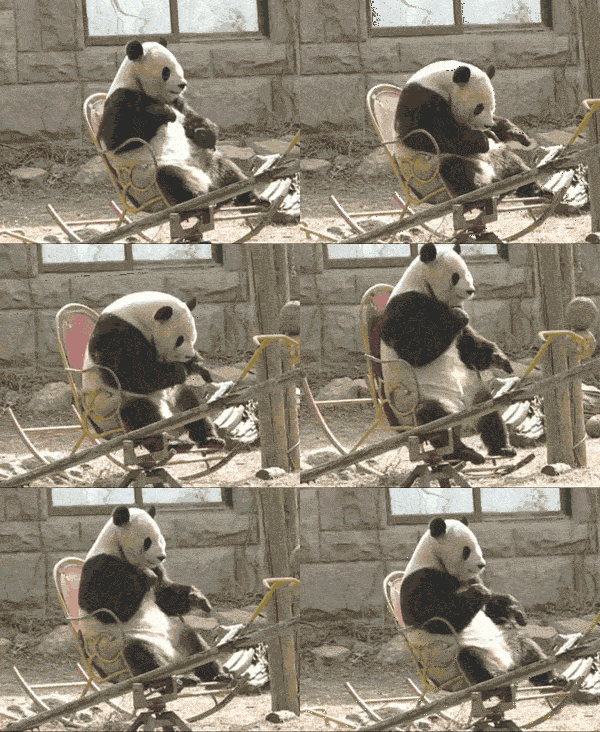
Provengo da un borgo so cosa vuol dire andare e cosa significa tornare. Ammiro le persone che scelgono di restare e quelle che decidono di andare. Per non essere Panda però c’è bisogno che qualcuno protegga i borghi, li mantenga vivi, attivi, attrattivi. E questo spesso manca