



There is an Italy that rarely appears in the headlines of the country’s major newspapers. Not because it is hidden, but because it is scattered across cities, languages and time zones. It has newspapers, radio programmes and digital publications of its own. They report on schools, associations, entrepreneurs, cultural events, administrative disputes, citizenship rules and lives that cannot be reduced to nostalgia.
Following all those stories would require opening dozens of different websites every day, knowing which publications exist and understanding the communities they serve. It is possible. It is also more work than most readers can reasonably undertake.
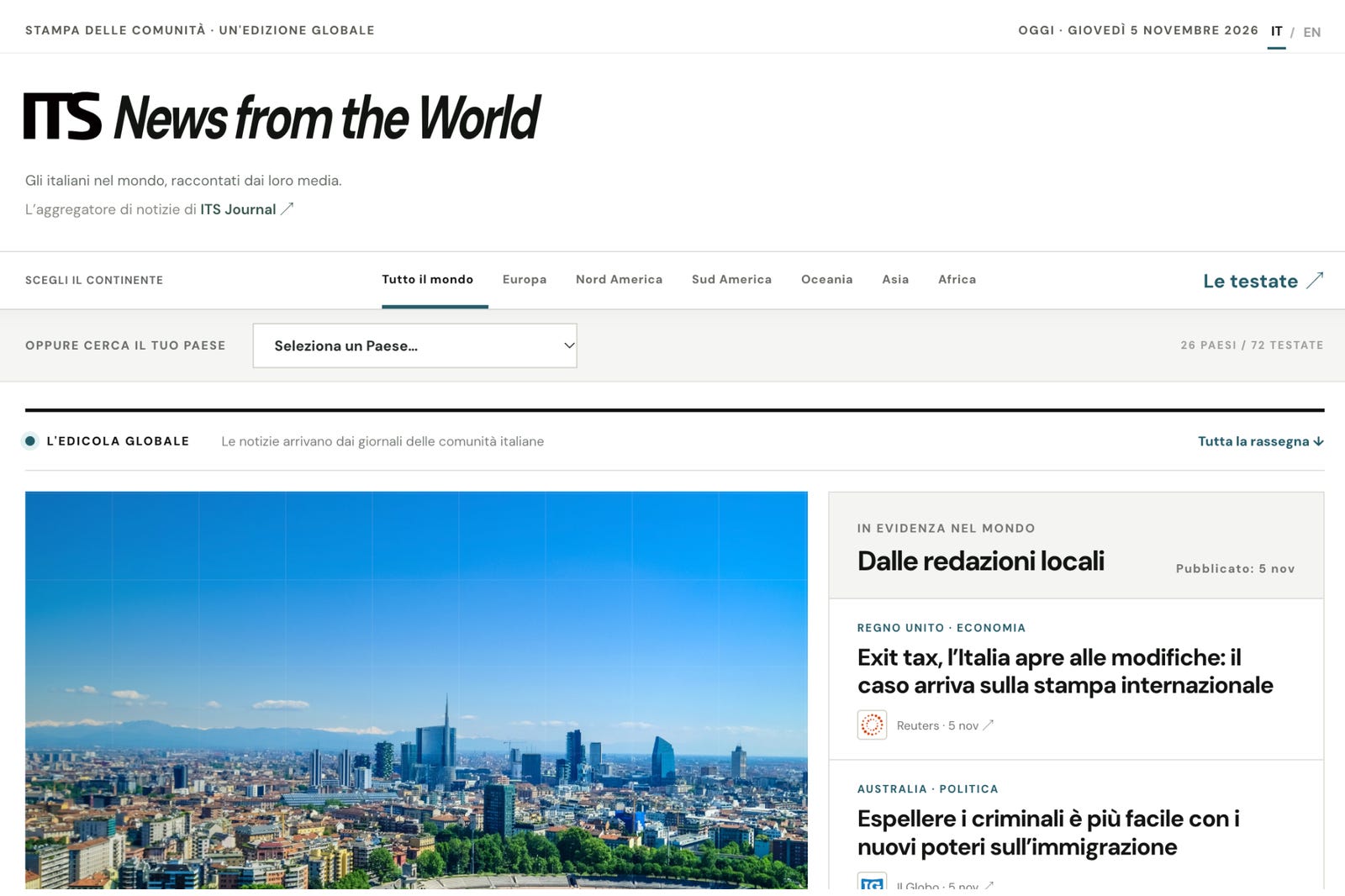
That is the idea behind ITS News from the World, the new news aggregator from ITS Journal, available at https://world.itsfor.it/
Its subtitle explains the editorial ambition: “Italians around the world, as told by their own media.” The aim is not to speak on behalf of Italian communities abroad. It is to make it easier to find the publications already telling their stories.
The website offers browsing by continent, country and topic, with an Italian- and English-language interface. Source publications retain their identities, and news entries link readers to the original material. The navigation also includes a space for radio and television media.
What distinguishes the project from a directory is its focus on the stories themselves, rather than merely listing outlets. What distinguishes it from a conventional newsroom is equally important: an aggregator does not claim to have reported the news it features. If a story comes from a newsroom in Buenos Aires, Toronto or Melbourne, that newsroom deserves the credit. Nor does aggregation amount to independent verification of every claim made by the selected sources.
There is a wider editorial question here. Coverage of Italians abroad often gravitates towards two familiar images: exceptional success stories and sentimental accounts of ancestry. Both may be genuine. Neither captures the everyday diversity of communities divided by generation, occupation, economic circumstances and relationships with Italy.
A broader selection can bring less predictable subjects into view: bilingual schools, employment, consular services, relationships with local authorities, entrepreneurship, political participation and changing cultural identities. The purpose is not to suggest that Italians abroad share one perspective. It is to show why assuming they do would be a mistake.
ITS News from the World is not an exhaustive census of diaspora media. It is an evolving editorial project whose credibility will depend on transparent selection, accurate attribution, working links and regular updates. Newsrooms can propose their publications and flag relevant stories.
For ITS Journal, the project adds another tool to its reporting. It does not replace interviews, analysis or original journalism. It broadens the field of view and recognises that stories about Italy do not always begin inside Italy.
Perhaps that is the point. Italians around the world do not need a single voice. They need their many voices to be easier to hear.