

NOMAG’s new research book follows international demand rather than the destination pitch. Its findings point towards private homes, connected medium-sized cities and services that remain available after the summer.
Italy rarely struggles to supply the opening image: a hillside town, a historic square, a table with a view. The harder part is explaining how someone can live there for eight weeks while continuing to work, sharing a home with a partner and dealing with the ordinary needs that travel advertising leaves outside the frame. A destination can be desirable before arrival and difficult to use afterwards. The distinction matters if the aim is to attract more than a brief visit.
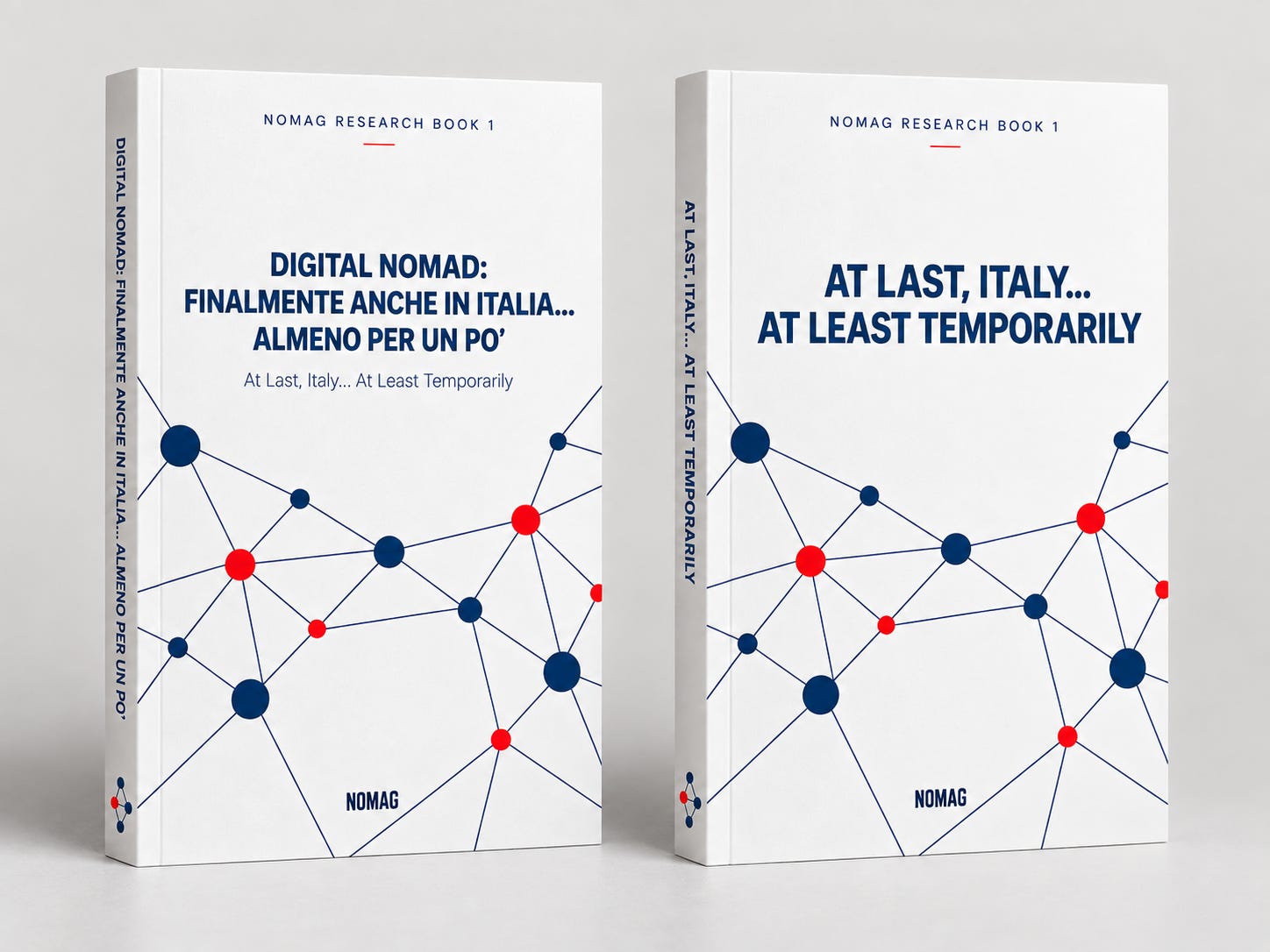
‘At Last, Italy… At Least Temporarily’, the first Nomag Media Research book by Matteo Cerri , examines that gap from the demand side. Rather than starting with what Italian places would like international professionals to do, it asks what a particular international audience would actually consider. The answer is less closely aligned with the familiar image of perpetual travel than many destination offers assume.
A temporary stay can require a stable base
Among valid respondents to the duration question, 66.8% choose one to three months as their ideal stay in Italy. In a separate question, 48.0% prefer one base with occasional travel, while just 9.9% would like to move frequently. These are stated preferences, not booking records. Even so, they describe a coherent product challenge: making ordinary life easy to establish for a limited period.
The household dimension strengthens that interpretation. 78.2% envisage living in Italy with a partner, children or other family members; only 11.8% expect to stay alone. The person answering a questionnaire may therefore be only one participant in the eventual decision. A convincing offer has to work for the household, not merely provide a desk for the person whose job can travel.
Housing is part of the destination
A whole private home or serviced apartment is preferred by 72.4%, while shared rooms and coliving together account for 15.6%. This does not suggest that social connection is unimportant. It means that wanting relationships and wanting shared accommodation are different things. A couple can be highly engaged locally and still need privacy, a kitchen and space for simultaneous work calls.
The accommodation budget adds a commercial constraint: 65.8% would realistically remain below €1,250 per month. The income distribution elsewhere in the survey is relatively strong, but that does not turn the audience into an unlimited market for tourist nightly rates. Housing operators need to test monthly propositions against actual demand, rather than infer willingness to pay from professional seniority or international origin.
The geography of everyday convenience
Medium-sized cities would be seriously considered by 49.4% of respondents, compared with 10.2% for rural or mountain locations. Up to two location types could be selected, so these are not exclusive market shares. Nor is the result a verdict against smaller settlements. It suggests that their connections to services and transport deserve attention alongside their scenery and available buildings.
Transport and accessibility lead the service question at 65.8%, followed by healthcare and everyday services at 59.8%. Reliable internet or workspace is selected by 45.5%. Internet remains necessary for remote work; the ranking is not an instruction to neglect it. It is a reminder that a digital occupation does not remove the need for physical systems. For territorial development, improving those systems can benefit existing residents as well as newcomers.
What the study can and cannot tell us
The English-language core survey ran from early June to 15 July 2026 among 1,500 selected contacts in NOMAG’s international audience. It received 1,056 responses, including 981 completed core questionnaires; six supplementary analytical variables were incorporated in the September edition. This is a purposive publishing-audience sample, not a probability sample of all digital nomads. Question-specific bases matter, and intentions cannot be treated as observed arrivals.
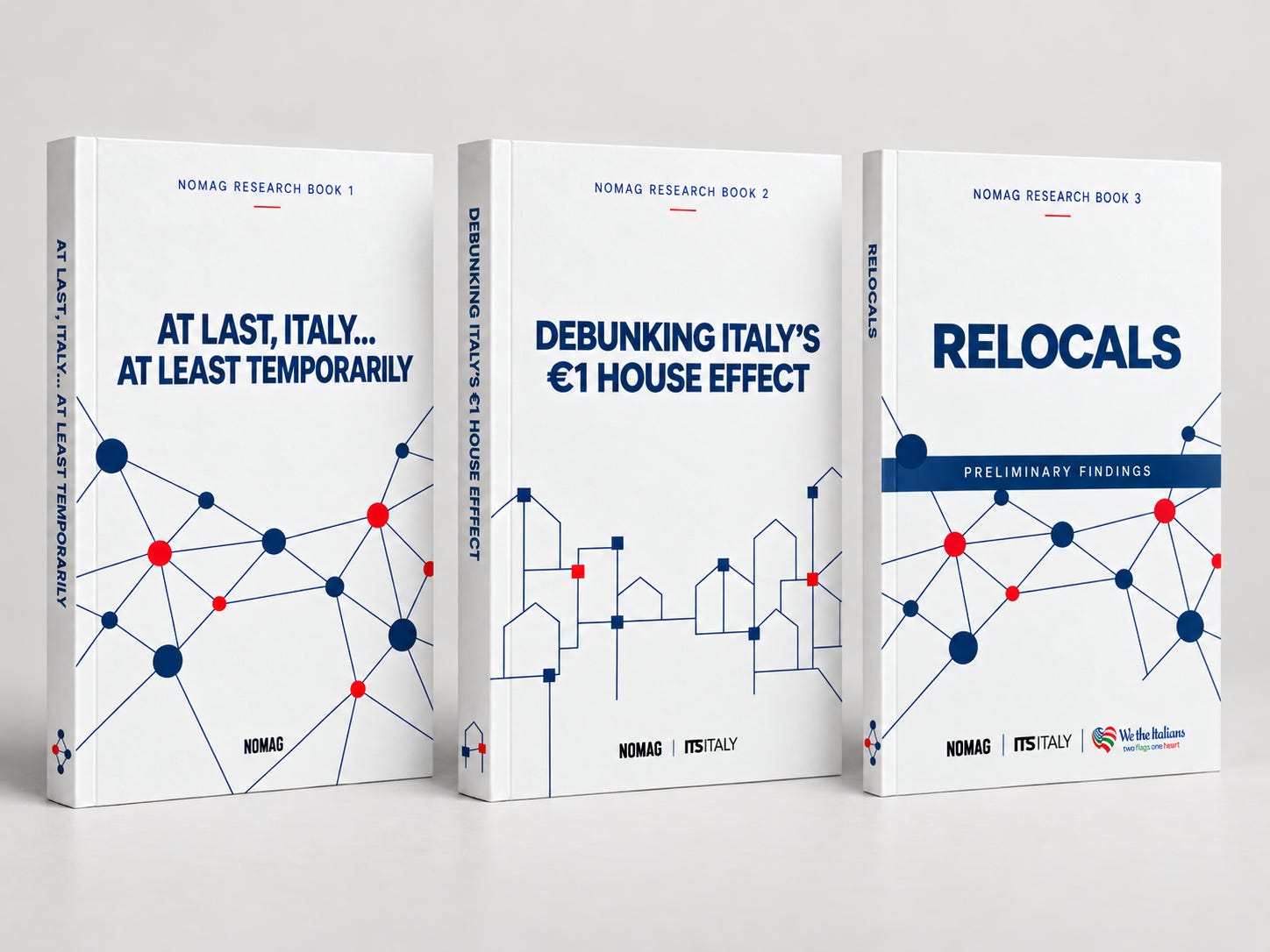
The 24.6% who considered Italy but decided against it nevertheless give destinations a useful question. Where does interest fail to become a stay? The survey cannot assign a single reason to each decision. It can encourage operators to examine housing, information and everyday usability before purchasing another layer of inspirational marketing. Published by NOMAG Media and presented in Rome on 24 September, the book argues for a more precise ambition: make a temporary home possible, then measure what that presence contributes.
Join the presentation in Rome
24 September 2026, 5 pm · Centro Studi Americani, Via Michelangelo Caetani 32, Rome. The event presents the first RELOCALS findings and the NOMAG Research series.