


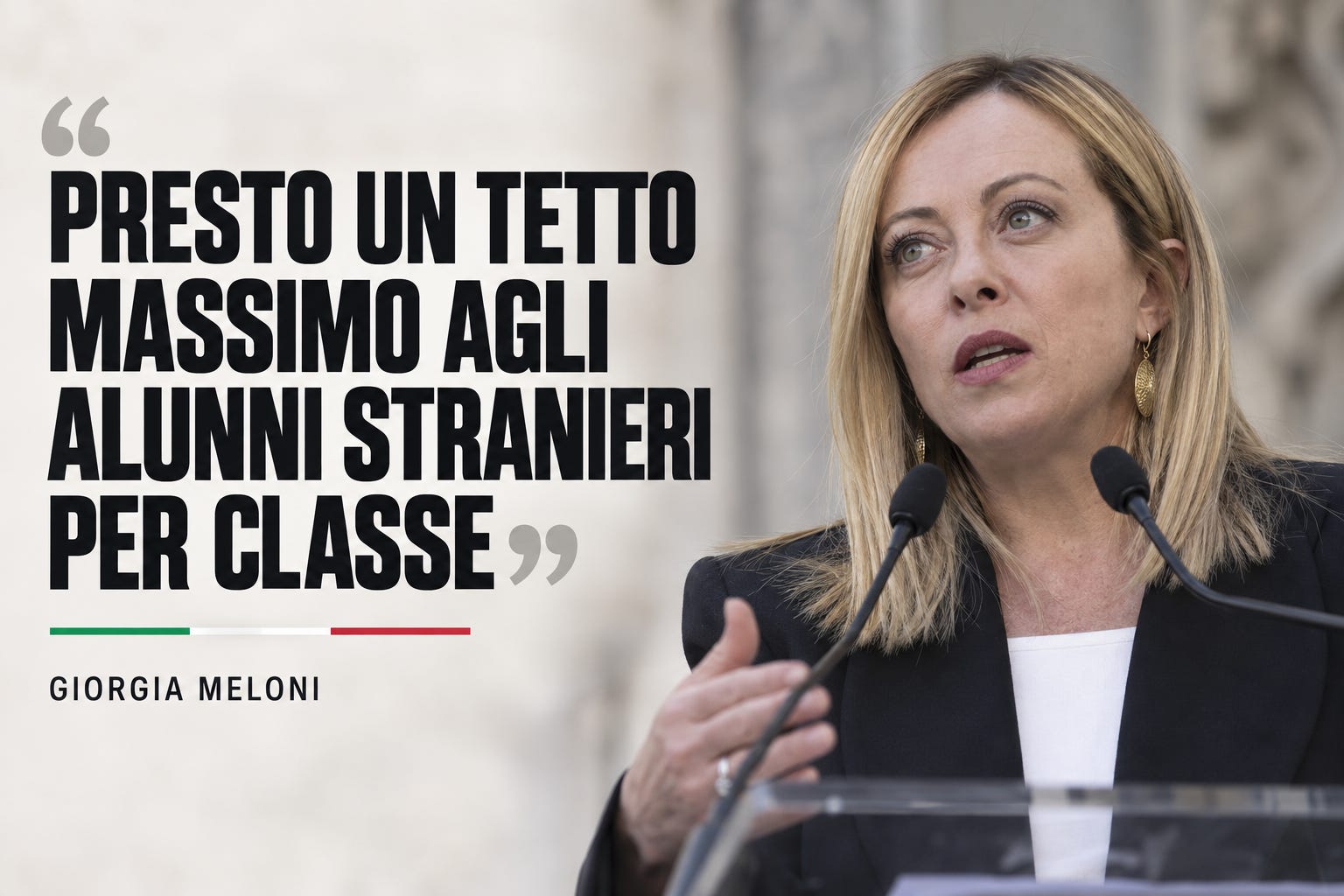
Giorgia Meloni says limiting the number of foreign students in each classroom will improve integration. In many of Italy’s shrinking towns, however, children from immigrant families are not placing schools under pressure: they are helping to keep them open.
Italy’s government is preparing to introduce a legal limit on the number of foreign pupils allowed in each school class.
Prime Minister Giorgia Meloni announced the measure on Sunday, saying it would form part of a broader package intended to strengthen integration in schools. The proposal will also require some foreign parents to learn Italian when their children are experiencing serious difficulties within the school system and will ban face-covering garments such as the niqab and burqa on school premises.
Meloni did not specify the maximum percentage of foreign students that would be permitted in each class. Although Italian media have discussed a possible 30 per cent threshold, the precise limit – and, crucially, the criteria by which a pupil would be classified as foreign – have yet to be set out.
The Prime Minister presented the proposed cap primarily as a linguistic and educational measure.
“If there is only one child in a class who does not understand Italian, that child will likely be able to learn the language and integrate quickly with the help of classmates and teachers,” Meloni said. “However, if the number of children who do not understand the language becomes large – or even the majority – that is no longer integration; it is neglect.”
The concern is not imaginary. Teachers and schools, particularly those with limited resources, can face serious difficulties when several recently arrived pupils require intensive language support. A policy that simply leaves those teachers to manage without additional staff, training or funding cannot reasonably be called integration.
But the government’s proposal risks treating three very different categories as if they were the same: pupils who have recently arrived in Italy and do not speak Italian; children born and educated in Italy who do not hold Italian citizenship; and foreign citizens who are already completely fluent in Italian.
That distinction matters because Italy’s official statistics classify pupils according to citizenship, not according to their command of the language.
According to figures reported by Fondazione ISMU, approximately 931,000 pupils without Italian citizenship attended Italian schools in the 2024–25 academic year, representing 11.6 per cent of the total school population. Around 65 per cent of them were born in Italy. More than half of the foreign pupils enrolled in Italian schools hold citizenship of another European country. ANSA and Reuters reported the figures following Meloni’s announcement.
The national average also conceals striking regional differences. More than a quarter of pupils without Italian citizenship attend schools in Lombardy. Their numbers are also particularly significant in Emilia-Romagna, Veneto and Piedmont, while their presence is much lower in several southern regions.
Yet the consequences of the proposal cannot be understood solely through national or regional percentages. They must also be examined school by school – and town by town.
In some towns, these children are keeping the classroom open
Over the past few years, I have visited many Italian schools, not as the parent or uncle of a pupil but as a “populariser” – although I am never entirely sure what I am supposed to be popularising, as I often learn more than I manage to explain – and as an observer.
I also spend much of the year in places where, if the community is fortunate, only one class remains open.
These are towns in which population decline has been slowed, and in some cases partially reversed, largely because Romanian, Albanian, Moroccan and Chinese families have settled there.
In the small Tuscan municipality where I am writing this article, approximately 75 per cent of minors were born locally to immigrant parents. The Italian state has not recognised many of them as Italian citizens. That is a separate political question which I will not address here. In everyday life, however, some of these children struggle more with their parents’ language than with Italian. They speak with a distinctly local accent and use expressions drawn from the regional dialect.
I have encountered comparable situations in Salento and Sicily.
Looking more closely at publicly available school data, I found that, among roughly 30,000 Italian compulsory-education schools, at least 7,862 have one or more classes containing five or more pupils without Italian citizenship. In 5,007 schools, their average presence exceeds four pupils per class.
These figures do not mean that every one of those schools would close without foreign pupils. They do show, however, that children from immigrant families form a structurally important part of the school population – particularly in peripheral districts, rural areas and small municipalities.
In such places, they frequently help maintain the minimum enrolment required to preserve a class, a school service and, ultimately, part of the community itself.
What does “foreign” mean?
Before imposing a numerical cap, the government will therefore have to answer a deceptively simple question: who exactly is a foreign pupil?
Will the classification depend on the passport a child holds? On where that child was born? On their knowledge of Italian? Or on whether they genuinely require additional language support?
A citizenship-based ceiling could classify a child born in Italy, educated entirely in an Italian school and speaking Italian as a first language in exactly the same way as a pupil who arrived in the country only a few weeks earlier.
It would also produce a practical problem. If one school or class exceeds the limit, where will the children go?
In large cities, redistributing pupils among nearby schools may be administratively possible, although it could still deepen residential and social segregation. In a mountain village, a rural municipality or an inland town, the next school may be many kilometres away.
The result could be daily travel for young children, additional transport costs for local authorities and families, and further pressure on schools that are already struggling with falling enrolment.
There is also an uncomfortable demographic contradiction at the centre of this debate. Italy is trying to protect schools from an excessive concentration of foreign pupils at the same time as hundreds of municipalities are losing young residents and fighting to preserve their final classrooms.
A uniform national cap may therefore respond to a real problem in some urban neighbourhoods while creating a different problem in the places Italy says it wants to repopulate.
A cap cannot replace investment
I understand both the political and practical message Giorgia Meloni wants to convey. I understand the constituency to which she is speaking, and I do not underestimate the difficulties that teachers and schools face every day.
But numerical limits cannot substitute for language teachers, classroom assistants, smaller groups, specialist support and properly funded integration programmes.
If the real concern is that too many children in one class do not understand Italian, the policy should measure linguistic need rather than citizenship. It should also provide schools with resources proportional to that need.
Otherwise, Italy may be left with two choices: closing more schools and making children travel every day, transferring the costs and disruption to their families; or investing more in schools, Italian-language teaching and educators.
In many of Italy’s smallest communities, the children labelled “foreign” are not preventing integration. They attend the local school, speak the local dialect and keep the last classroom alive.
Before introducing a cap, the government should take a closer look at them.
Tertium non datur, I fear.