


There is a moment when Italy stops being a place you would like to visit and becomes a place you could imagine living. The questions change immediately. Where would you go? What could you afford? Could you work from there, start something, retire there, bring your family? Which rules would apply to you? And who would help you work through the answers when you finally arrived?
We have built Relocation Atlas for that moment.
Launching under the ITS ITALY name, the Atlas brings together tax regimes, relocation and housing support, business incentives, selected property opportunities, visa and residence information, and places where remote workers can work and connect. You can explore them geographically, follow the sources and begin to understand what an opportunity might mean in a particular place.
Then comes the part that gives the project its purpose: you can ask ITS ITALY to help you take the next step, drawing on the people and expertise in our territorial network.
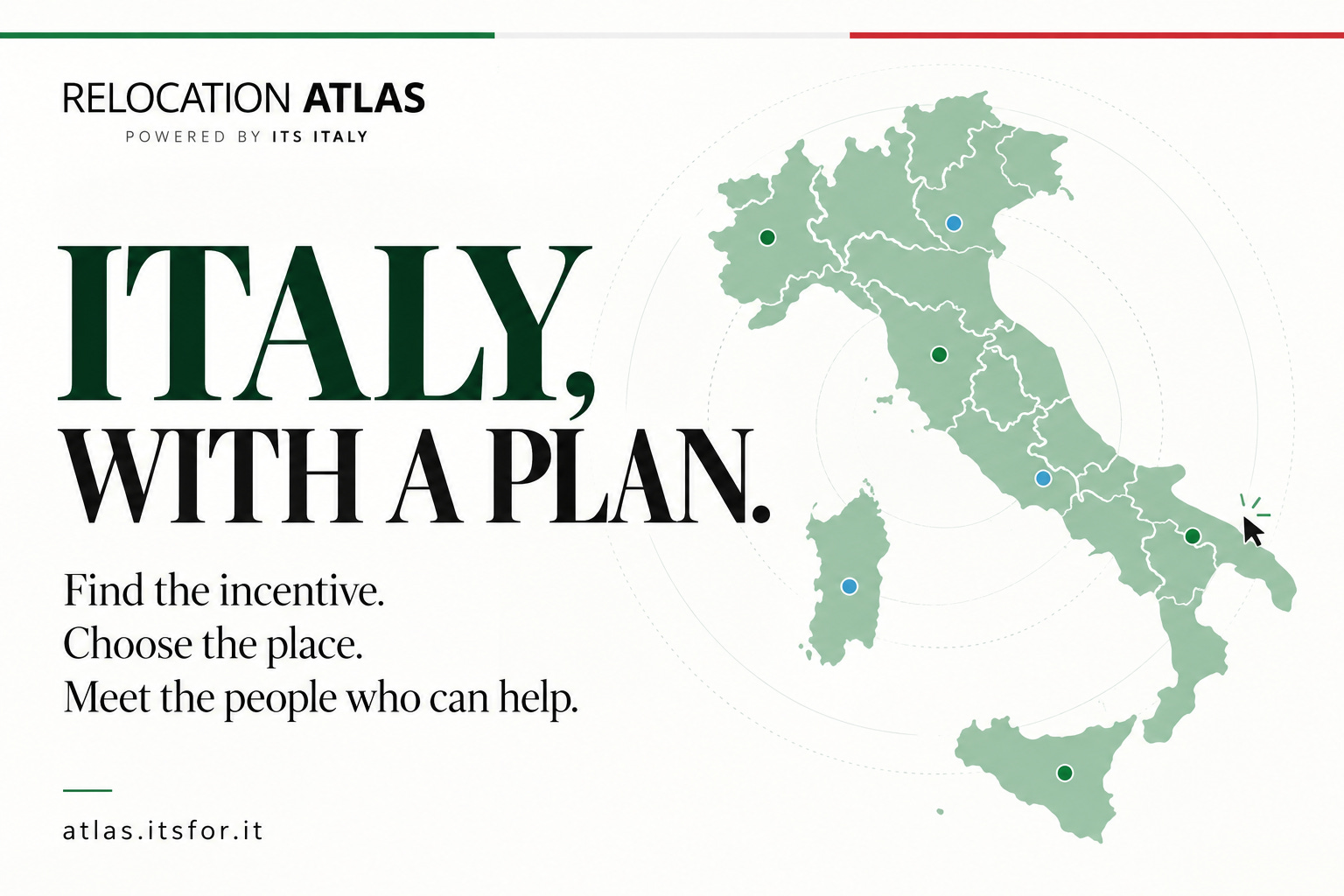
Find the incentive. Choose the place. Meet the people who can help.
That is the idea behind Relocation Atlas. We believe those three steps belong together.
For years, the conversation about moving to Italy has been driven by extraordinary individual propositions. A house with a symbolic purchase price. A town offering support to new residents. A tax regime that could make retirement or a professional move more attractive. A grant for a new enterprise. Each can open an interesting door. Each also creates a further set of questions, usually scattered across several websites, offices and conversations.
A housing contribution has a municipal boundary, an application window and conditions attached. A business incentive requires an actual business project. A tax regime depends on a person’s circumstances as well as geography. A property requires a budget, technical checks and an understanding of what making it usable will involve. The usefulness of the opportunity emerges when these details are considered together.
Relocation Atlas gives that investigation a place to begin.
Its map helps you move between the national picture and the local one. You can explore different kinds of support, consider their relevance to your situation and examine the locations associated with them. The source links sit inside the records, including the cards opened from the map, so the route back to the issuing authority remains part of the experience.
The distinction between an open application, an established legal framework and a programme awaiting further implementation matters. So does the difference between a municipality that fits a preliminary population test and one with a confirmed local call. We make those distinctions visible because a credible starting point should help you ask better questions before you commit time or money.
Consider how differently three people might use the same map. A pensioner arriving from abroad may start with the territorial conditions of a tax regime. A younger professional may be interested in housing costs, connectivity and places to work. Someone planning a new venture may begin with business support, then look at where the activity could operate and what kind of local assistance would be needed.
Their searches may lead to very different parts of Italy. They may also bring them to places they had never considered.
That possibility is particularly exciting to us. Italy has an enormous range of towns, landscapes and local economies in which a different kind of life might be built. Smaller municipalities and inland areas deserve to be considered through the practical questions that determine whether someone can settle successfully: housing, work, services, access, community and the ability to get things done.
An incentive can start that conversation. A viable move requires the conversation to continue.
This is where the connection to ITS ITALY becomes central. Through the Atlas, you can bring us a destination, an opportunity or an idea and request help identifying the next steps. Depending on the place and the work involved, that can mean involving appropriate property, relocation, technical, legal, tax or project expertise from our network. The scope and availability of assistance are agreed for the individual case.
There is considerable value in having someone help establish which professional question should come first. A tax discussion can shape the choice of destination. A technical assessment can change a property budget. A conversation about a business can reveal whether a particular support programme is relevant at all. Coordinating those questions early can make the whole process more intelligible.
We have designed the Atlas to create that connection between research and a real conversation with people who can help.
Our own territorial activity is visible through the ITS ITALY ACTIVE and PROJECTS layers. These distinguish active areas from project records, explored ideas and earlier work, with their respective positions explained. Alongside them, municipal one-euro-home initiatives retain their independent identity and their own issuing authorities. Public-property notices have their own purposes and participation rules. Digital Nomads records identify independent operators and documented workspaces or communities.
Keeping those identities clear makes the map more useful. You should be able to understand whose opportunity you are examining, where its information comes from and whom you need to approach. The presence of a place on the map does not turn every initiative there into an ITS ITALY offer or partnership.
The remote-work layer adds another practical dimension. Coworking spaces, coliving projects and community hubs can help someone investigate a destination through everyday experience. A working stay may introduce the rhythms of a place, the distances involved and the people who make up its local life. Published services and actual availability still need to be confirmed with the operator, but having a documented starting point is useful in itself.
Relocation Atlas launches as a beta, with the ambition to become increasingly useful as verified programmes, places and sources are added. Italy’s opportunities change: calls open, deadlines move, inventories evolve and conditions are amended. The Atlas therefore records an editorial review date and links back to the sources that govern each opportunity. Individual eligibility and the terms of any purchase, application or professional service require their own checks.
For ITS ITALY, this launch brings together several strands of our work: understanding places, investigating opportunities, connecting expertise and helping people think seriously about the practical shape of a move.
It also gives a concrete expression to the invitation behind our work: Don’t just visit. Belong.
Belonging takes time. It begins with decisions that make sense for the person arriving and the place receiving them. We want to help people reach those decisions with more knowledge, better connections and a clearer sense of what they can do next.
Today, there is a new starting point for that journey.
Explore Relocation Atlas, find an opportunity that interests you and tell us what you would like to make happen. We can start working out the next step together.