

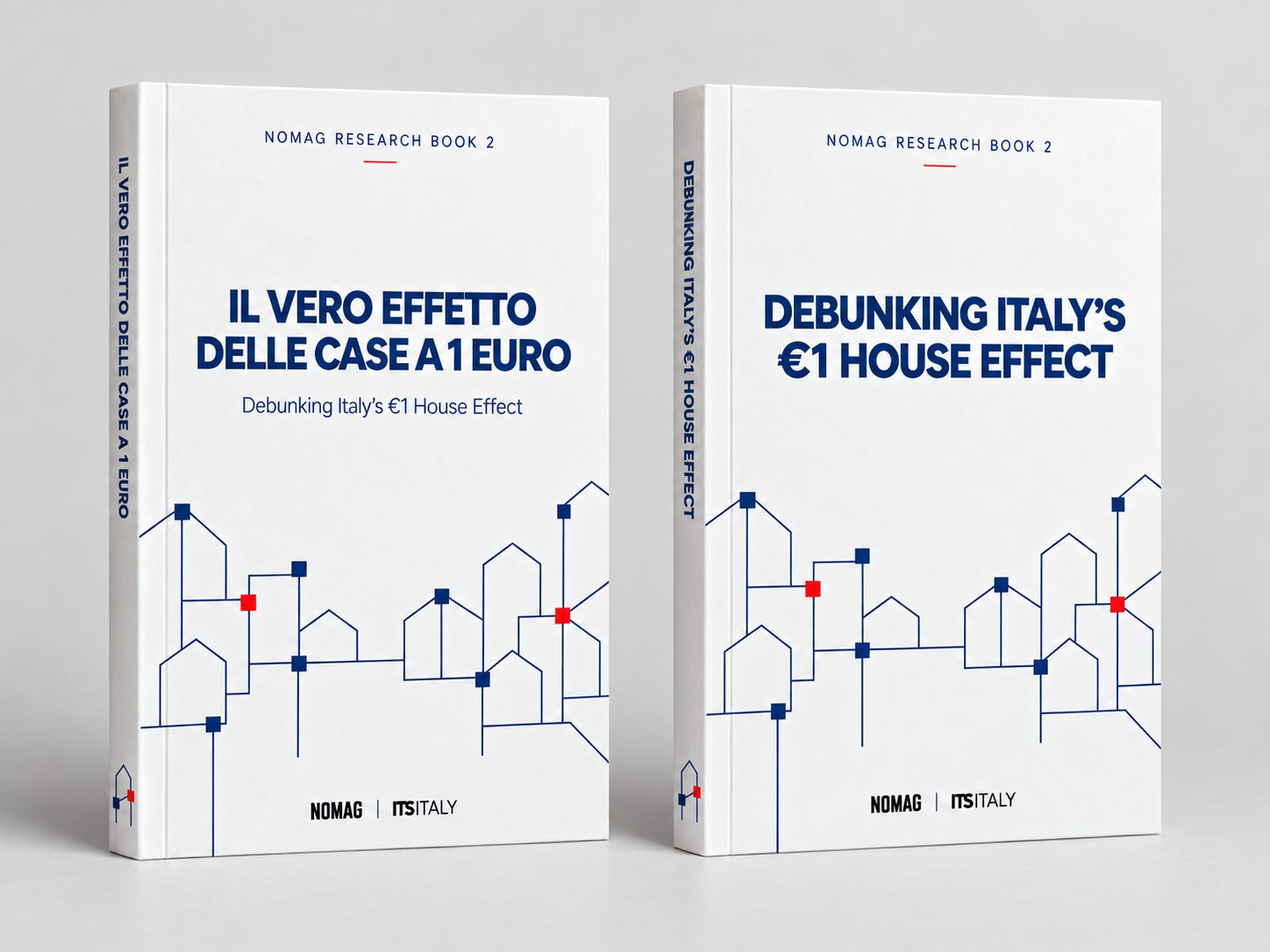
A symbolic price can make a difficult property visible to people who would otherwise never discover it. That is a real achievement, particularly in a town whose housing market has attracted little outside attention. The problem begins when discovery is treated as evidence that the entire local economy has been repaired. A foreign enquiry is not a purchase; a purchase is not a renovation; a restored house is not necessarily a new resident household.
‘Debunking Italy’s €1 House Effect’, by Matteo Cerri, follows those distinctions through Salemi, Sambuca di Sicilia, Mussomeli, Ollolai and Fabbriche di Vergemoli. Co-published by Nomag Media and ITS ITALY, the second NOMAG Research volume asks what happened after the story became internationally irresistible. Its answer is more specific than either the promotional success story or the easy dismissal of every scheme as a failure.
Five places do not make one uniform programme
The shared label covers different arrangements: municipal auctions, facilitation between private owners and buyers, symbolic transfers and wider initiatives involving temporary use or residence. Their timelines also differ. In Salemi, the early public idea and the later operational auction belong to different moments. Treating them as a single uninterrupted intervention risks attributing years of local change to a programme that was not operating in the same form throughout.
The book combines demographic series, property-market evidence, municipal records, tourism material and published buyer trajectories. Comparable municipalities supply context rather than a perfect counterfactual. Regional cycles, accessibility and other policies can affect the same outcomes. The research therefore avoids pretending that every change following an initiative was caused by it.
The ordinary market may be part of the effect
Mussomeli provides the book’s strongest evidence of unusually active property turnover and movement from interest in the symbolic offer towards ordinary low-cost homes. Sambuca shows auction activity with wider private-market spillovers. These mechanisms matter because the headline product may introduce buyers to a place without being what they eventually purchase. A programme can influence discovery beyond the properties formally included in it.
That is also why counts require careful labelling. A mayor’s estimate of transactions linked to a project cannot automatically become a count of €1 houses sold. Programme assignments, completed deeds and total municipal market activity answer different questions. When those distinctions disappear, even a genuine economic effect becomes harder to understand and easier to exaggerate.
Use has value without becoming residence
The demographic series examined show continued population decline in all five selected municipalities. The available property-value evidence does not establish a consistent appreciation effect across the cases. Neither finding proves that the schemes had no benefit or that decline would have been identical without them. Both make sweeping claims of demographic reversal or general price uplift difficult to sustain.
A restored second home can still generate local work and recurring expenditure. A property used for part of the year is different from an abandoned building even if its owner remains registered abroad. The appropriate question is how often it is used, what economic relationships it sustains and whether those relationships persist. Tourism conversion introduces another test: more accommodation capacity does not, by itself, demonstrate sufficient visitor demand.
A disclosed position and a more useful policy question
The author’s involvement through ITS Italy is declared at the start. Practitioner observations help explain buyer journeys but are kept separate from official statistics, municipal claims, private-platform estimates and participant testimony. This matters for ITS Journal readers: the co-publisher’s operational perspective can identify questions, but it cannot substitute for independent evidence or represent every local transaction.
Presented in Rome on 24 September, the book asks municipalities to define the outcome they want and follow the chain beyond initial interest. If the goal is recovery of buildings, completed works matter. If it is recurring use, occupation matters. If it is demographic stabilisation, resident households and services matter. The euro can help a place enter the conversation. What comes after it determines whether the intervention has changed a building, a market or the conditions for living there.
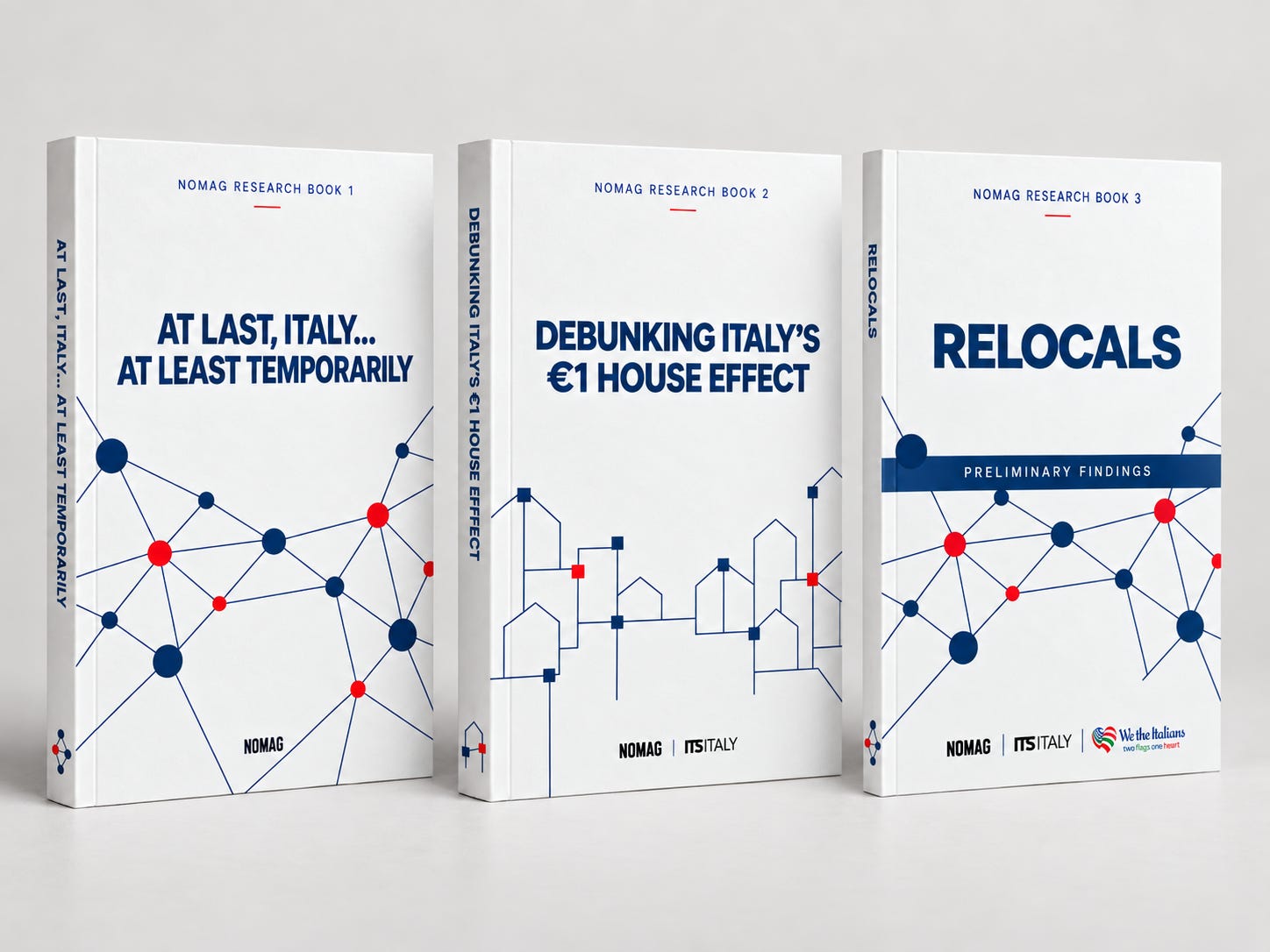
Join the presentation in Rome
24 September 2026, 5 pm · Centro Studi Americani, Via Michelangelo Caetani 32, Rome. The event presents the first RELOCALS findings and the NOMAG Research series.