


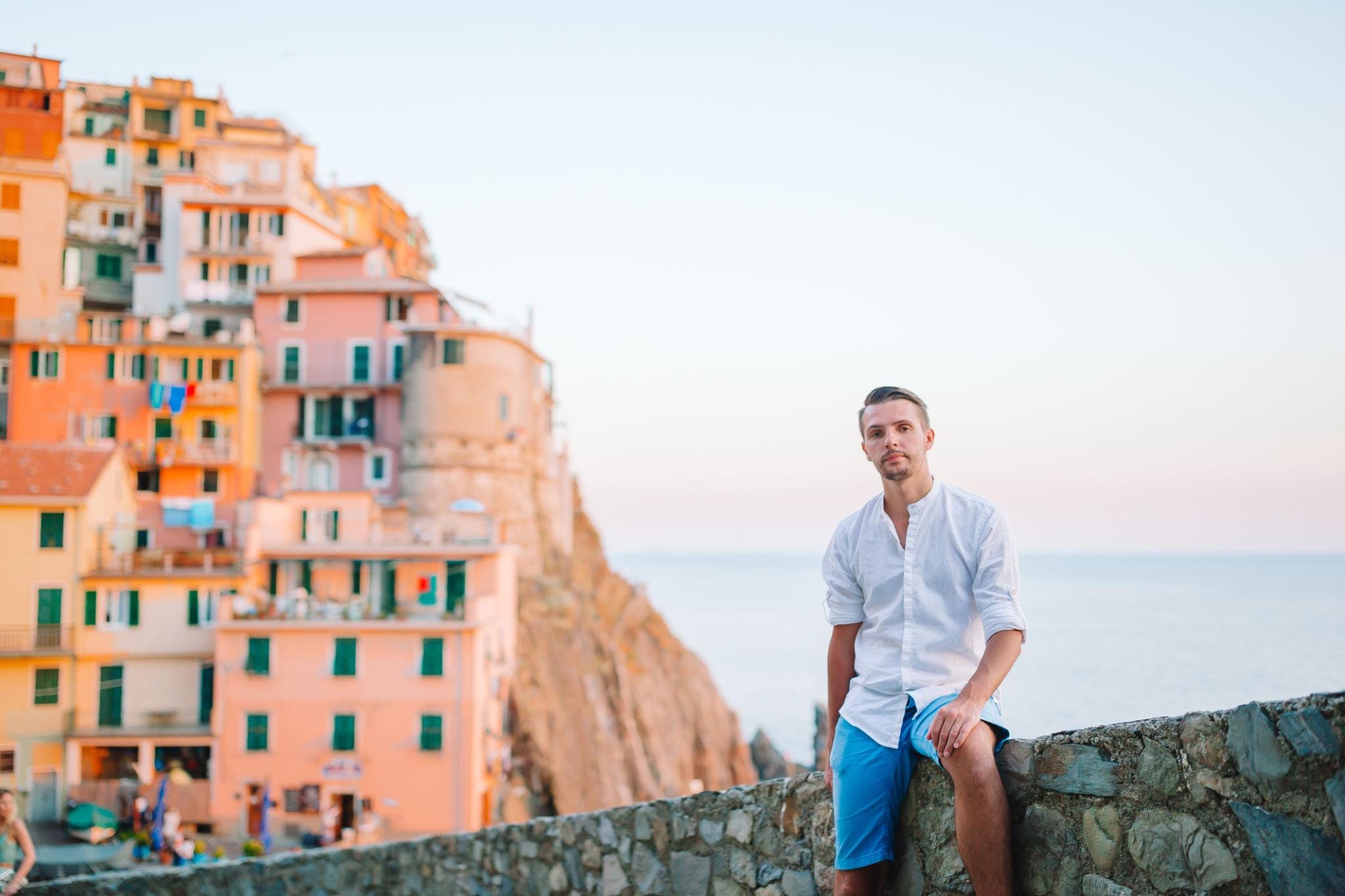
A few days ago, Instagram served me yet another reel about a foreigner who had abandoned the chaos of northern Europe for a new life in an Italian village.
It opened, naturally, with wooden shutters being pushed open over a medieval alleyway. Then came an espresso on a windowsill, tomatoes at the market, sheets drying in the sun, an elderly man sitting outside a bar, a slightly battered Fiat Panda and our newly liberated international villager strolling across the piazza in a billowing white linen shirt.
The linen shirt is essential. You cannot escape the rat race in technical sportswear.
The caption explained that life in Italy was different.
People still had time for one another. Neighbours arrived with baskets of vegetables. Nobody looked at the clock. Lunch lasted three hours. Older people sat in the square. Houses cost almost nothing. The entire community welcomed you as family and nobody asked what you did for a living, because Italians understood that life was about much more than work.
Apparently, while the rest of Europe was busy industrialising, we had quietly developed an alternative economic system based on aubergines, espresso and not replying to emails.
Our friend had finally discovered la dolce vita.
The post office only opens three mornings a week? La vita lenta.
The nearest pharmacy is twenty-five kilometres away? The bus came on Tuesday and may return on Friday? Especially authentic forms of la vita lenta.
The municipality requires a document that is not mentioned online, obtainable from an office that opens between 10.15 and 11.40 on alternate Wednesdays? Charming Italian bureaucracy.
The roof leaks? Character.
The internet disappears during a video call? Digital detox.
The builder has not turned up for two weeks? Italians simply have a different relationship with time.
When the same things happen to someone who must get to work, take children to school, accompany a parent to hospital or keep a business running, however, they are rarely described as la dolce vita.
They are described as losing an entire morning.
And so I began to wonder: if life in Italian villages is so wonderfully relaxed, why does the baker get up at three?
Why does the nurse drive fifty kilometres each way to reach the hospital?
Why does organising the lives of two children require military logistics, because the school is in one town, the sports centre in another and the school bus may not be funded next year?
Why do young people keep leaving these traffic-free, stress-free paradises that also happen to be employment-free?
And how can a house be “unbelievably affordable” to someone earning a salary in London, Amsterdam or New York, yet remain unaffordable to many of the people who work in the town where it stands?
Then I understood.
Friend in linen: you have not necessarily discovered the Italian way of life.
You are buying a romantic getaway - as seen on TV.
You saw the crumbling house on a property programme. You saw the village in a film. You saw the market, the nonna, the aperitivo and the golden light in a hundred Instagram reels.
You recognised the life before you had even lived it. And now you are recreating it.
The coffee must be taken at the bar. The vegetables must come from the market. The neighbour must become a character called Giuseppe. The old bicycle must be photographed against the ochre wall. Lunch must be long, wine must be local and every minor inconvenience must prove that Italians have preserved some ancient wisdom the rest of the world has forgotten.
You are not necessarily entering local life. You may be transplanting your preferred idea of life into a beautiful setting whose economic reality you do not share.
You kept the remote job, the foreign salary, the international clients, the private health insurance and the ability to leave. You moved them into a prettier and less expensive landscape.
Your experience is real. Your pleasure is real. The view is genuinely beautiful and the tomatoes may genuinely taste better.
But it is still your experience, not an objective documentary about how Italy works.
Your time feels different because you have reorganised your life around the parts of Italy you came to enjoy. The time of the woman cleaning your house has not changed at all.
You can wait for the plumber while admiring the bell tower. She must fit four clients, three villages and two school runs into a car with 200,000 kilometres on the clock.
You find it poetic that everybody knows everybody. Your teenage child may find it less poetic when the entire village knows where they were last night before they have even returned home.
You call it community when a neighbour leaves courgettes outside your door. And it is community and generosity, and one of the genuinely beautiful things about village life.
But community is also committee meetings, parish festivals assembled at six in the morning, family disputes dating back to 1987, arguments over parking and a WhatsApp group in which someone asks every three days who owns the suspicious car beside the fountain.
Authentic life remains authentic even when it is not photogenic. None of this means foreigners are the problem.
I work with them. Quite literally, I make a living from helping people relocate to Italy.
I know how much they can bring to these places: money, energy, skills, children for schools that risk closing, customers for local businesses and new life for houses that have been empty for decades.
Many genuinely become part of their new communities. They learn Italian. They stay through February. They discover that Italy continues to exist when the geraniums have died, the piazza is wet and the warm vintage filter has been switched off.
The problem is not the people. The problem is presenting a personal romantic fantasy as a truthful account of local life.
There is a difference between living in a place and consuming its authenticity.
If you buy a house, use it for three weeks and turn it into a cosy Italian retreat for the other forty-nine, you are not necessarily repopulating the village. You may simply be creating another short-term rental.
If the local bar becomes a cocktail lounge “inspired by Italian tradition”, the bakery closes and the last available flat costs more than a local salary, adding #supportlocal beneath a photograph of burrata does not entirely solve the problem.
And if you say that the beauty of the village is that “time has stood still”, remember that the people living there may be desperately hoping that the train, the medical clinic, the school and the local economy will start moving again.
Foreign residents can be part of the solution. Visitors are welcome. Remote workers can bring opportunity. New arrivals can help villages survive.
But structural neglect is not la dolce vita.
A lack of public transport is not a lifestyle. Limited healthcare is not simplicity. Low property prices are not evidence that the locals have transcended capitalism. Often, they are evidence that jobs, services and demand have disappeared.
Come to Italy. Buy the house. Restore it. Work from the terrace. Drink the local wine. Wear the linen shirt. Take the photograph.
Build your romantic Italian getaway. There is absolutely nothing wrong with that.
Just do not market it as the everyday life of an entire country.
The barista calmly making your cappuccino has been awake since 5.30.
Frankly, some of these reels should carry the same warning as misleading advertising:
Lifestyle shown is based on a romanticised television concept of Italy and may have been financed by foreign income. Experience may differ if you require a local salary, public transport, childcare, healthcare or a plumber before September.
An Italian village is not a film set that has happily remained behind in time.
It is a living place trying, often with enormous difficulty, not to be left behind.
If you truly love it, enjoy the fantasy.
Then stay long enough to meet the reality.
And don’t get me wrong, I’ll be still here to try to help you out with ITS ITALY.