
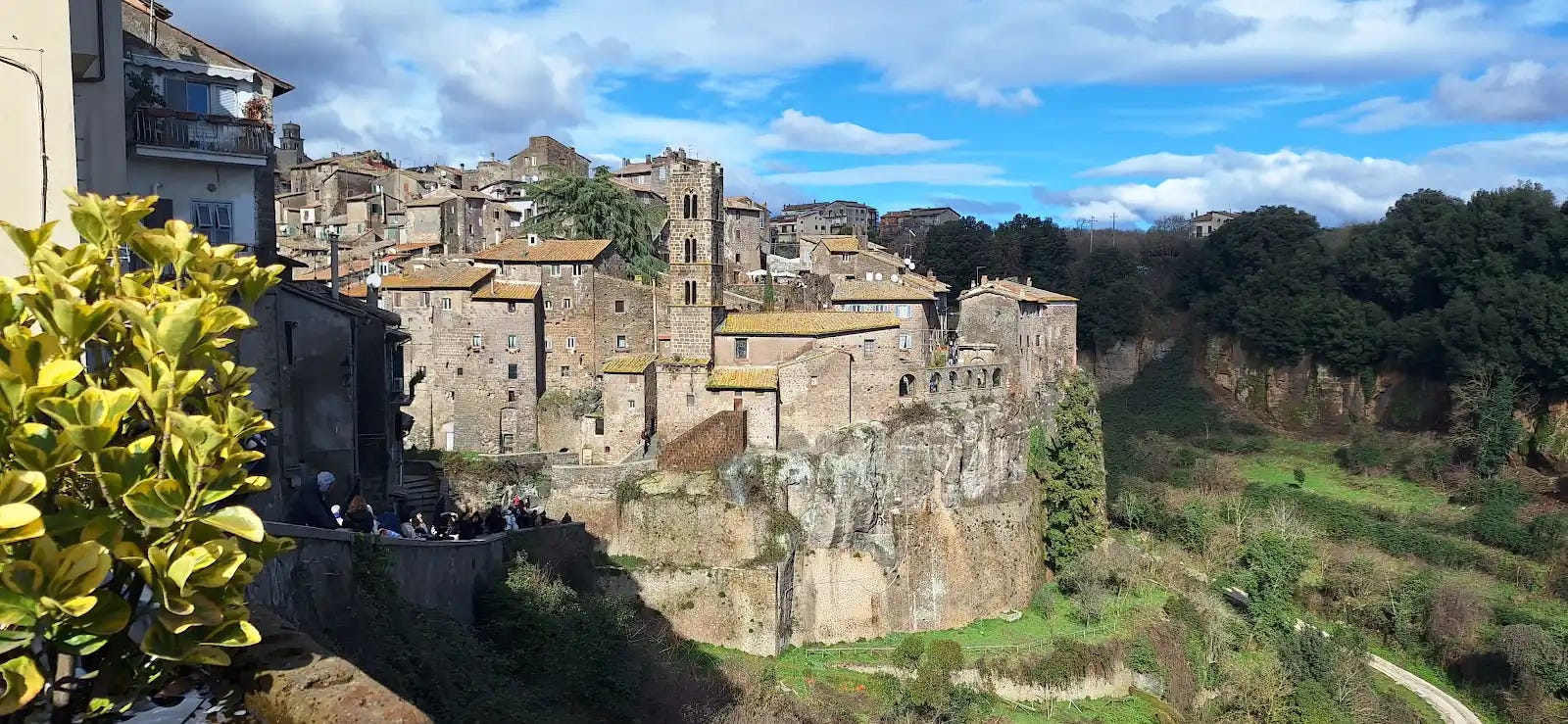
Living in small villages: the great equaliser
One of my favourite things about living in a small Italian village must be the (relative) lack of stratification…. In a global society where all companies are placing you in different groups depending on your ability to pay (think airlines, loyalty programs, skip the queue offers etc) Italian villages - as a general statement - offer a space where people have no place to hide: you chat to everyone regardless of your status. And if you’re rude or discriminate towards anyone good luck trying to get anything sorted in the village again. Condescending to the local mechanic? You’ll see the results in the next bill. Rude to the waitress? You’ll experience challenges at the local supermarket next time as rumours spread.
The trend...
My foundation’s work (we work in over 455 cities) means we get to see a lot of cities and communities and one thing that we notice is the slow disappearance of communital spaces that used to bring people of all classes together and instead a move towards payment gated communities: think exclusive clubs or gyms or associations that filter who they allow in. I mean: when was the last time you sat in a public park chilling with everyone else? That’s not to say it doesn’t happen, but in my observations it is happening less and less.
This is much more important than perhaps people realise. When you stratify (is there such a word? If there isn’t I am claiming it today :-) people what you are doing is creating barriers to empathy and connection. People start hanging out less and less with people who think differently and more and more with likeminded people. As a horrible oversimplification: look at politics and how people start only to hang around with other people who think the same and the problems this creates in terms of real respectful dialogues. The same in religion, fitness, private schools, member clubs, what people read/follow etc.
In big cities you can pretty much get away with this. In small towns good luck hiding from people: you are forced to chat to everyone irrespective of their political or religious inclinations. The grandmother you could ignore in a bit city is the person you will sit down and chat with in the village’s local cafe.
And in a way - as someone who lives life in small villages - this is the thing I love about smaller villages... is that it forces you to interact. It ‘forces’ you to be human irrespective of financial standing, job title or other metrics. In a small village it’s almost irrelevant how many followers you have on substack, what important job you think you have or how successful (or not) you are in business. You are polite and engaging with everyone and you lend a hand when you can.
There is also the other side of the coin of course. In smaller villages you also come across people who don’t view change and innovation the same way or with the same speed as you so there are times when you will feel enormously frustrated. People have time in a way that they don’t in big cities so your messy terrace will get you a reprimand and make you become the local gossip despite it being a trivial matter. The person working in the local post office has been working there for a million years and treats each customer with the love and attention that is almost unheard of in big cities where processing times and turnover is important. I have personally sat in a post office for 45 mins waiting for the worker who patiently helped the elderly lady with something related to her post bank account while also chatting about just about anything. I took a deep breath, opened my podcasts and listened to an amazing episode as well as sent a few lovely voice-notes to friends which made time fly. I hope one day when I am old and frail a young person in the queue behind me will show me the same kindness in giving me the time it takes at my future age :-)
On showing off...
I was very lucky in life in that I had parents that taught me - while growing up in pre-George-Clooney Lake Como - a village in those days - to never show off wealth. To be honest I think it was more a strategy to not raise suspicion to the tax man... but jesting aside, it instilled in me a deep sense of being humble. If you can afford to fly business or first class well done, but don’t go around posting it on social media and showing off. Real wealth is not seen or heard (in fact, one of my favorite books ever is a 1996 classic called The Millionaire Next door: a study of who is really wealthy. Read it. It will be the best financial education ever). In small towns and villages showing off is just rude and you will quickly feel embarrassed if you do. You will by default live close to people who are struggling: families trying to make ends meet on EUR 1.800 a month (individuals take home an average net salary of ca. 1.400 to 1.700 a month). In fact in Italy (source: Eurostat) close to 60% of families report having difficulties in making ends meet with absolute poverty around the 9% of all families.
I ran a AI query (and double checked it also against my personal experience and local knowledge after having lived in ca. 10 Italian villages in the last 4 years):
For a Single Person: €1,000 – €1,300 per month
A single person (often a young worker or a retiree on a basic pension) can live a dignified, comfortable life in a village on this amount:
Rent: €350 – €450 (or €0 if inherited).
Utilities & Internet: €150 – €220 (heating in the winter is usually the biggest wildcard).
Groceries: €250 – €300 (shopping at local open-air markets and discount supermarkets like Eurospin or Lidl keeps food costs incredibly low).
Car Expenses: €100 – €150 (a car is mandatory in villages, as public transit is sparse).
Leisure & Socializing: €150 – €200 (a local espresso is €1.20, a pizza margherita is €6–€8, and village festivals provide plenty of free entertainment).
For a Family of Three or Four: €1,800 – €2,500 per month
A family of four living on this budget in a village is incredibly common. They have to watch their spending, but they live well:
Rent/Mortgage: €450 – €600 (again, frequently €0 due to family property).
Utilities: €250 – €350.
Groceries: €700 – €900.
Car Expenses (usually 1 or 2 modest, older cars): €200 – €300.
Children & Schooling: €150 – €250 (public school is free, though books and school lunches require a small budget).
Misc/Savings: €100 – €200.
The Village “Buffer”: Life in a small Italian village offers an invisible economic cushion. Neighbors frequently swap homegrown vegetables, eggs, and homemade olive oil. Furthermore, child care is almost always handled for free by nearby grandparents, and there is very little social pressure to spend money on trendy consumer goods or expensive lifestyles.
The point is that you showing off wealth is just rude in small villages which means you start behaving much more in a socially kind way and are ending up less in separated small worlds of niche interests.
If that doesn’t appeal to you then don’t go and live in small villages! You’ll hate it.
If however you do enjoy the simpler life, the long chats, the catchups and the feeling of community then you’ll become totally addicted to life in a small village. It brings back a humanity that sometime is lost in the bigger cities where your role is predominantly as a consumer and not a community member.
I personally find myself very much a happier person (though I should warn I am generally always happy)... more real connections. A little less privacy (though to be fair, small village people are actually surprisingly good at carving space for a bit of privacy), people coming to visit you unannounced and you having to get out of your comfort zone a little more often (that town fair you never liked? tough. Go and help out!). Hanging out with people - especially those we would not perhaps normally hang out - is life’s great equaliser and creates also incredible empathy bridges.
My wife and I live in a small village and I can honestly say we are better humans for it.


