


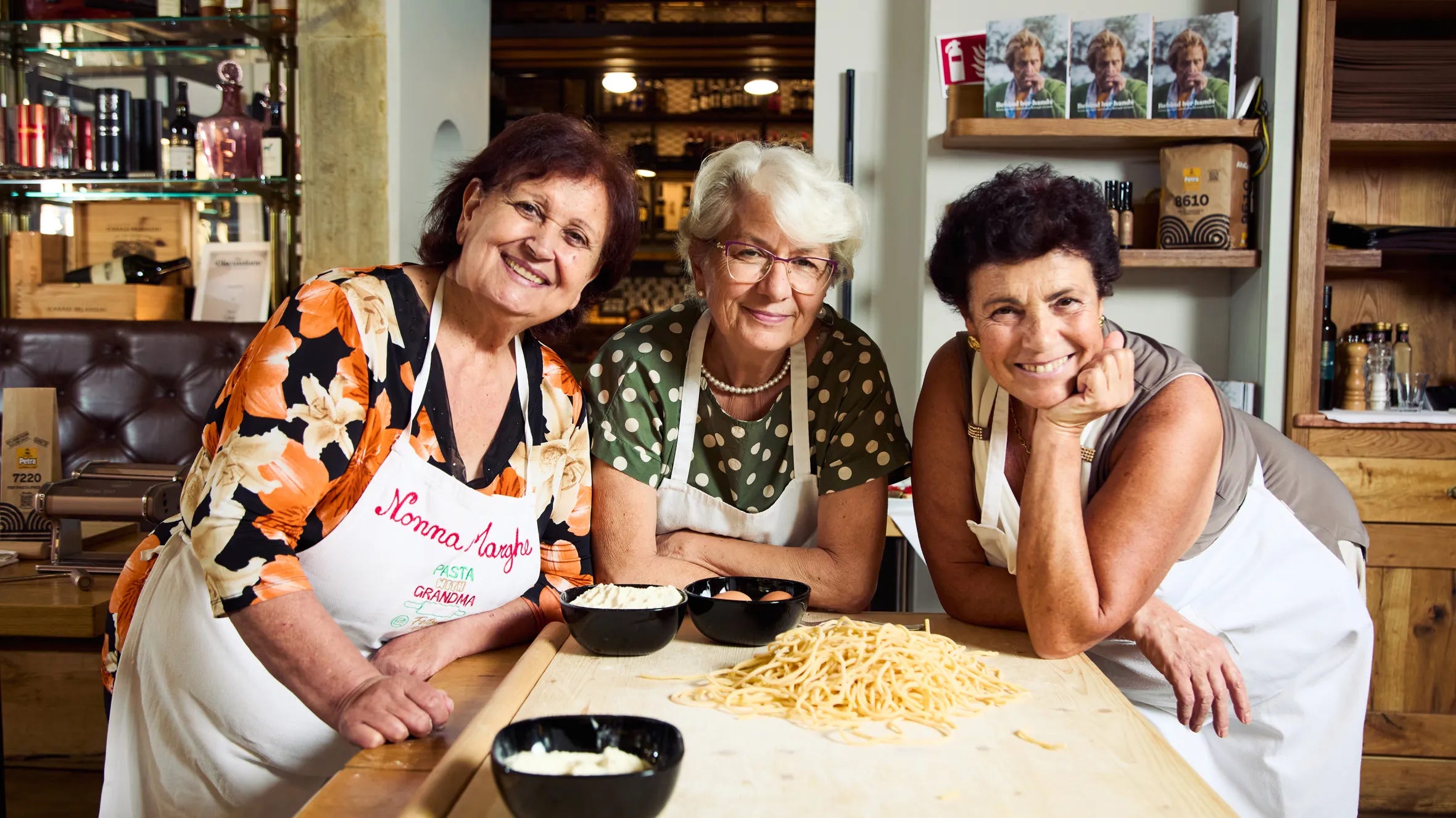
Three grandmothers stand behind a table in Rome, making pasta and teasing their guests. There are hugs, songs and affectionate nicknames. A journalist from The Sunday Times joins the class, and soon the scene has a name: nonnamaxxing, apparently one of travel’s new trends.
I can see why someone would book it. I can also see why an Italian might wince.
How often must we play the version of ourselves that visitors already recognise? The grandmother with flour on her hands, the expansive gestures, the noisy table: these things exist. But once arranged as a two-hour experience near the Pantheon, are we sharing a part of Italian life or performing someone else’s idea of it?
The distinction matters. According to GetYourGuide, searches for classes hosted by grandmothers rose by more than 50 per cent between 2023 and 2025. The company does not give the underlying numbers, so the figure alone cannot tell us how large this market has become. It can tell us that a travel platform sees a promising story to sell. The Times writer attended as its guest. None of that means she invented the warmth she describes; it means we should read the language of a “viral trend” with some care.
The women in her article are harder to dismiss than the marketing. They come from Palombara Sabina, outside Rome, and have known one another for years. Chiara Nicolanti began the project with her own grandmother before inviting other local women to teach. One of the participants, Rosella, says people expect them to stay at home; working with visitors is her way of pushing back. Renzia, who spent much of her life working in the fields, speaks of meeting people from around the world.
That deserves to be taken seriously. Too often we praise older women’s knowledge while assuming they will give it away: to children, grandchildren, neighbours, anyone who needs feeding or looking after. A class can give that knowledge an audience and a value. It can give its teachers colleagues, income and the pleasure of learning something new themselves.
Still, affection is not the same as equality. A visitor may leave saying, “She felt just like my grandmother,” without learning much about the woman in front of them. A business may celebrate her skill while asking her to sing, hug and act out a ready-made idea of Italy. The questions I would ask of any such experience are simple: Do the women want to be there? Are they paid fairly? Can they decide how to teach and how much of themselves to share? Would the class still be compelling if they declined to perform the familiar nonna character?
Nor should “authentic” mean untouched by commerce. Italians have always cooked for other people, taught skills and found ways to earn a living from what they know. A ticket does not make an encounter false. But neither does an apron make it genuine.
Perhaps there really is growing demand for time with people of another generation. That would be welcome. Perhaps travel platforms have also found a highly photogenic way to package it. Both can be true.
The best thing about the Times story is not that it confirms a new trend. It is the moment the grandmothers speak for themselves. They are not there merely to preserve a visitor’s picture of the past. They are doing something with their present.
If we want to meet Italy through its older women, we should be curious about their lives beyond the pasta table. And if we want more initiatives like this, their freedom, pay and enjoyment matter at least as much as our photographs.