


The two opposite housing markets: tourism hotspots where short-term rentals may displace residents, and declining towns where the real problem is that nobody uses the homes at all.

The European Commission is preparing legislation that could make it easier for cities and regions experiencing housing shortages to restrict short-term rentals.
According to the Financial Times, the forthcoming Affordable Housing Act will establish criteria under which local authorities may introduce proportionate measures such as licensing systems, limits on rental nights, caps and moratoria.
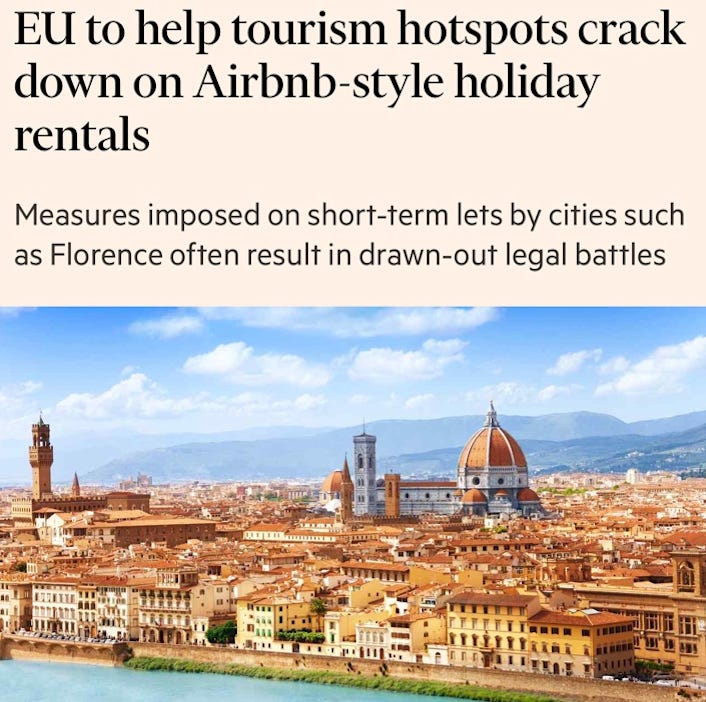
Italy is likely to become one of the most important testing grounds for the new European approach. It combines internationally famous cities under intense tourism pressure, coastal and island destinations dominated by seasonal demand, and thousands of inland municipalities where homes remain empty because the population and local housing demand have been declining for decades.
Treating all these places as a single housing market would make little sense.
The Italian question is therefore not whether Airbnb should be restricted. It is where short-term rentals are genuinely removing homes from the residential market and where, instead, they are bringing otherwise unused properties back into circulation.
The 1.2% that becomes 20%
According to the European Commission’s Joint Research Centre, short-term rentals account for only 1.2% of the EU’s total housing stock.
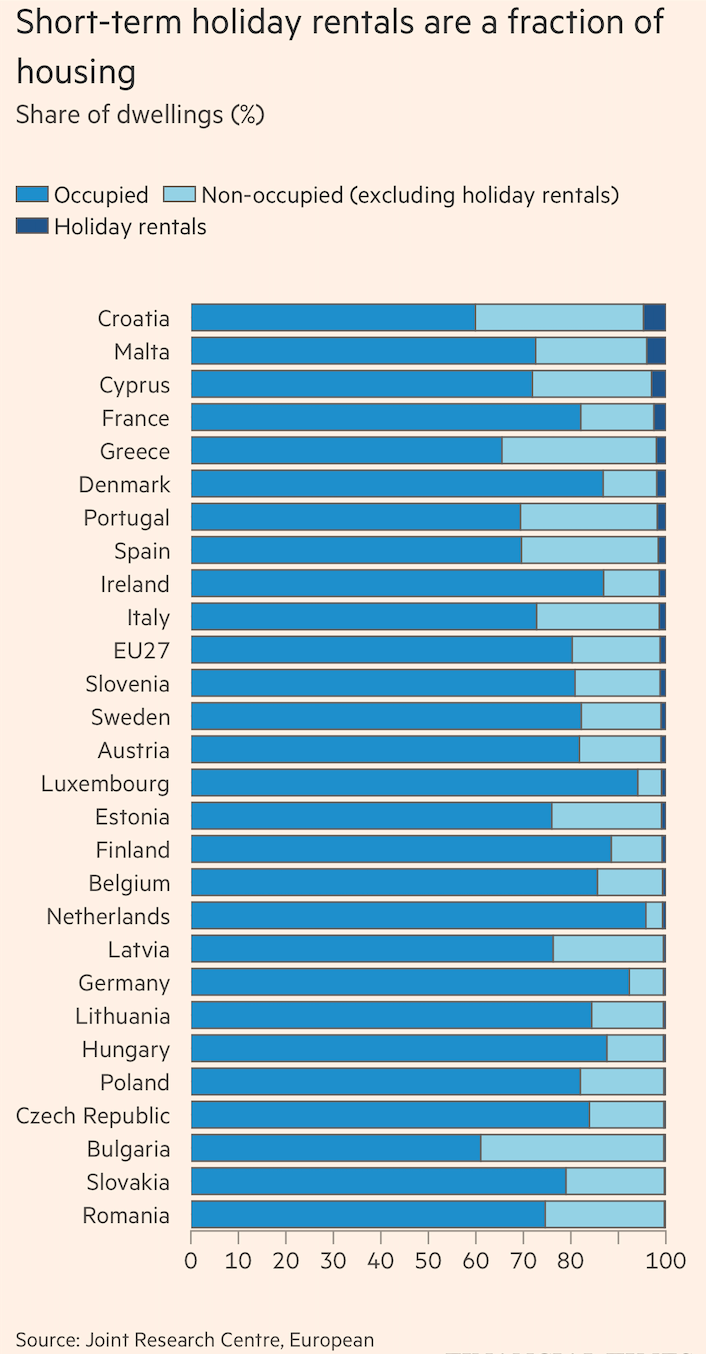
In Sorrento, however, as well as in Dubrovnik and Fuerteventura, they can represent as much as 20% of all homes.
That contrast explains almost everything.
At national or European level, the number of holiday rentals may appear too small to have a significant impact. At neighbourhood level, the conversion of residential homes into visitor accommodation can substantially alter the local housing market.
It can also transform the everyday economy of a place. Businesses serving permanent residents are gradually replaced by luggage-storage facilities, restaurants, souvenir shops and visitor services. Workers employed in tourism may then find themselves unable to live near the businesses that depend on their labour.
But Sorrento is not representative of Italy as a whole.
An apartment converted into a tourist rental in central Florence may be a home no longer available to a resident. A renovated property offered to visitors in a shrinking inland village may previously have been vacant for twenty years and have had no realistic long-term tenant.
Recording both as “one additional Airbnb” produces a statistic, but not an explanation.
Florence and the struggle to regulate
Florence has become Italy’s most visible legal and political test case.
The city first imposed a moratorium on new short-term rentals in its historic centre and subsequently expanded its intervention. In May 2026, the administration proposed extending the ban to an area containing more than 103,000 homes, almost tripling the housing stock covered by the restrictions, according to Reuters.
The measures have faced repeated challenges from property owners and tourism operators.
This legal uncertainty is not unique to Italy. In 2020, the Court of Justice of the European Union accepted that a shortage of long-term rental housing could justify an authorisation system for short-term lets. Restrictions must, however, remain necessary and proportionate.
The judgment recognised the right of cities to intervene, but left substantial room for disagreement over what proportionality means in practice.
The forthcoming Affordable Housing Act should give local authorities a more defensible framework. It will not give every city unlimited power to prohibit holiday rentals, but it may clarify which evidence is required to justify different forms of intervention.
From collecting data to deciding where action is needed
One important regulatory change has already taken place.
Since 20 May 2026, EU Regulation 2024/1028 has provided a common framework for collecting and sharing data on short-term accommodation and registration schemes.
That regulation is primarily intended to establish how many properties are being offered, where they are located and for how many nights they are rented.
The Affordable Housing Act should represent the next step: using those data to identify areas experiencing genuine housing stress and determine what measures local authorities may take.
The distinction matters. A citywide percentage may reveal very little if most short-term rentals are concentrated in three neighbourhoods. Counting listings is equally insufficient unless the data distinguish between a room occasionally rented in someone’s main residence and ten entire apartments operated professionally throughout the year.
A credible regulatory system should therefore consider the density of short-term rentals at neighbourhood level, the proportion of entire homes removed from the residential market, the number of nights actually rented, movements in local rents, the availability of long-term accommodation and the relationship between housing costs and local incomes.
Without those indicators, governments risk replacing a housing policy with a politically convenient target.
What the Italian income chart does - and does not - tell us
The chart accompanying the Financial Times analysis appears, at first sight, to tell a surprising story.
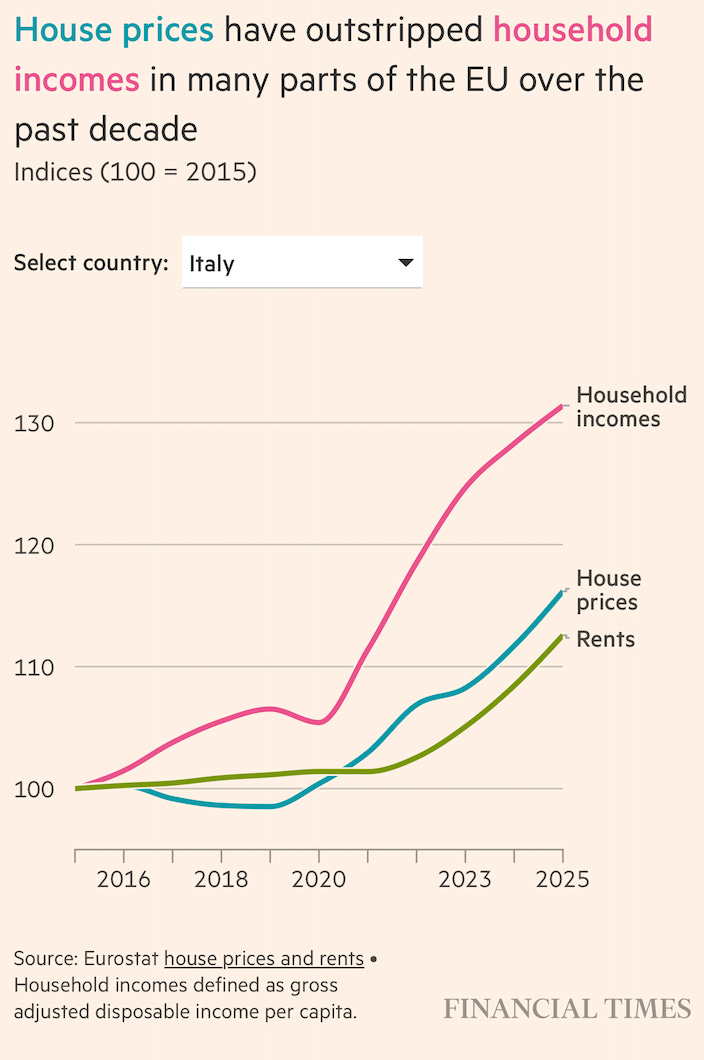
Between 2015 and 2025, Italy’s gross adjusted disposable household income per capita increased by approximately 31% in nominal terms, while house prices rose by around 16% and rents by approximately 12%.
This does not mean that Italians became 31% richer or that their purchasing power improved by that amount.
Gross adjusted disposable household income is much broader than wages. It includes income from employment and self-employment, pensions and other social benefits, property income and public services received in kind, including healthcare and education.
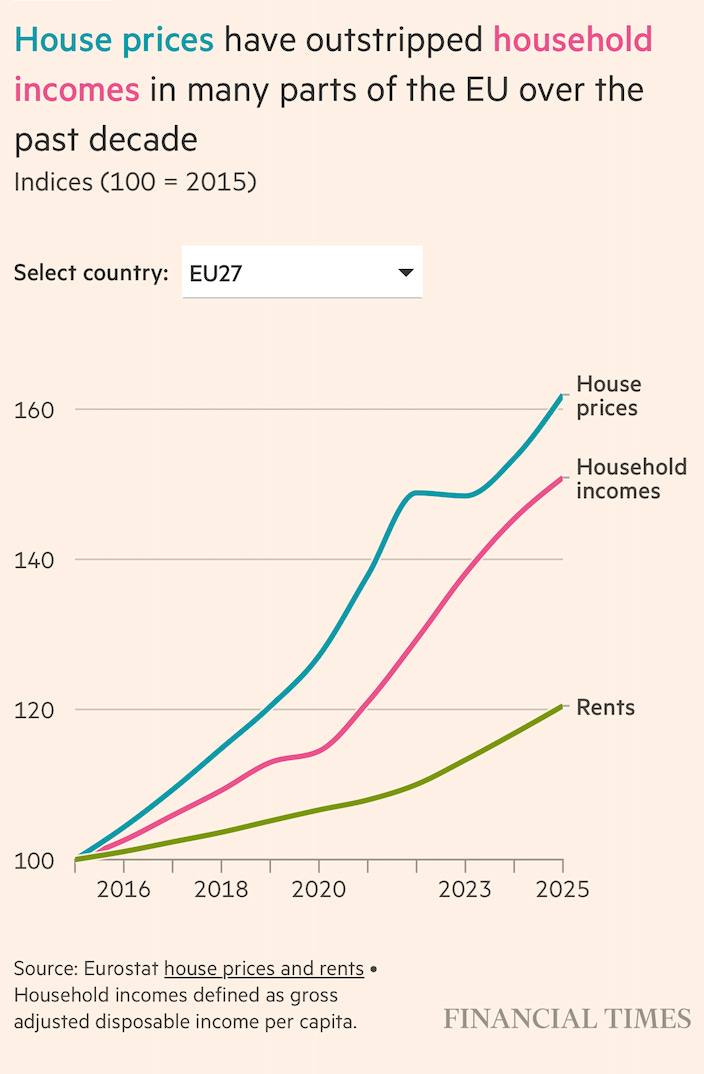
The figure does not measure the position of the median Italian household, nor the specific incomes of younger people attempting to rent or purchase their first home.
Once inflation is taken into account, the Italian picture is radically different. Eurostat reports that Italy’s real household income per capita declined by 4% between 2004 and 2024, making Italy - together with Greece - the only EU country to record a fall over that twenty-year period.
The OECD also found that Italian real wages in early 2025 remained 7.5% below their level at the beginning of 2021. Its 2026 Economic Survey states that average real wages in 2025 were still below their 1990 level.
The Financial Times chart therefore supports a much narrower conclusion: at national level, nominal house prices and rents have risen less rapidly since 2015 than this broad measure of household resources.
It does not show that Italian households are substantially better off, nor that housing has become more affordable.
Its real value is to demonstrate the limitations of national averages. Italy can simultaneously have stagnant real wages, relatively modest national house-price growth and severe housing pressure in particular cities and tourism destinations.
The affordability crisis is real, but highly concentrated — and its geography cannot be understood from a single national index.
The industry has been making this argument for years
Many of these distinctions are not entirely new to the Italian debate.
AIGAB, the Italian Association of Short-Term Rental Managers, has long argued that the effects of holiday rentals should be measured through local data rather than inferred from national totals or platform listing counts.
According to its internal research centre, approximately 492,000 Italian homes were being offered online for short-term rental in June 2026, equivalent to about 1.4% of the national housing stock and 5.2% of the estimated 9.6 million second homes in Italy.
AIGAB also points to the much larger number of unused properties and argues that housing policy should identify which homes are actually vacant, where they are located and why they are not entering the residential market.
This is a legitimate contribution, but AIGAB’s institutional position must be made clear. It is not an independent statistical institute: it is a trade association created to represent professional property managers and promote what it considers fair regulation for the sector.
Its figures should therefore be assessed alongside public and independent data rather than treated as neutral evidence.
Nevertheless, AIGAB is right about one essential methodological point: national percentages alone cannot establish whether short-term rentals are causing housing pressure in a particular city or neighbourhood.
The sector’s economic contribution must also form part of the assessment. Visitor spending supports restaurants, transport, cultural activities, cleaning services, maintenance companies and local tradespeople.
These benefits do not automatically outweigh the housing costs in destinations under pressure, but excluding them would produce an equally incomplete analysis.
Rural tourism is a different use case
Companies such as Ruralis illustrate a very different side of the short-term rental economy.
Its model focuses on managing holiday homes in villages, rural destinations and less internationally visible areas. It provides online distribution, guest management and operational coordination while involving local cleaners, technicians and other service providers.
In these territories, short-term rentals can create a mechanism through which an underused home is maintained, made visible to international visitors and connected to a small network of local economic activity. They can also help redirect part of tourism demand away from overcrowded destinations towards places that still have accommodation capacity.
Ruralis should not be presented as definitive proof that holiday rentals reverse depopulation. The company’s claims about revitalising rural communities form part of its own commercial positioning, and a proper impact assessment would require independent evidence on occupancy, local expenditure, employment, property renovation and the number of additional permanent residents generated over time.
What its model does demonstrate is that short-term rentals are not used exclusively to convert scarce city-centre apartments into tourist accommodation. They can also provide the commercial infrastructure needed to bring difficult, dispersed and previously underused rural properties back into circulation.
That is an important distinction for European policymakers. Restricting a professionally operated apartment in an oversupplied tourist district and preventing an abandoned rural home from reaching international demand are not necessarily the same public-policy objective.
What international property buyers need to understand
For international buyers, the debate is relevant even when purchasing a home primarily for personal use.
Many foreign buyers are attracted by the possibility of renting their property during periods when they are not in Italy. Rental income may help offset running costs, maintenance, taxation and renovation expenditure.
But expected short-term rental income should not be treated as guaranteed.
The regulatory direction is moving towards greater registration, data sharing and local differentiation. A property’s future rental potential may therefore depend not simply on Italian national law, but on its precise location, the classification of the unit, the type of owner and the intensity with which it is rented.
Anyone purchasing on the assumption that an apartment will remain available for unrestricted tourist letting should examine local policy as carefully as the condition of the roof or the property’s legal title.
There is also an economic issue. Gross revenue projections often overlook management charges, platform commissions, utilities, cleaning, maintenance, taxation, periods without bookings and the original cost of making a property suitable for guests.
An attractive nightly rate is not the same as a reliable net return.
Not every foreign-owned home is a lost Italian home
The political debate frequently places very different owners in the same category.
There is a meaningful distinction between a resident occasionally renting a room, an international owner using a second home for part of the year, and a professional operator controlling a portfolio of entire apartments in an area with an acute shortage of residential accommodation.
There is also a difference between buying an existing habitable apartment in a constrained city centre and restoring a property that had effectively disappeared from the usable housing stock.
A foreign buyer who renovates an abandoned house in an inland village has not necessarily displaced a local family. In some cases, that investment may preserve a building, employ local tradespeople and generate spending in a community experiencing economic and demographic decline.
This does not automatically make every such investment beneficial. A town made up predominantly of seasonal homes can remain empty for much of the year, while visitor spending alone may be insufficient to sustain schools, healthcare, public transport and essential services.
Short-term rentals can support regeneration, but they cannot substitute for permanent population. You cannot Airbnb your way out of depopulation.
Italy needs different answers for different territories
The Affordable Housing Act will not solve Europe’s housing crisis.
Restricting holiday rentals may reduce pressure in selected areas, but it does not build new homes, accelerate planning decisions or automatically turn a tourist apartment into an affordable home for a local family.
Platforms and operators are right to point out that restricting short-term rentals will not solve structural housing shortages caused by inadequate construction, planning delays and insufficient affordable housing.
Cities are equally right to argue that when a substantial share of homes in a particular area is being used for transient accommodation, the residential market can be damaged.
Italy needs different policies for different territories.
In cities and destinations experiencing measurable housing stress, restrictions may be justified to preserve accommodation for residents and workers. In towns with declining populations and large numbers of unusable or abandoned properties, tourism and international ownership may form part of a wider regeneration strategy.
The essential word is measurable.
Authorities should examine the concentration of entire-home listings, the number of nights actually rented, local wages and housing costs, the availability of long-term accommodation and the proportion of properties that were already vacant before entering the tourism market.
For buyers, owners and communities, this means moving beyond the idea of one Italian property market and one Italian Airbnb problem.
Italy has many housing markets. The consequences of short-term rentals depend on which one you enter.