


An Italian version of this article was first published by Esco Quando Voglio.

I had just ordered Una splendida rovina, the new novel by Vincenzo Latronico, mostly out of curiosity. The book has not yet been released, so I have not read it and I cannot know where the story ultimately goes, or what answer, if any, Latronico gives to the questions it seems to raise. Then I read Luca Mastrantonio’s interview with him in Sette, and that curiosity became something rather different. I am now extremely interested in reading the novel and, if I ever have the opportunity, I would be equally interested in discussing it with Latronico, because in the way he describes the genesis of the book I recognised much more of myself, and above all much more of the people I meet every day through my work, than I would have expected.
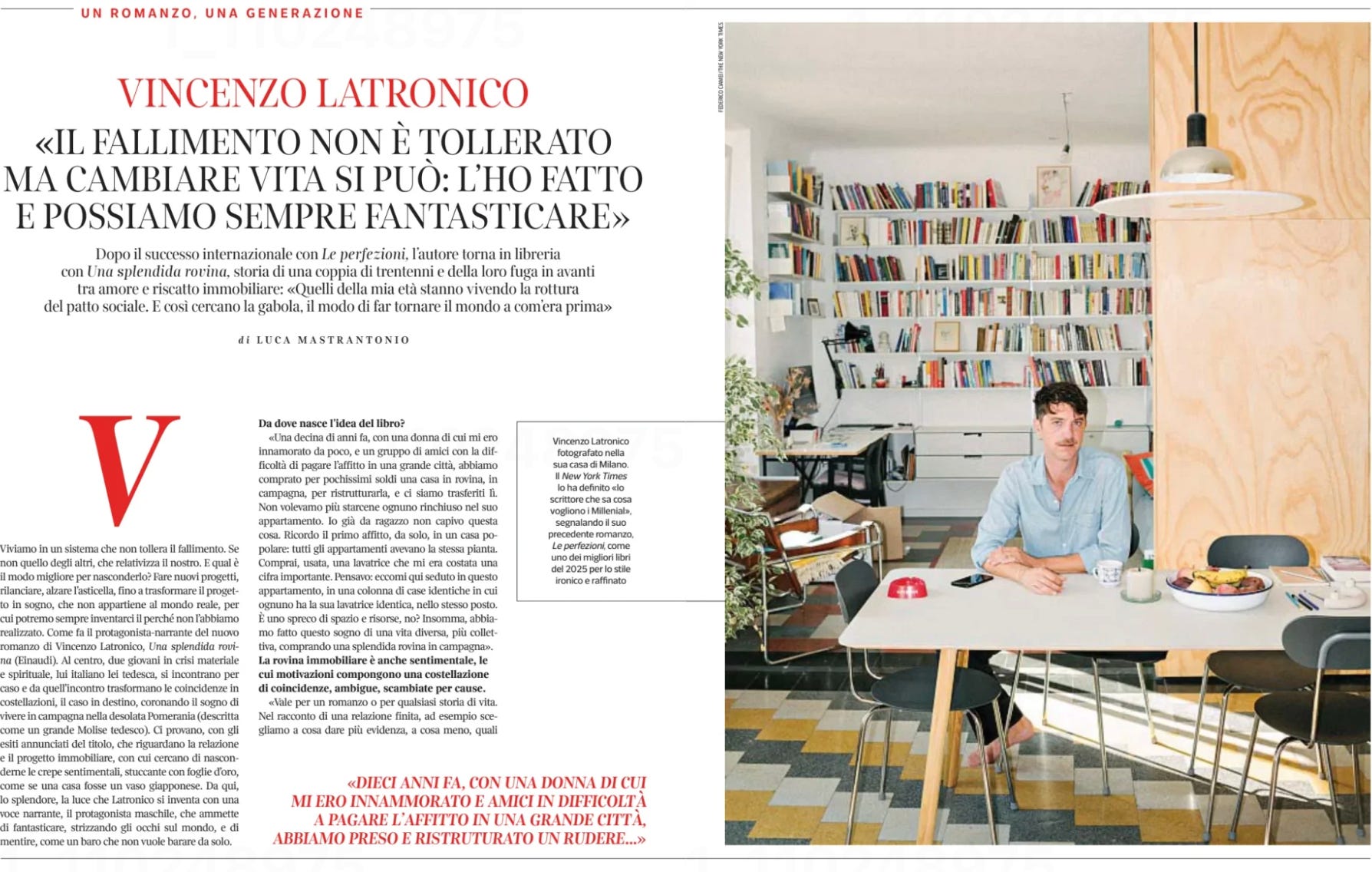
Latronico explains that around ten years ago, together with the woman he was in love with and some friends who were struggling to pay rent in a large city, he bought an almost derelict house in the countryside for very little money, renovated it and moved there. He also recalls that, while he was still living in Milan, he would spend time on his phone looking at seaside properties he could not afford, even narrowing the search to that wonderfully dangerous filter, sea view. He calls it property porn — not exactly a new expression, particularly for those of us who have spent far too many hours watching HGTV, renovation programmes or scrolling through property portals — but it is difficult to find a better description of that very contemporary habit of looking at houses without necessarily looking for a house. What we are often looking at is the life that might exist around it. The terrace, the stone walls, the village square, the sea somewhere beyond the window, the idea that there could be another geography in which we might somehow become a slightly different version of ourselves.
This also seems to be the territory from which Una splendida rovina begins. The book’s presentation offers what are effectively two versions of the same story. Two people in their thirties meet, fall in love and, carried away by the enthusiasm of a new relationship, decide to change their lives, leave the city and move towards the countryside, eventually reaching the Baltic coast and an enormous ruined house that needs to be restored. Or perhaps those same two people are simply drifting in cities that have become too expensive, exhausted by jobs that no longer give them what they once did, and they find in one another, and in a rural fantasy cultivated through social media and property websites, a possible escape route. Both stories can be true at almost exactly the same time. What changes is the way we choose to tell them, perhaps also to ourselves: are we chasing something or running away from something else, are we constructing a dream or manufacturing an alibi?
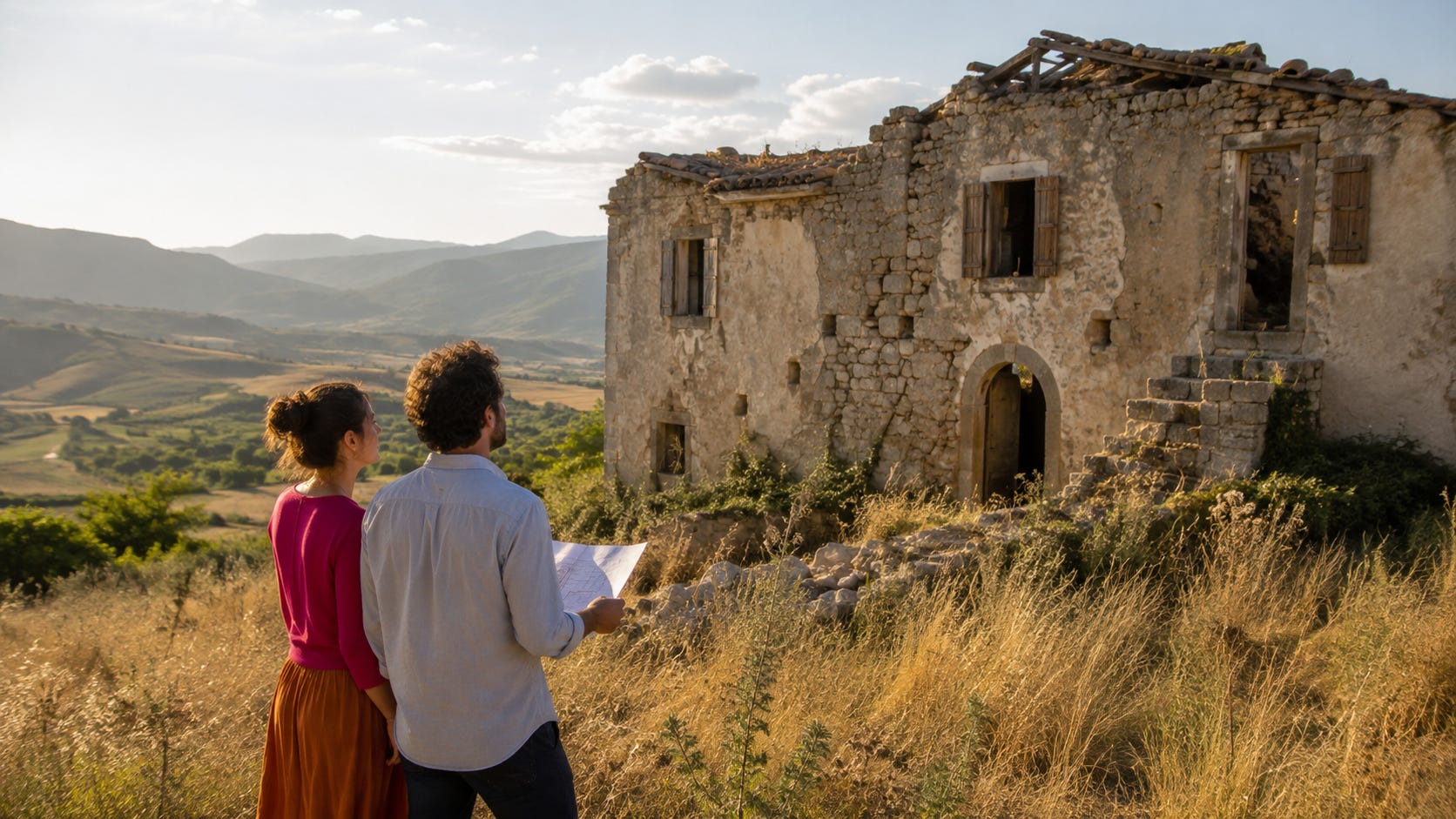
It would be easy to dismiss all this as another manifestation of the Instagram age. We know the imagery by heart by now: the stone house, the abandoned ruin waiting to be rescued, the small Italian town, the laptop on the wooden table, the Saturday market, the glass of wine at sunset, laundry moving in the breeze and the suggestion that somewhere, probably south of Bologna, life is still slower, simpler, more authentic and considerably better lit. We even know the filters used to photograph it. There is, by now, a whole visual and commercial grammar attached to the fantasy of starting again in Italy, and in its worst form it comes very close to consumer fraud: not because the beautiful house, the village or the landscape are necessarily fake, but because almost everything required to make that life possible has been edited out. We see the €30,000 house but not the €100,000 renovation, the British or American couple drinking wine under the pergola but not the income, savings or passport that made the move possible, the laptop beside the olive trees but not whether that person actually lives there for twelve months or twelve days a year. We see the castle bought “for less than a London flat” and are rarely told what it costs to heat, restore, insure or maintain a castle. The individual facts may all be true while the overall impression is completely misleading.
This distinction matters because there is a very large difference between saying, “I bought this house for €30,000,” and allowing the audience to understand, “For €30,000, you too can have this life.” The first is a fact about a transaction; the second turns somebody’s personal circumstances into a supposedly reproducible model. Social media, television and quite a lot of international journalism are particularly good at collapsing that distinction. Italy, perhaps more than almost any other European country, has become an extraordinarily successful product in this market: a backdrop on which frustrated urban professionals can project another possible existence, usually involving old buildings, food, sunshine and an apparently unlimited supply of picturesque elderly neighbours. The irony, of course, is that many of the people consuming those images are not foolish at all. They are often highly educated, professionally successful and perfectly capable of understanding numbers. What makes the fantasy powerful is that, for an increasing number of them, the alternative they are comparing it with has become genuinely unattractive.
This is where the phenomenon becomes much more interesting to me, because through what we do every day at ITS Italy I no longer meet only people who fantasise about that possibility. I meet people who act on it. They arrive from London, Amsterdam, Berlin, New York, Toronto and many other places, as well as from Italian cities in which continuing to live has stopped feeling like the obvious choice. Some buy a house that costs less than a car and then discover that putting it right will cost three times what they expected; some arrive convinced they want Tuscany and end up buying in Sicily; some discover after six months that the romantic village in which they imagined growing old is intolerably quiet in winter; some divide their year between two countries; others, five years later, speak Italian, know their neighbours and have no intention whatsoever of going back. What all of them discover, sooner or later, is that the interesting part starts precisely where the reel ends: when the picturesque ruin needs a new roof, when somebody has to obtain a tax code, when the couple realises that they have been imagining two completely different Italies, when a visa becomes necessary, when a surveyor has to be found, when children need schools, when healthcare, taxes, residency, utilities and contractors replace sunsets and aperitivi as the main subjects of conversation.
And it is not necessarily at that point that the dream collapses. Quite often the opposite happens. Once stripped of its decorative layer, it becomes a life.
There is also a harder economic reality behind this that deserves much more attention than it receives. In the interview, Latronico talks about the breakdown of a social contract, and I think this is central. A large part of my generation grew up with a relatively simple equation: study, work, build a career and you would eventually be able to buy a home, create some stability and perhaps live slightly better than your parents. For a significant part of the Western middle class that mechanism no longer works in the same way. It is perfectly possible to have a good job and still be unable to buy a modest property in the city in which that job is located; to earn nominally more than your parents and feel economically less secure; to have followed almost every rule and discover that the promised reward has moved further away while you were working towards it. Seen from Milan, London or New York, a €30,000 house somewhere in inland Abruzzo can easily look like social-media fantasy. Seen by someone paying several thousand pounds or dollars every month simply to remain in a city they no longer particularly enjoy, the calculation begins to look rather different. Moving to a smaller town, working remotely, buying in an Italian inland area or splitting the year between two countries may contain a romantic element, but that does not make the decision economically irrational. Income, work and place of residence are no longer tied together as rigidly as they were twenty or thirty years ago, and that change is producing consequences that are only beginning to become visible.
The most extreme example is, of course, the international fascination with Italy’s one-euro houses, a subject I have now spent years observing both through our work at ITS Italy and through research. Few stories demonstrate the mechanics of property porn more perfectly. The international press loves the €1 because €1 is an extraordinary headline; “an abandoned property transferred at a symbolic price subject to renovation obligations, deposits, professional fees, taxes, deadlines, structural risks and considerable additional capital expenditure” is rather less seductive. Yet a one-euro house is almost never a one-euro project, and anyone who has dealt seriously with these schemes knows it. The purchase price may genuinely be symbolic; the financial commitment is not. Nevertheless, years of television programmes, viral articles and before-and-after reels have created an audience that sometimes arrives in Italy genuinely surprised to discover that a collapsing house costs money to stop collapsing. I do not think all of that can be blamed on naïve buyers. When an entire media ecosystem repeatedly presents the purchase price while treating the total project cost as an irritating footnote, it should not be surprising that people misunderstand what they are being offered.
That is one of the reasons I have been working on a book about the one-euro-house phenomenon, which will be published in Italian in September 2026 and will also be available in an English-language edition. I am not particularly interested in proving that the programmes failed, nor in repeating the equally simplistic claim that they saved dying villages. I am much more interested in what actually happened once the television crews went home. How many houses were really sold? How many were renovated? How many buyers became residents rather than occasional owners? What happened to transactions, property values and local economic activity? Did populations stabilise? Did new residents remain? Did the extraordinary international attention translate into measurable change, or did it produce a new property market without materially changing the demographic trajectory of the places involved? After years of headlines about houses costing less than an espresso, those seem to me much more useful questions.
ITS Italy inevitably sits in the middle of this contradiction. Part of our work exists because people are capable of imagining themselves elsewhere, and it would be hypocritical to pretend that the emotional attraction of Italy plays no role in that. Before buying a house, people have to be able to imagine themselves living inside it; before relocating, they almost certainly need to have imagined at least once that a different life might be possible. There is nothing wrong with that. The problem begins when imagination is marketed as information. Our work starts where the fantasy has to survive reality: deciding where someone should actually live rather than where they spent a wonderful weekend; understanding whether they can legally reside in Italy; deciding whether to rent before buying; establishing what a renovation will really cost; checking the legal and technical position of the property; understanding schools, healthcare, taxation and transport; dealing with the difference between an Italian village in August and the same village in February. That is not the glamorous part of relocation, but it is the part that determines whether relocation works.
Perhaps this is why Latronico’s premise feels much less exceptional to me than it might to someone looking at it simply as the starting point of a novel. I have watched dozens, and by now probably hundreds, of people begin in much the same way: scrolling through listings, saving properties, examining photographs, constructing an alternative geography of their own lives. Some never go any further, and probably should not. Some make bad choices. Some spend far too much money. Some discover that the Italy they loved on holiday is not the Italy they want to inhabit every day. Not every village is idyllic, not every cheap house is a bargain and certainly not every ruin becomes beautiful. But enough people are actually buying, renovating, moving and reorganising their lives around places they would once have considered merely holiday destinations that dismissing the phenomenon as Instagram escapism has become intellectually lazy.
Perhaps they are running away. Perhaps they are pursuing something. Most likely they are doing both, as human beings generally do when making radical changes to their lives. The more interesting question is what happens afterwards, when the fantasy has to withstand contracts, winter, money, bureaucracy, relationships, neighbours and the banal routines of ordinary life. Some dreams do not survive that encounter. Others finally become real because of it.
The people I meet through ITS Italy generally start where property porn starts: with an image of a house and the suspicion that somewhere else a different life might still be possible. The important difference is that, at a certain point, some of them close Instagram, take a plane, inspect the property, do the numbers, speak to a lawyer and a surveyor, argue with a builder and eventually sit down in front of an Italian notary.
Then they buy the bloody house.
For me, that is where the interesting story begins.
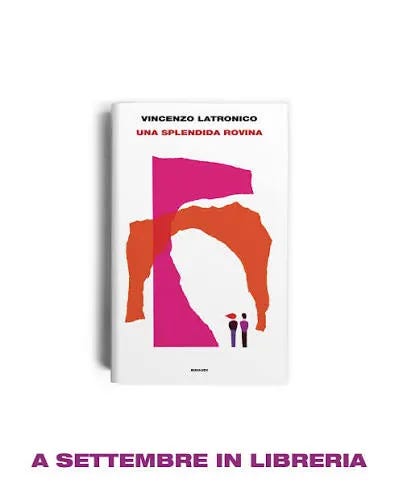
Editorial note: This is not a sponsored article or a commercial collaboration. Neither Vincenzo Latronico nor Einaudi has paid me to write it and, regrettably, they have not even given me a free copy of the book. I ordered Una splendida rovina myself out of curiosity and intend to read it when it is released.
The opening image accompanying this article was created using artificial intelligence; the cover of Una splendida rovina shown within the image is the actual cover of the book.
An Italian version of this article was first published by Esco Quando Voglio.
My book examining the reality and measurable results behind Italy’s one-euro-house phenomenon will be released in Italian in September 2026, and an English-language edition will also be available.