Dall’articolo dell’avv. Paolo Greco, esperto di diritto internazionale e sindaco di Caprarica di Lecce, una riflessione sul recupero degli immobili fatiscenti, sugli affitti transitori e su una nuova strategia per rigenerare i territori italiani
In un articolo pubblicato su In Puglia tutto l’anno, dal titolo “Quel patrimonio dimenticato. Gli immobili fatiscenti e le idee per la rinascita”, l’avv. Paolo Greco, esperto di diritto internazionale e sindaco di Caprarica di Lecce, affronta un tema che parte dal Salento ma riguarda, in realtà, una parte enorme dell’Italia: il destino degli immobili abbandonati, fatiscenti, collabenti, urbanisticamente complicati o semplicemente lasciati fuori da ogni funzione utile. Non parla soltanto di case vecchie, né di ruderi romantici da fotografare, né di borghi da trasformare nell’ennesima scenografia per visitatori di passaggio. Parla di un patrimonio edilizio dimenticato che, se resta vuoto, produce degrado, insicurezza, perdita di valore e impoverimento della vita comunitaria, ma che, se viene letto e governato con intelligenza, può diventare una delle leve più concrete per ricostruire abitabilità, lavoro, servizi e presenza nei piccoli centri.
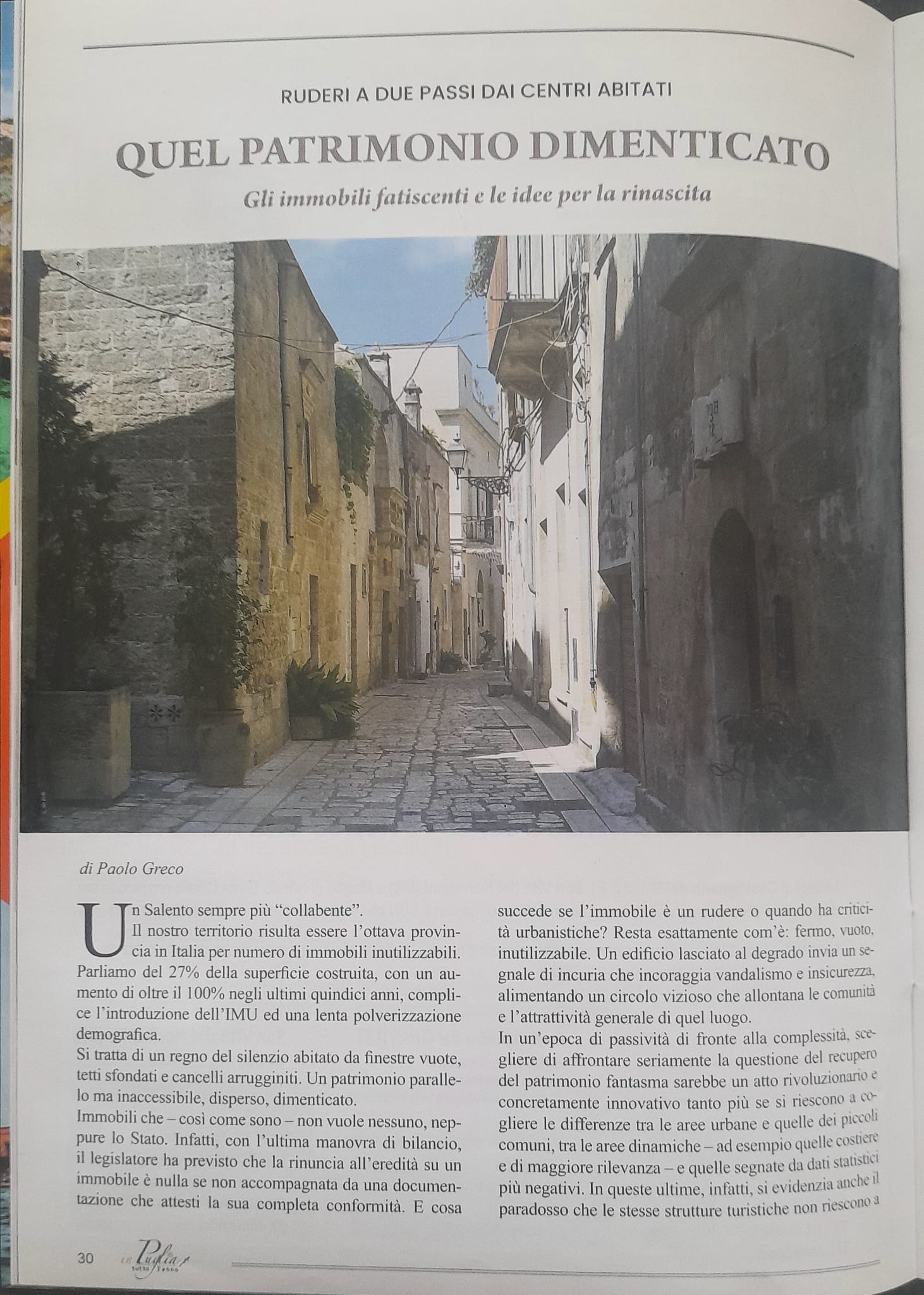
La forza dell’articolo di Greco sta proprio nel non trattare il tema come una questione puramente estetica. Una finestra chiusa, un tetto sfondato, un cancello arrugginito o un fabbricato che nessuno riesce più a usare non sono soltanto dettagli di paesaggio. Sono segnali di un sistema che si è bloccato. Un immobile abbandonato dentro o vicino a un centro abitato non è mai neutro: interrompe la continuità urbana, abbassa la percezione di sicurezza, scoraggia nuovi residenti, rende più fragile il commercio di prossimità, indebolisce la fiducia di chi vorrebbe investire e, in molti casi, impedisce persino di rispondere a bisogni abitativi molto concreti. Greco cita dati particolarmente significativi sul Salento, ricordando la forte presenza di immobili inutilizzabili e la crescita del fenomeno negli ultimi anni, ma il suo ragionamento va oltre il dato statistico. Il punto non è soltanto quanti ruderi ci siano. Il punto è che cosa producono quei vuoti quando vengono lasciati fuori da ogni progetto.
Uno dei passaggi più interessanti dell’articolo riguarda il rapporto tra patrimonio edilizio e vita reale dei territori. Greco osserva che non basta domandarsi quanti visitatori arrivino in un luogo, se poi non ci si chiede chi possa restare, dove possa vivere, a quali condizioni e con quali servizi. È un cambio di prospettiva importante, perché per troppi anni il discorso sui borghi italiani è stato costruito intorno a parole seducenti ma spesso poco operative: autenticità, bellezza, tradizione, lentezza, paesaggio. Tutte cose vere, naturalmente, ma insufficienti se non si traducono in case abitabili, contratti sostenibili, servizi accessibili, connessioni, manutenzione, opportunità di reddito e forme di presenza distribuite durante l’anno. Un paese non vive perché è bello. Vive se qualcuno lo usa, lo attraversa, lo abita, lo mantiene, lo racconta, lo lavora e lo sceglie non soltanto per un fine settimana.
È qui che la riflessione di Paolo Greco diventa particolarmente vicina al lavoro che ITS Italy ha deciso di sviluppare proprio in territori come Caprarica di Lecce, uno dei Comuni nei quali abbiamo scelto di investire. Caprarica non è interessante perché rappresenta un’eccezione pittoresca, ma perché rappresenta bene una condizione molto italiana: un piccolo centro con una forte identità locale, vicino a poli più grandi, inserito in un territorio ad alta attrattività, con un patrimonio edilizio sottoutilizzato e con la necessità di immaginare nuove forme di abitabilità che non siano né semplice residenza tradizionale né solo turismo breve. In luoghi come questo, il recupero degli immobili non può essere pensato come un esercizio immobiliare isolato. Deve diventare parte di una strategia più ampia, capace di collegare case, servizi, domanda reale, gestione professionale e obiettivi di rigenerazione.
Per questo pensiamo che il tema degli affitti transitori e di medio termine sia una delle chiavi più intelligenti su cui lavorare. Non perché il turismo breve non abbia valore, anzi: in molti territori continua a essere una componente fondamentale dell’economia locale. Ma il turismo breve, da solo, non basta a rigenerare un paese. Può portare reddito, può aumentare la visibilità, può aiutare alcuni proprietari a ristrutturare, ma rischia anche di concentrare tutto in poche settimane, di lasciare immobili chiusi per gran parte dell’anno e di trasformare i centri storici in spazi utilizzati più come prodotto che come luogo. Gli affitti transitori e di medio termine, invece, intercettano una domanda diversa: lavoratori stagionali che non trovano casa, professionisti che potrebbero vivere alcuni mesi in un territorio, imprese che hanno bisogno di sistemazioni temporanee per collaboratori e consulenti, famiglie che stanno valutando un trasferimento, studenti, ricercatori, lavoratori da remoto, persone che non vogliono semplicemente visitare un luogo, ma provarlo.
Questa distinzione è decisiva. Chi resta due, tre, sei o nove mesi non è un turista nel senso tradizionale. Compra nei negozi locali, usa servizi, chiama artigiani, conosce persone, frequenta bar e ristoranti anche fuori stagione, crea domanda di manutenzione, porta competenze, costruisce relazioni e, soprattutto, produce quotidianità. In molti piccoli centri italiani, la vera sfida non sarà soltanto aumentare il numero dei visitatori, ma trasformare una parte della presenza temporanea in quasi-residenza, cioè in una forma di abitare più leggera della residenza stabile ma molto più utile, continua e fertile del consumo turistico occasionale.
L’articolo di Greco è importante anche perché richiama la necessità di strumenti urbanistici più intelligenti e più aderenti alla realtà locale. Non tutti gli immobili sono uguali, non tutti i centri storici hanno gli stessi problemi, non tutte le aree rurali vanno trattate allo stesso modo, non tutti i fabbricati compromessi possono essere recuperati con la stessa logica. Greco parla, in sostanza, di una urbanistica di prossimità, capace di distinguere, semplificare, accompagnare e rendere possibile il riuso. È un punto essenziale, perché una parte del patrimonio dimenticato non resta ferma per mancanza di desiderio o di potenziale, ma perché l’incontro tra proprietà, norme, investimenti e destinazioni d’uso è troppo complicato. Proprietà frammentate, eredità bloccate, conformità urbanistiche incerte, costi di recupero non prevedibili, paura della gestione e assenza di modelli professionali finiscono per produrre immobilismo. E l’immobilismo, in un centro abitato, non è mai innocuo.
La questione, però, non è soltanto salentina. Il Salento offre dati molto interessanti e, in alcuni casi, molto preoccupanti, ma il tema è nazionale. Dalla Puglia interna alla Sicilia, dalla Calabria all’Abruzzo, dall’Appennino alla Toscana rurale, dalle Marche all’Umbria, fino ai piccoli Comuni vicini a città universitarie, aree produttive o destinazioni turistiche forti, l’Italia è piena di immobili vuoti in luoghi dove una domanda abitativa esiste già o potrebbe essere costruita. Il paradosso è evidente: ci sono case inutilizzate e ci sono persone che avrebbero bisogno di case; ci sono borghi che cercano nuove presenze e ci sono professionisti, lavoratori, famiglie e imprese che potrebbero usare quei luoghi in modo nuovo; ci sono proprietari che non sanno come recuperare o gestire i propri beni e ci sono investitori che spesso non trovano progetti ordinati, trasparenti e scalabili.
Per uscire da questo paradosso servono iniziative concrete.
La prima è una mappatura seria degli immobili recuperabili, non come inventario generico di ruderi, ma come strumento operativo capace di distinguere tra immobili immediatamente riattivabili, immobili recuperabili con interventi ordinari, immobili che richiedono operazioni più complesse e immobili che, almeno nel breve periodo, non hanno una reale sostenibilità tecnica o economica.
La seconda è la creazione di percorsi di accompagnamento per proprietari e investitori, perché il piccolo proprietario spesso non ha competenze, tempo o fiducia per affrontare da solo urbanistica, fiscalità, contratti, lavori e gestione, mentre l’investitore esterno rischia di leggere male il territorio se non viene inserito in una strategia locale chiara.
La terza iniziativa riguarda la costruzione di modelli professionali per l’affitto transitorio e di medio termine, con standard minimi di qualità, contratti chiari, manutenzione programmata, gestione degli ingressi e delle uscite, garanzie per i proprietari e servizi reali per chi arriva. Molti immobili non vengono rimessi sul mercato non solo perché sono da ristrutturare, ma perché chi li possiede teme problemi di gestione, danni, morosità, burocrazia e incertezza.
La quarta iniziativa è ragionare non sulla singola casa, ma su portafogli immobiliari diffusi. Una casa recuperata può essere un buon investimento; dieci, venti o trenta case recuperate e gestite in modo coordinato possono diventare una vera infrastruttura territoriale, capace di generare economie di scala, manutenzione più efficiente, promozione comune, servizi condivisi e un rapporto più solido con imprese, amministrazioni e comunità locali.
La quinta iniziativa, forse la più importante, è collegare il recupero immobiliare ai servizi. Una casa recuperata, da sola, non rigenera un paese. Una casa recuperata dentro una rete di mobilità, connessioni digitali, spazi di lavoro, artigiani, commercio locale, cultura, presidio amministrativo e servizi essenziali può invece diventare parte di un ecosistema. La rigenerazione non nasce dai muri, ma dall’uso dei muri. Non nasce dal fatto che un immobile sia tornato bello, ma dal fatto che torni utile.
In questo senso, il lavoro di Paolo Greco e il caso di Caprarica di Lecce ci interessano perché indicano una direzione concreta. Non una narrazione generica sui borghi, non una celebrazione del passato, non un invito a trasformare ogni pietra in prodotto turistico, ma un ragionamento più maturo su come il patrimonio dimenticato possa tornare a essere funzione, presenza, abitabilità e futuro. Da qui passa anche una parte del lavoro di ITS Italy: individuare immobili recuperabili, costruire modelli sostenibili, attivare investimenti intelligenti, sperimentare affitti transitori e di medio termine, collaborare con territori che non vogliono semplicemente essere guardati, ma tornare a funzionare.
La domanda decisiva, allora, non è soltanto quanti turisti arriveranno. È chi potrà restare. Non è soltanto quanto varrà una casa ristrutturata. È quanta vita produrrà. Non è soltanto come recuperare un rudere. È come trasformare il patrimonio dimenticato in una nuova infrastruttura dell’abitare.
Ed è per questo che l’articolo dell’avv. Paolo Greco merita attenzione ben oltre i confini del Salento. Perché racconta un problema locale, ma intercetta una questione italiana: il futuro di molti territori non dipenderà da una grande soluzione astratta, ma da molte operazioni precise, realistiche e coordinate. Recuperare immobili fatiscenti per renderli abitabili, utilizzabili e gestibili non è solo una scelta immobiliare. È una politica di territorio. E, se fatta bene, può essere una delle più intelligenti.

When Ruins Become Future: Paolo Greco’s Lesson on Italy’s Forgotten Property Heritage
Starting from an article by Avv. Paolo Greco, expert in international law and Mayor of Caprarica di Lecce, a reflection on derelict buildings, temporary and mid-term rentals, and a new strategy for regenerating Italian territories
In an article published in In Puglia tutto l’anno, entitled “Quel patrimonio dimenticato. Gli immobili fatiscenti e le idee per la rinascita”, Avv. Paolo Greco, expert in international law and Mayor of Caprarica di Lecce, addresses an issue that begins in Salento but in reality concerns a very large part of Italy: the future of abandoned, derelict, collapsing, planning-trapped or simply unused buildings. He is not merely writing about old houses, romantic ruins to be photographed, or villages to be turned into yet another backdrop for passing visitors. He is writing about a forgotten property heritage which, if left empty, produces decay, insecurity, loss of value and a weakening of community life, but which, if understood and governed intelligently, can become one of the most concrete levers for rebuilding liveability, work, services and presence in smaller towns.
The strength of Greco’s article lies precisely in the fact that it does not treat the issue as a purely aesthetic one. A closed window, a collapsed roof, a rusty gate or a building that no one can use any longer are not simply details of the landscape. They are signs of a system that has become stuck. An abandoned property within or near an inhabited centre is never neutral: it interrupts urban continuity, lowers the perception of safety, discourages new residents, weakens local commerce, undermines the confidence of those who might invest and, in many cases, even prevents territories from responding to very practical housing needs. Greco quotes particularly significant data on Salento, pointing to the strong presence of unusable buildings and the growth of the phenomenon over recent years, but his reasoning goes beyond statistics. The issue is not only how many ruins there are. The issue is what those empty spaces produce when they are left outside any project.
One of the most interesting passages in the article concerns the relationship between property heritage and the real life of territories. Greco observes that it is not enough to ask how many visitors arrive in a place if we do not also ask who can stay, where they can live, under what conditions and with which services. This is an important shift in perspective, because for too many years the conversation about Italian villages has been built around seductive but often weakly operational words: authenticity, beauty, tradition, slowness, landscape. All of these things are true, of course, but they are not enough unless they become habitable homes, sustainable contracts, accessible services, connections, maintenance, income opportunities and forms of presence spread throughout the year. A town does not live because it is beautiful. It lives if someone uses it, crosses it, inhabits it, maintains it, tells its story, works in it and chooses it for more than just a weekend.
This is where Paolo Greco’s reflection becomes particularly close to the work that ITS Italy has decided to develop in territories such as Caprarica di Lecce, one of the municipalities where we have chosen to invest. Caprarica is not interesting because it is a picturesque exception, but because it represents very well a deeply Italian condition: a small town with a strong local identity, close to larger centres, located in a highly attractive territory, with underused property heritage and with the need to imagine new forms of liveability that are neither traditional permanent residence nor short-term tourism alone. In places such as this, the recovery of buildings cannot be treated as an isolated property exercise. It must become part of a wider strategy capable of connecting homes, services, real demand, professional management and regeneration objectives.
This is why we believe that temporary and mid-term rentals are one of the most intelligent keys to work on. Not because short-term tourism has no value; quite the opposite. In many territories, it remains a fundamental component of the local economy. But short-term tourism alone is not enough to regenerate a town. It can bring income, increase visibility and help some owners renovate, but it may also concentrate everything into a few weeks, leave properties closed for much of the year and turn historic centres into spaces used more as a product than as a place. Temporary and mid-term rentals, on the other hand, intercept a different demand: seasonal workers who cannot find accommodation, professionals who could live in a territory for several months, companies needing temporary housing for collaborators and consultants, families considering relocation, students, researchers, remote workers and people who do not simply want to visit a place, but to test it.
This distinction is crucial. Someone who stays for two, three, six or nine months is not a tourist in the traditional sense. They shop locally, use services, call craftsmen, meet people, go to cafés and restaurants outside the peak season, create demand for maintenance, bring skills, build relationships and, above all, produce everyday life. In many smaller Italian towns, the real challenge will not only be to increase the number of visitors, but to turn part of temporary presence into near-residence: a way of living that is lighter than permanent residence but much more useful, continuous and fertile than occasional tourist consumption.
Greco’s article is also important because it recalls the need for planning tools that are more intelligent and more closely connected to local reality. Not all properties are the same, not all historic centres have the same problems, not all rural areas should be treated in the same way, and not all compromised buildings can be recovered with the same logic. Greco is essentially calling for proximity-based urban planning, capable of distinguishing, simplifying, supporting and making reuse possible. This is essential, because part of the forgotten property heritage remains stuck not because there is no desire or potential, but because the meeting point between ownership, rules, investment and use is too complicated. Fragmented ownership, blocked inheritances, uncertain planning compliance, unpredictable recovery costs, fear of management and the absence of professional models all produce paralysis. And paralysis, in an inhabited centre, is never harmless.
The issue, however, is not only about Salento. Salento offers very interesting and, in some cases, very worrying data, but the theme is national. From inland Puglia to Sicily, from Calabria to Abruzzo, from the Apennines to rural Tuscany, from the Marche to Umbria, and even in smaller municipalities close to university cities, productive areas or strong tourism destinations, Italy is full of empty properties in places where housing demand already exists or could be created. The paradox is clear: there are unused houses and there are people who need houses; there are villages looking for new presences and there are professionals, workers, families and companies that could use those places in a new way; there are owners who do not know how to recover or manage their assets and there are investors who often cannot find orderly, transparent and scalable projects.
To escape this paradox, concrete initiatives are needed. The first is a serious mapping of recoverable properties, not as a generic inventory of ruins, but as an operational tool capable of distinguishing between properties that can be reactivated immediately, properties that can be recovered through ordinary works, properties requiring more complex operations and properties that, at least in the short term, do not have real technical or economic sustainability. The second is the creation of support pathways for owners and investors, because small owners often do not have the skills, time or confidence to deal alone with planning, taxation, contracts, works and management, while external investors risk misunderstanding the territory if they are not inserted into a clear local strategy.
The third initiative concerns the construction of professional models for temporary and mid-term rentals, with minimum quality standards, clear contracts, planned maintenance, check-in and check-out management, guarantees for owners and real services for those who arrive. Many properties are not returned to the market not only because they need renovation, but because their owners fear management problems, damage, arrears, bureaucracy and uncertainty. The fourth initiative is to think not in terms of a single house, but in terms of distributed property portfolios. One recovered house may be a good investment; ten, twenty or thirty recovered houses, managed in a coordinated way, can become a true territorial infrastructure, generating economies of scale, more efficient maintenance, common promotion, shared services and a stronger relationship with companies, administrations and local communities.
The fifth initiative, perhaps the most important, is to connect property recovery to services. One recovered house alone does not regenerate a town. A recovered house within a network of mobility, digital connections, workspaces, craftsmen, local commerce, culture, administrative presence and essential services can instead become part of an ecosystem. Regeneration does not come from walls. It comes from the use of walls. It does not come from the fact that a building has become beautiful again, but from the fact that it has become useful again.
In this sense, Paolo Greco’s work and the case of Caprarica di Lecce interest us because they indicate a concrete direction. Not a generic narrative about villages, not a celebration of the past, not an invitation to turn every stone into a tourism product, but a more mature reflection on how forgotten property heritage can become function, presence, liveability and future. This is also part of ITS Italy’s work: identifying recoverable properties, building sustainable models, activating intelligent investment, experimenting with temporary and mid-term rentals, and collaborating with territories that do not simply want to be looked at, but to function again.
The decisive question, then, is not only how many tourists will arrive. It is who will be able to stay. It is not only how much a renovated property will be worth. It is how much life it will produce. It is not only how to recover a ruin. It is how to turn forgotten property heritage into a new infrastructure for living.
This is why Avv. Paolo Greco’s article deserves attention well beyond Salento. Because it describes a local problem, but captures an Italian question: the future of many territories will not depend on one grand abstract solution, but on many precise, realistic and coordinated operations. Recovering derelict buildings to make them habitable, usable and manageable is not only a property strategy. It is territorial policy. And, if done well, it may be one of the most intelligent.