


This is not a celebration of village life. It is the story of what happens when, for a few hours, a tiny village rediscovers somewhere to be together - and then, a few days later, wakes up after months of heat to rain, silence and no electricity.
Before someone serves me with some sort of penalty notice for the unauthorised romanticisation of village life, a disclaimer.
I am not particularly inclined to romanticise life in small Italian villages. Quite the opposite. If I had to choose a soundtrack for the aree interne, Italy’s inland and increasingly depopulated areas, I would probably go for fewer church bells at sunset and considerably more swearing in dialect: when a service disappears, the electricity goes off, someone who was supposed to turn up does not, you have to drive fifty kilometres to sort out something that would take twenty minutes in a city, or you find yourself - together with the other handful of unfortunate souls still around - digging, carrying, repairing or organising things that technically should not be your responsibility at all.
So we can spare ourselves the authentic village, slow living, the smell of freshly baked bread, the wisdom of the elderly and the rest of the gift-wrapped package.
Villages also contain dust, empty houses, disappearing services, ageing populations, petty feuds that often survive even the memory of what started them, and a quite astonishing number of practical problems per hundred inhabitants.
And, to be fair, the criticism of the romantic rhetoric surrounding Italian villages gets one important thing right: turning abandonment into a pretty photograph is not merely silly. It is fairly insulting to the people actually living through it.
That said, this morning it is difficult not to allow oneself a few minutes of Leopardi.
Because in less than a week this tiny village in the Maremma has somehow managed to stage first Il sabato del villaggio - Saturday in the Village - and then La quiete dopo la tempesta - The Calm After the Storm.
Entirely by accident, obviously.
Had we proposed it as a cultural project, probably nobody would have come.
It all started with a terrace.
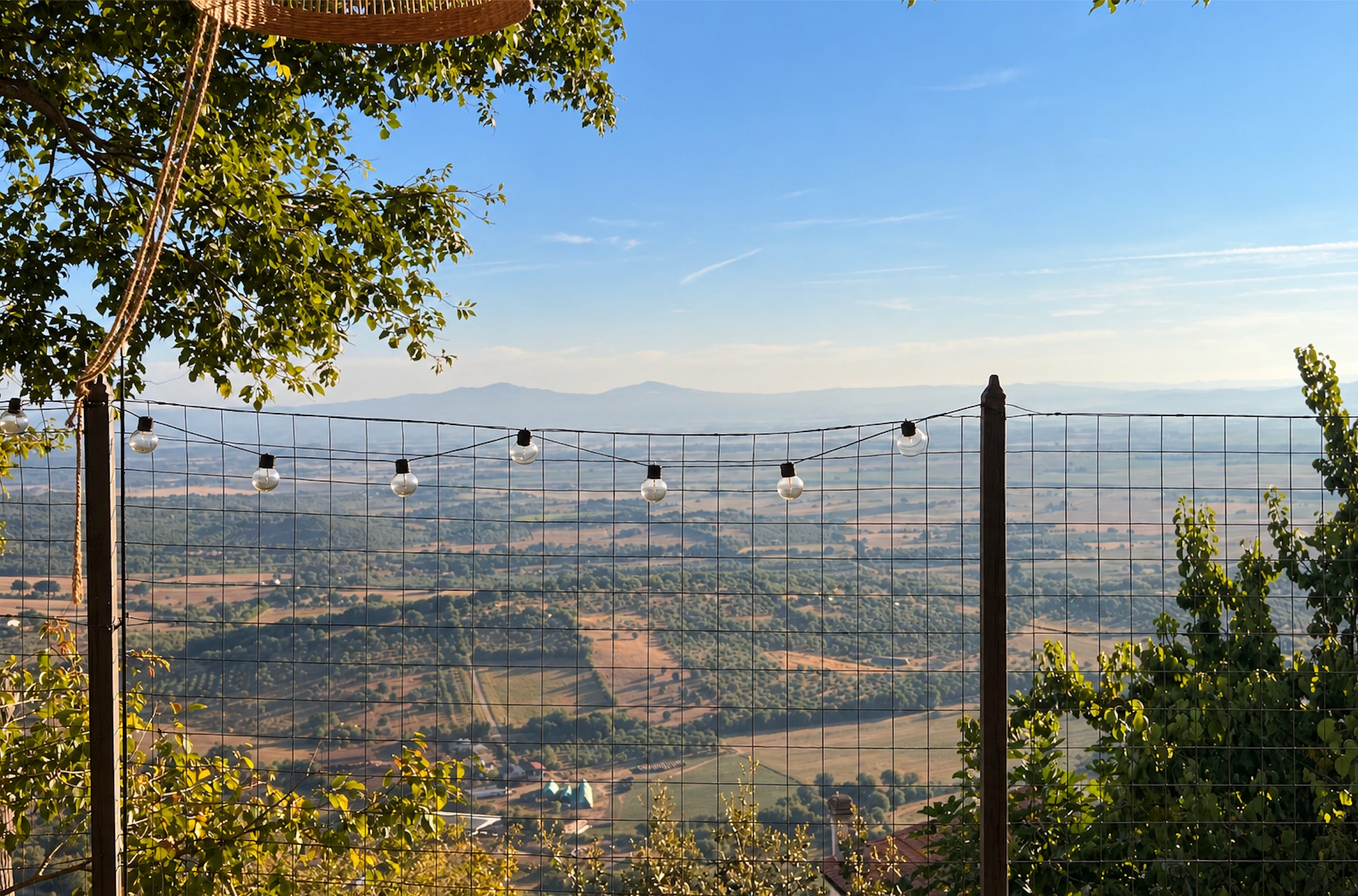
We are finishing a house which will shortly be handed over to its new owners, who will come and live here. Before doing so, we thought it would be nice to inaugurate its terrace overlooking the Maremma and, for one evening, give the space back to the village.
No event. No sagra, the traditional village fête invariably accompanied by some vague promise of raising money - for whom, exactly? No stage. No printed programme. No municipal patronage. And above all no project with a title such as “Resilient Territories: New Practices of Social Interaction in Italy’s Inner Areas”.
Just a little party.
Something to drink, something to eat, a few people from the village, a finished terrace and a view which, to be fair, does most of the work without even sending an invoice.
Except that roughly one hundred people live here.
When fifteen of them turn up, statistically speaking you have not organised a small party. You have practically won an election.
I will not even go into the demographics of the guests because the gathering could have been used as a textbook example of a perfect diversity mix by gender, race, age and economic status.
The most interesting part, though, was not even the evening itself.
It was the anticipation.
Over the previous few days we had begun to notice the sort of tiny agitation that becomes immediately visible in places this small. Someone asking what they could bring. Someone volunteering food. Someone else becoming deeply invested in the responsibility of reheating a dish and stopping me twice a day for logistical updates. Someone bringing a bottle. Someone wanting to know exactly what time. Someone even wondering what to wear.
And then there were those who appeared not to be remotely interested but somehow possessed impressively detailed information about the entire operation.
People passed by. People leaned out of windows. People asked questions.
Everyone was also rather amused that, in a reckless breach of local protocol, the only person not invited was the self-appointed queen of the village fête - a woman who lives here mainly in summer, when there are events to organise and opportunities to feel in charge. A sort of local bully whom people are slightly afraid of and whose little impositions they have learnt to tolerate.
She lives above us and has attempted various small acts of village terrorism since the day we arrived.
We ignored them.
The fact that something was happening without her at the centre of it - and that she had failed to sabotage it - appears to have caused a certain amount of distress. She has barely been seen for a week.
Had Leopardi been here, he would probably have started taking notes.
Because the real point of Saturday in the Village is not the celebration itself. It is the anticipation of the celebration.
Saturday is better than Sunday because Sunday has not happened yet and can therefore still contain everything we imagine it might be.
Something similar happened here. For a few days, the little party existed before it actually took place. It had given people something very small, but apparently not very common, to look forward to.
And something positive.
I do not want to exaggerate this either. Fifteen people bringing salami, wine and cake do not automatically constitute a resilient community. Nobody has defeated depopulation with a bottle of wine.
Local GDP is unlikely to register the event.
But something did happen.
For a few hours, a private space became somewhere people could meet. And in a village with very few - perhaps almost no - places where people can simply gather, that is not entirely insignificant.
Something else happened too.
Some of the local fault lines which, in villages, can achieve levels of cartographic precision worthy of an international border appeared temporarily to disappear.
This one does not speak to that one. That family had an argument with the other family. Someone has not greeted someone else for twenty years for reasons nobody can now quite remember.
Only one person remained behind closed shutters watching us, talking irritably to someone on the telephone about the outrage taking place below.
Everyone noticed.
And, to be perfectly honest, enjoyed their five minutes of genuine pleasure.
Part of the problem is that anyone who might normally organise something is already embedded in this geography: friend of one person, enemy of another, cousin of a third, morally indebted to a fourth.
We had one enormous advantage.
We did not know enough about the local geopolitics.
Or, at the very least, we did not care.
So we invited people whom someone more knowledgeable might have carefully avoided putting together.
And, in a shocking display of disrespect towards decades of village diplomacy, they came anyway.
They brought things. They ate. They drank. They talked. They sat on a terrace overlooking the Maremma which, for one evening, became something like an elevated village square.
Then everyone went home.
No anthropological miracle occurred. I assume most of the old hostilities were fully operational again by breakfast.
And that is precisely why the evening was interesting. There is no need to attribute miraculous powers to it to recognise that, for a few hours, it simply worked.
Indeed, throughout the following day there was one recurring question:
“When are we doing it again?”
A question addressed, in fairness, far more often to my wife - by now clearly recognised as the actual authority - than to me.
Apart from definitively settling the question of hierarchy within our marriage, it perhaps said something about the night before. It had not merely been pleasant. It had left people wanting another occasion.
Then came the second question:
“So, do you live here?”
After nearly three months, we have effectively become a sort of externality - hopefully a positive one - in village life.
I have supplied IT support to elderly ladies and their PCs and have apparently been elected Dog Walker of the Year.
And whenever we explain that the work which originally brought us here might now be almost finished, faces immediately fall.
So we quickly explain that no, this may not be the end. We will be back. There are other projects nearby. And, whether we intended to or not, we have put down a few roots ourselves.
“Don’t just visit, belong!” is something we have been telling other people for years.
It would be rather embarrassing to discover that we are incapable of following our own advice.
The truth is that we will return, but we are also expected elsewhere.
And I admit that this gives me a small, slightly ridiculous sense of pride, despite the fact that over these three months I have developed a profound hatred for certain very specifically Maremman characteristics.
I am beginning to feel a little like Nanny McPhee.
I even have the little British car to complete the part.
“When you need me but do not want me, I must stay; when you want me but no longer need me, I must go.”
One hopes, of course, always to reach the second part.
Because that should be the point: leaving behind something that carries on after you move on.
Then, a few days later, came the storm.
A proper end-of-the-world sort of storm.
After months in which even the ground seemed to have stopped expecting rain, it finally arrived. Thunder, wind, water and that almost physical sensation of the air changing after weeks spent wondering whether it was possible to sweat while remaining completely motionless.
Naturally, the electricity went off.
For hours.
Because, as I said at the beginning, Leopardi is all very well, but the electricity network retains a right of reply.
And this morning the village woke into an almost surreal silence.
Anyone who actually lives in the countryside knows that the silence of the countryside does not really exist.
It is largely an urban invention.
The countryside is normally incredibly noisy. Birds, tractors, strimmers, dogs, engines, insects and, around here, the more or less continuous buzz of wasps and Vespas.
The winged ones and the Piaggio ones.
Minor variations on the same acoustic principle.
This morning, nothing.
For a while even the insects appeared to have disappeared — which, considering I have just spent a small fortune on new windows with insect screens, I found personally irritating.
Neither the biological nor the mechanical ones.
Empty streets. Almost all the windows closed. Nobody around. Wet earth and a silence so unusual that it felt almost artificial.
And then, slowly, The Calm After the Storm began.
One window. A woman looking out. Another door opening. Someone appearing in the street. Two people finally stopping to talk.
And then the sentence that inevitably had to come:
“Oh, finally.”
Finally, rain. Finally, we can breathe. Finally, a little cool air.
Leopardi argued that this was precisely the trick. Pleasure arrives when something unpleasant stops: his famous piacer figlio d’affanno, pleasure born of suffering.
We are not happy because something extraordinarily wonderful has happened. We are happy because something we could no longer bear has finally ended.
After months of heat, this fairly substantial philosophical concept was being demonstrated this morning with remarkable efficiency by several ladies leaning out of their windows.
And so here we are.
In less than a week: first the anticipation of a small party, then the party itself, then the storm and finally this strange, cool, silent morning in which the village seems to be reappearing one inhabitant at a time.
I do not think any of this proves that life in small villages is better.
It is not, necessarily.
Nor does it prove the existence of those organic, mutually supportive, naturally happy communities so beloved of a certain literature about Italian villages.
Real communities are considerably less photogenic. They argue, divide, gossip, help one another, ignore one another, suddenly cooperate and then perhaps go back to arguing.
Exactly like every other human community.
If anything, these past few days suggest something much less romantic and perhaps more useful: social life is infrastructure too.
A village can have one hundred inhabitants and almost nowhere for those one hundred people simply to meet.
It can have houses, roads and a spectacular view and still be desperately poor in opportunities to come together.
A terrace opened for one evening does not save a village, obviously.
But it can show how remarkably little is sometimes required to change, temporarily, the way a place is lived.
That interests me far more than the argument over whether villages are wonderful or terrible.
The opposition between the postcard village and the village of abandonment risks producing two equally static pictures.
Real villages are more inconvenient than that, because they contain both at the same time - and much else besides.
Here, electricity and services can disappear with infuriating ease. And when there is no electricity, the Wi-Fi dies, the phone already barely works and my eyelid begins to twitch.
You can find yourself doing jobs which elsewhere somebody would be paid to do.
You can genuinely wonder what the hell you are doing here.
And then, one evening, fifteen people out of a hundred voluntarily bring food to a terrace and, without anyone designing a “community-building initiative”, spend a few hours building one.
This morning, meanwhile, the silence continues. The ladies have slowly started appearing in the street. The wasps are presumably assessing conditions. The Vespas, knowing them, will be back shortly.
I still have no intention of romanticising village life. At least I now know the insect screens will come in useful.
But today, allow me Leopardi.
And the forecast says rain and thunderstorms for another three days.
PS: We also organised a darts tournament during the party - just to add a touch of English pub culture. Your correspondent comprehensively defeated the natives.
The Italian version of this article was published in Esco quando voglio.

“Resilient Territories: New Practices of Social Interaction in Italy’s Inner Areas”.
Ouch. Would you like to join our advisory board?
Great story, and if I had any authority whatsoever I would authorize you to romanticize.