


We’re pleased to welcome Peter Benei | Anywhere Italy, to our pages with a reflection sparked by our recent piece, “I borghi non sono panda.”
Peter chose Italy, lives and works here, and has actually spent months living in some of those small villages everyone talks about “saving”. His is a tough, sometimes deliberately cynical take - one we publish unfiltered, and with gratitude.
It may not be the final word on the subject. But it is a lucid, uncomfortable and valuable perspective worth hearing. - Matteo Cerri, Editor in chief of ITS Journal and Cofounder of ITS ITALY.
This article might piss some people off, but hey, I’m just a straniero, so feel free to dismiss anything I write about this on the baseline that I am not even Italian. I can promise you, I will sleep just fine.
So there is a big talk. There has been a big talk about this topic: saving Italian communes that are dying out because people either leave them or the old population simply dies out there, turning these into empty places. It’s basically about stopping towns from becoming ghost towns. Everyone has ideas on the how, but only a few of them look at the why. Why are these towns becoming empty in the first place?
I recently had the chance to read Matteo Cerri’s piece, Borgos are not pandas, on ITS Journal. I know Matteo lives in a small village (note from Matteo Cerri: I actually live in several small Italian villages and London - YES I am a sort of rural digital nomad), so I trust whatever he writes on this topic more than naive urban planners from Milano, or anyone who’s talking about 1 EUR houses from an armchair in Texas.
To pull out some street cred, though I have very little as a foreign immigrant here, I guess, I have to show you a photo:
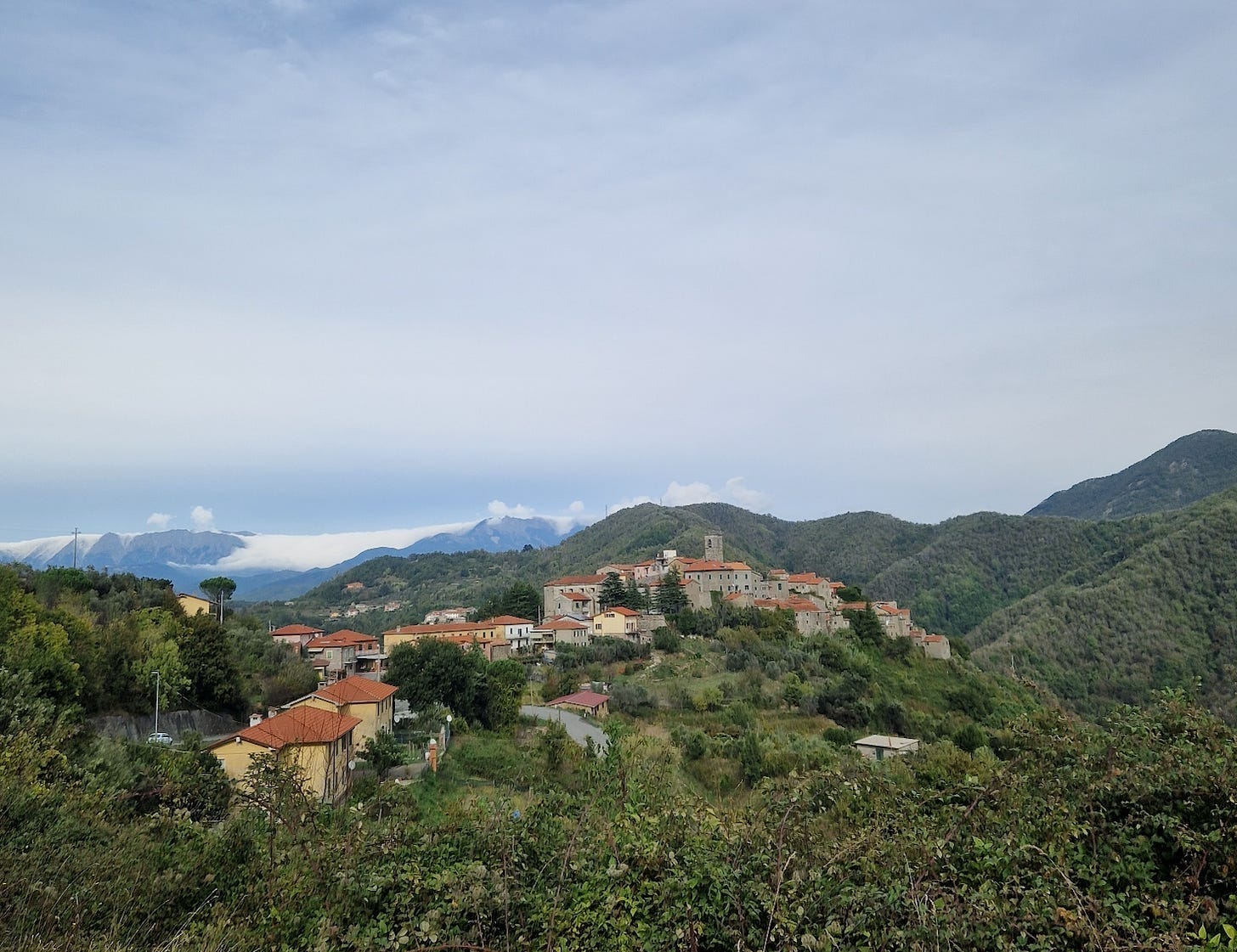
This is Marciaso. We lived here for months. I wrote about this and the surrounding region called Lunigiana here, and there is also an entire guide written about the Apuan Alps, the wider region of this place. It’s an old borgo (medieval village) that sits on a rock, about 400 meters above sea level, in a small valley between mountains. It’s a frazione of Fosdinovo, which means Fosdinovo is a real town with a real council and somewhat real services, while Marciaso is just a place administered by Fosdinovo’s council.
And before you jump out of your chair and expect Fosdinovo to be a bustling city, this is Fosdinovo:
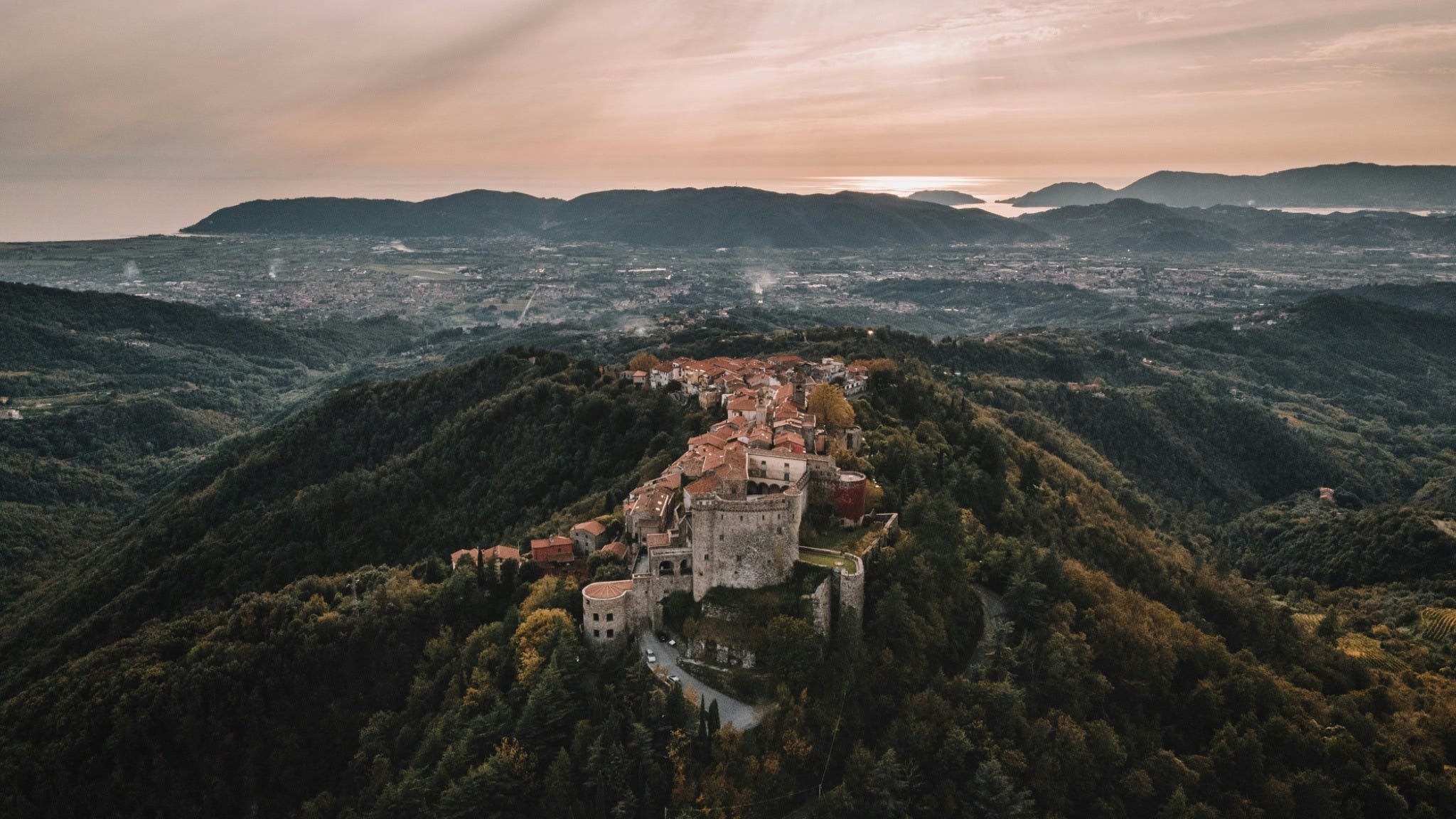
It has a castle. One more church than Marciaso. And a bit more people with a bit more houses. Also services, I imagine they are working.
So, on that street cred, I might not have an urban planning background (though I studied sociology and history at uni, if that matters, and urbanism was one of my classes), but unlike most people who rave about saving these places, I actually lived in one of them. I need to talk a little more about Marciaso, because my experiences serve as the base for most of my arguments here. This won’t be a travel piece, that’s already written.
Before Marciaso, quick stuff about the POV I have. My wife and I are the ones most people would call digital nomads, though personally I can’t describe how much I hate this term. Let’s just say that we work online (marketing and design). In practical terms, it means we have no connection whatsoever to a country’s job market (aside from the market conditions of North America, where all our clients are from). We are originally Hungarians, if that means anything here. I’ve been working online since way back in 2014, before it was cool. We also don’t have kids. All in all, I am telling you this to back up one statement: we can live anywhere in the world, and we chose Italy as our home. Since then, we have also acquired residency, and I moved my online business to Italy, so I pay taxes here, which alone is a much more painful story than this “save the whales” villages one. Also, Italians, anyone who says I am not contributing to this country, please, just don’t. I contribute as much as any bloke who lives, works, and shops here.
So. With that out of the way, let’s talk about Marciaso. We traveled across the entire country, lived in Florence, Palermo, Calabria, and, please don’t hate me Italians, but we also lived for almost a year in Rome. I know. I feel you. After all this running around, we moved to Marciaso for two reasons. First, we had some family tragedies, so we simply wanted something quiet, reserved, relaxed, and off the map. Honestly, that was the main driving point, aside from the fact that the Airbnb was cheap. Second, we always wanted to live in a secluded mountain-top village in Italy. I don’t know why, it was just a thing we wanted to do once in our lifetime. We figured, we work online, we need space and silence, what could go wrong?
Everything went wrong. And this is what most people who talk about saving these villages don’t understand, because they never lived there. Maybe their grandma lives there, and they visit her. Maybe they lived there when they were kids and life was simpler. But I bet that most people who talk about this topic are exactly the ones fighting for political and social causes from their comfy armchairs with family funds.
The village had nothing to offer anyone, except the very basics of services, and even those were pushed to their limits. Let’s go one by one:
Sewers were overflowing after one heavy rain. We were there in October, rainy season. Also, good luck leaving the village on the winding roads during heavy rain. There was a week when we were stuck inside.
There was no grocery shop. There was a truck parked in front of the church that came up selling cheese, bread, and cold cuts every Tuesday.
No cleaning whatsoever. There was trash collection, though, but you had to walk to the small piazza to bring your bags. Not a problem for us, but imagine I’m 75 and it is raining, and the streets are made of slippery stone.
Most of the buildings in the borgo were abandoned. Zero maintenance meant zero protection from falling debris off old stone houses. Some houses had dead animals inside, which we knew only because of the smell.
Almost zero mobile signal and almost unusable internet. I don’t know why, but we always had electricity, yet the internet broke almost 10 times per day. And you want to transform these villages into digital nomad hubs?
Zero hospital, clinic, family doctor, dentist, nothing. Again, it’s OK for us, though accidents can happen, but most people who live in these places are 60+ with health issues. And if you call for an ambulance? First off, no signal, so good luck, but if you manage, it takes probably an hour or more to arrive at your door.
Forget moving in or transporting anything. Yes, most small Italian towns have narrow streets, that’s why the Piaggio Ape is a thing around here. But borgos like this have uneven stone streets, stairs everywhere, zero accessibility. You park your car down below on the only piazza (Marciaso had one, some don’t even have any) and you walk. You want to design your own home, move furniture, or do construction work? GL!
Wildlife. I mean, nature is taking these places back already. It has its charm, yes, wild grapes running everywhere, tree branches growing out of buildings. But wait until a spider the size of your fist starts crawling in your kitchen. Or a gecko the size of your arm runs across your ceiling. You could insulate the windows and put up nets, right? But then again, look at the previous point.
But above all of these, the worst of the worst is the unspoken horror of all of these places: the mold. It’s everywhere. No point fighting it. It’s behind every piece of furniture. It’s in your air conditioning unit (if you have any). It’s in every corner. It’s under your bed. Most of the houses don’t even have interior paint, it’s just the stone. Even if they have any, the paint is at least 50 years old. A full renovation and repaint would solve this, yes, but then... Look two points above.
I’m sure I forgot something else, but let’s stop here. In return, you get a shorter list:
It’s unbelievably quiet. Seriously. It’s like an isolation chamber. We wanted this and it kept us there for a couple of months.
Nature is magnificent. The panoramic views from our place were unforgettable.
It has its vibe. We surely enjoyed it for the first couple of weeks. It was fundamentally different from any way we have ever lived. I guess this is how it would feel to live on a small, almost uninhabited island.
It’s cheap. There was one bar, open only on Saturdays (sometimes), selling some cooked food for hikers around the area. Dirt cheap. Housing is super affordable too, our Airbnb was pretty cheap, and we had an entire stone house for ourselves.
Once you are off the winding roads, you are reminded that you are in Italy. In our case, a 30-minute drive got us down to Carrara, and from there it was wide-open Versilia and Tuscany. So you are isolated, but once you are out, you are probably in a place that makes people cross entire continents to see and experience.
Now that you know, let’s enter the discussion. If I had god-like powers, how would I save Marciaso?
Because Marciaso needs saving. We didn’t count, but I would guess more than half of the houses were empty. It is an old borgo, with one road, circling around a bell tower, which is not operational. There was an old lady living in the middle of the borgo, some old couples in the houses, our host Marco who rented out three houses next to each other to hikers and weirdos like us, and there were like two or three actual families, but they lived outside the borgo, in modernish houses. Give or take, 50 people, tops. In about 20 years, this will be down to 10 or fewer. The church was never open, which in Italy means the village has no future.
How to save a failing village?
Well, let’s run through the usual answers.
I am trying not to laugh, but there is this option of turning the village into a hub for innovation, remote work, and a lifestyle location for digital nomads. Co-living, co-working, and let’s also have a festival, or even better, a conference here.
I’m not entirely sure I need to explain why this is an idea coming from people who never spent a minute in a place like this, but let’s stay on course and treat it as a serious answer.
Like Marciaso, most of these villages have no infrastructure to support this idea. Some of them fail to support the very basics for their residents, see my examples. It’s almost impossible to live in these places. Anyone who lives in these places probably lives there because they have lived there their whole life, so I don’t know, they adapted and got used to it, or they are newcomers, like our host Marco, but it is very clear that these people are choosing this life because all the other choices are exhausted. Marco was a construction worker who got paid nothing. He probably inherited some of these houses and was smart enough to put air conditioning in them, list them on Airbnb, and earn a living from that, while he lived in one of the smaller houses, mostly playing video games (true story).
Also, look at the market. Let’s say you are miraculously able to secure the place, make it habitable for young people who want modern infrastructure, and God knows how, but you build out this infrastructure: internet, basic shopping, and an environment that is clean, safe, and won’t fall on your head. Now people can rent these stone houses up in the mountains of Italy for 800 EUR per month.
I hate to break this down for you, but this is exactly the price that buys you an entire 4-bedroom modern villa, with a pool, a maid, a gardener, and absolutely flawless infrastructure, probably near or by the beach in Bali. Or, this is the price of a penthouse with an infinity pool in the center of any Southeast Asian capital. Or OK, you prefer the New World, this is the price of a massive apartment in downtown Buenos Aires. And I’m picking randomly here, not even venturing to exotic places like Uruguay or Chile, or even Mexico.
Do you think people would pick a no-name town in the Italian mountains that is not even close to the dreamy landscapes of Italy? Oh, and you expect them to have a car, because without one, you are simply dead here?
So, no, nomads are not a solution here. So how about attracting expats who will genuinely live there, or at least have a vacation home there? The 1 EUR houses. The renovation dreams you saw on YouTube. The guy from Arizona who got his hands on a cheap house and turned it into a home for pennies. The girl who painted the attic of the stone house by hand. We have all seen this. Some of these stories are true. I personally know many people who did this. I recently bought property in Italy myself, and I bought a penthouse apartment in a Turin condo. Zero renovation required. Because I know what you might not know about these stories. So let me help you out:
Regardless of the story, all of them require cash-heavy funds. Depending on the scale of the project and your personal involvement in doing the labor, expect a quarter of a million to a million in cash. I know this might still count as affordable for you, dear someone from Atlanta or New York or London, but here, this is a sum that is rarely available in full at your disposal. So you will be viewed and treated as a cash cow by everyone who will “help you out” on this self-discovery renovation journey.
You will need either a fixer or someone who helps you out with Italian things. Your lawyer in Rome or Milan will speak English, yes, if you are lucky. If you are even luckier, your lawyer will actually do the job and not just bill you for the hours. Providing service is a whole other level in this country, and most people (including Italians, who sometimes have no idea what basic service standards are for, like, anything) have no idea. And your renovation crew up in the mountains? I mean, I wish the best of the best for you, honestly. I hope they show up. I hope at least one of them will talk to your fixer (who speaks Italian). I hope they will do what the contract says. I hope they will do it in time. Let me just tell you that I have heard many stories. Exactly zero of them were fairy tales, and 99% of them were massive horror stories.
You should be aware that most of the government-funded projects, like the famous 1 EUR housing, force you to do things in a certain way. The conditions are things like: you have to legally live there, or you have to renovate in a certain way, or you can only use the finished place in certain ways, and so on. And I can’t highlight enough how unimaginably difficult it is to deal with Italian councils and anything paperwork-related. Not just the fact that no one speaks anything but Italian, that’s the basic problem. But even if they do, the way and speed things move forward is fundamentally different from anything I can promise you. By the way, there are many projects, just in Tuscany there are houses in these villages you can buy for a couple of thousand euros, but all of them come with a Bible-long list of rules.
Even if you succeed, because you are that one miracle child, that prodigy and wonderboy, you still live in a town that is dying out and has all the problems I listed above.
Want a renovation project still? I know some dream stories too. Pick a stone house in the countryside, without a village, or an old villa in a city, buy a nice big truck, hire a lawyer and a fixer who manages the entire project, allocate half a mill, and live the dream. You will either end up with a wonderful agriturismo or farmstay, or a small palazzo fully modernized in a liveable city like Lucca or Pisa. This route is doable and enjoyable. But the stone house in a ghost town that the country gives you so they don’t need to pay to demolish it? Not a route you want.
Oh, and for those of you real estate speculators. I just buy a 1 EUR house, throw 150K on it, cool, then I sell it for 200-300K to a clueless Texan. Yeah, good luck selling a house in a town that has 5 stray cats and 10 grannies, with basically zero infrastructure. Send me the sales receipt, I’ll personally buy you a bottle of prosecco.
OK, next. Oh, those visa and tax break incentives, those will save these towns! Like the 7% flat tax if you retire into a small southern commune, and so on. The problem with these is that they might be helpful for the country as a whole, but no one could give a flying f about the dying villages.
Do you really think that Jimmy, who moves his entire life, with kids, wife, and 1M in the bank, wants to live in Marciaso? At best, he might start a business here, and some jobs and taxes come with him. That counts for something. But in most cases: it’s only the taxes. No jobs are created, because most expats employ other expats, and work with Italians only if it is absolutely unavoidable. I know, sorry, read any expat forums.
Jimmy will pick up only the incentives, then casually drop his pin in the closest dreamy town to an international airport. And who could blame him? I would do the same. Hell, I did the same when I moved to Pietrasanta (Pisa airport is 30 minutes), or now that I am moving to Turin.
Last, tourism and culture as solutions. Let’s stick with Marciaso, just for the sake of argument. I worked two decades in advertising and spent years at agencies in London and the US, so please allow me to dust off my creativity, and let us all have a big-ass whiteboard in front of us. Now let’s grab that bulky red marker, slurp down our Americano, and start.
How about a film festival on the piazza? Let’s convert the church into a cinema! The local bar sells rabbit stew (true story), how about organizing a Coniglio e Porcini festival, bunny and mushrooms, all local, we can have hundreds of people visiting. Or, we contact all the location scouts, let’s turn this village into a movie set! Or, let’s pay a bunch of graffiti artists, let them paint whatever the fuck they want on the walls, and then organize an annual gathering of artists. Or, let’s turn the church into a conference center and let all the local unis have student outposts there, discuss your most pressing problems inside this town! Or, lastly, might be too much, but what if we simply ask and pay Gucci to open a pop-up store here? The town will be listed on Gucci’s site, the shop itself will be hidden in a stone house, and people will flock there like a pilgrimage to a sanctuary. Gucci can write it off as a contribution to a foundation saving Italian villages, and it’s amazing PR.
OK, so jokes aside, except for the Gucci idea, all of the others are real-life examples. The common thing in all of them: none of them move the needle. The infrastructure can’t support long-term tourism use, and the event and festival options are temporary fixes. Also, it’s not the town that benefits, just the organizers, and even if it is a community volunteer event where the income goes toward renovations, it won’t be enough, ever. And if something like this does turn a town around, because some towns did manage to step up with an event, it’s because the town didn’t need saving. It just needed a lift.
Lastly, all tourism-like fixes are taxidermy. You don’t save the town itself, it will still be abandoned. You will just have fewer empty houses and more Airbnbs. The town becomes an open-air museum, a preserved place where still nothing happens, but people come and visit. I can literally name 5-10 towns I have visited: maybe 100 people lived there, all of them running the tourism infrastructure, visited by thousands of tourists. I don’t know. It’s not a happy ending, to be honest.
And here is the thing I can’t highlight enough. Living in a borgo is fundamentally different from visiting one.
Would I visit Marciaso again and spend an afternoon there? Absolutely. The circular borgo road is a nice walk, the panorama is amazing, and it is a really, really silent experience. If there were an event celebrating the borgo, would it make me visit more? Maybe. Maybe I would time my visit around it. But I would never visit more often just because of it.
Would I live in Marciaso? Spend sizeable time there, months, even years? Oh my god, a lifetime? I barely made it through a couple of months, and no, I would never do it again. Not even if my rent were paid, or counted as a contribution to the local government. No. Never.
And this is an utterly different question. We don’t save these towns so we can visit them. We save them so we can live in them. If we don’t want to live in them, then what’s the point of saving them? Whom are we saving them for?
Lastly, there are the wild ideas. Let’s have a hero, an entrepreneur who starts something local. The returning young brave one, ideally from New York, whose grandmother lived here, spent his first 40 years as a stockbroker, but now he opens a heritage craft bakery in the town and immediately gets listed on the “best bakeries in Italy” map. Yeah, this really happens. But it is not a trend, not a signal, not a case study. It’s an isolated exception inflated by the media.
Or the free money rainfall from the government, or even better, from the EU. First of all, as an Eastern European and a Hungarian, I could tell you some horror stories about how people use these funds locally, but let’s dream and imagine that in this case, no corruption happens. It’s Italy after all, it never happens here, right?
Second, this already happened. I won’t bore anyone with this, but TLDR: Italy spent 1 billion of EU money through its Culture Ministry on two lanes in 2021/22 to recover these small towns. 230 villages got 580M, mostly for cultural events (like if these towns needed that to recover), but also do the math: it was thinly spread. Basically, the money went to fireworks and EU-funded festivals, typical Italy. Layer two went to one pilot town per region, so 420M for 21 towns, around 20M for one town each. That’s like nice money, you could do something with it, at least save one town per region, right?
Yeah, so, it’s Italy… The closest analogy I can give for anyone about how Italy works is the opera. If there is theatricality (fireworks), a great solo singing (speech), and some drama with big bold emotions (festival), people will get in line for tickets. So this entire funding project on pilot towns? Trentino picked Palú del Fersina because the region’s president was pumped about a local linguistic minority and had the chance for a great speech there on saving them. Like if language has anything to do with town infrastructure. Or my personal favorite, Piedmont’s pick Elva, in the Maira valley, 78 registered residents, but only 20 of them actually live there year-round, which means a million euros per actual resident in free money. Ok, this is something, you would say: maybe they will do something sane and logical with this money, make the place more habitable, comfortable. The town barely has a paved road leading up to it. Guess what they started building. A fucking observatory. I am not kidding. An astronomical observatory. Not an ambulance station, a doctor’s office, a grocery shop, a proper paved road, or any basic town infra. No, an observatory. I mean…
Last note on this, because it is just funny to write about this madness at this point, sorry, but since this is originally EU money, there are some rules. One rule is to hand over the finished project by a certain deadline. So you get the money, but you have to cut the ribbon by (in most cases) the end of this August. If you can’t, you need to pay back the money with interest. Italy is like a punctual speedometer, everything and everyone is always on time, right? Guess how many of these projects got finished by the deadline? Whatever your guess was, halve it. Ok, halve that one too.
So no, none of these options will work. But then, what will?
How to really save these villages?
I don’t know the answer, but I do know that this can be done only if we remove the emotions, go full-blown city-planner mode, and start a very, and I mean very, intimate relationship with our Excel sheet.
I have lived in Marciaso, but I have also visited an endless number of borgos since I got here, because I’m just that weirdo who loves these places. The entire concept of Anywhere Italy is about the 1,000 towns most travelers skip: most of them are these old borgos, and a sizeable number of them have fewer than 1,000 residents.
So, I would kill all my emotions and classify all the dying villages based on one single test:
Is there a functioning service town within twenty or thirty minutes, and does the village still have a demographic pulse, meaning anyone under fifty and any economic reason to exist?
Depending on the answer, you will have three options. Maybe-saveable, unsaveable, already finished. In medical terms: do we need risky surgery, do we need hospice, or do we need a funeral?
I’m all into optimism, so let’s start with the funeral. If the town is empty, it’s not a demographic or an economic question anymore, it’s land management. No need to bulldoze towns off the mountains, that’s stupid. Also, these villages and their terraced land are what kept the slopes from sliding down into the valleys, so someone still has to manage that. Most of this land is not important in an economic sense, so no need to fear a Hilton suddenly built on top of an empty village.
Manage the land, keep the slopes from coming down into the valleys, and bulldoze only the buildings that are dangerous to keep. Anything tall, a tower, a gate, should come down to the ground so no one gets hurt. Then let the place decay and be reclaimed by nature.
Now, the interesting part, the unsaveable. The village that has 50 people in it, all of them really old. There are no young people anymore, no one who is economically viable. Yes, you can find some unique cases, but you have to face the fact: these places will become land-management problems once the current residents die. So there is no point in investing in infrastructure that is needed for only 20 years. You need only two things here as infra: a well-built road and a proper mobile signal, so the ambulance can be there, on time, fast.
Then invest in on-demand, regularly scheduled services: a visiting doctor, a pop-up grocery shop, regular and proper door-to-door transport, telemedicine. Make the borgo accessible, accident-free, and easy to deal with for old people. No need to fix the sewers and build new buildings there. Why? For whom? And if you organize ANY kind of event or wild idea, do it for the old people there. It will make their day. But, all in all, let the village become a land problem within 20-30 years. No need to save it. Let it pass with dignity.
I want to be clear: I am just writing about this, and even that is hard. Whoever acts will find it much, much harder to make the hard calls. Think about the old lady in the middle of Marciaso, the church that never opens, the bell tower that doesn’t ring anymore. Hospice is sad even when it is right and needed.
Lastly, the good news. The ones that might be saved. I count Marciaso here, by the way. There are some young people who do something. I explained the place in detail, it obviously isn’t the epicenter of the world, and you are beyond saving if you want to build a digital nomad coliving whatever in a place like this. Or an observatory. So, what can you do? You do two things.
One: you invest in maintaining the village so it won’t literally fall apart. Fix the mobile signal, make the borgo accessible, have good roads, fix the drainage issues, and make sure the old buildings won’t fall on your head. But that’s it, that is where you stop. You don’t invest in places like these. You should never invest in Marciaso. Two: you invest in Fosdinovo! Yes. This IS the solution.
Look around these villages. It’s not a coincidence that these places are dead. It’s not because people said, you know what, I will just leave this place so it can rot. No. All of them are in areas that are economically either challenged or completely dead anyway.
I personally love Lunigiana. But it is clearly visible that it is not Tuscany’s economic miracle. No wonder its mountain-top villages are becoming ghost towns, everyone moves to the cities where there is something to do. So you should never invest in the borgo itself. Invest in the town that is the hub for the borgo.
In our case, it’s Fosdinovo. The clinic, the pharmacy, the ambulance station, the high school, the big grocery store, the bars, the restaurants, the hotel, the jobs, all should be in the hub. Invest in the hub so the town’s basic services are absolutely, unquestionably fantastic.
If you do, the surrounding borgos become residential satellites for people who are OK with driving 15 minutes to work in exchange for 50% cheaper real estate. You know you are doing it right when a local 40-year-old says this to you: “You know, I work in Fosdinovo, but it’s just so cramped, so busy. We picked Marciaso with my wife because it’s so much quieter, and the house was half the price of an apartment in the city, and we have a garden here!” That’s the goal.
To achieve that goal, you need to keep the borgo in bare-minimum habitable shape. But all investment should go to the hub, so the hub itself becomes the reason people consider moving to the borgo. A strong hub pulls up all the villages around it. Otherwise, you are investing in a small borgo that has nothing to offer people except cheap real estate, silence, and relaxed nature.
Oh, and no, I am not smart enough to think this up from zero. This is the Japanese model, explained in plain English. They let most of their ghost towns die out, they invest zero in them. Sad? Yeah. The ultimate solution would be making more kids. But until then, you have a not-so-optimistic demographic curve, which leads to ghost towns. They are about 10 years ahead of Italy in this game and 20-30 years ahead of everyone else, so whatever is done in this game, it will have a track record there first.
This is what they do: let most towns die out completely, zero money involved. The very few “maybe we can save these” also get zero pennies, but their hubs get huge funding. So the best-case scenario is that these towns turn back into quiet heritage residential sleeping towns. Suburbs with a history, basically.
Last thing, probably the best tip for politicians: never publish the list. Once you say a town is beyond saving, it is sure to die out, and people will smack you in the face as the villain who let it die. It doesn’t matter that it would have died out anyway and you just saved the funding money. Instead, only announce the good news. Huge funding to X hub town. Oh, surprise, some of the surrounding little hamlets got off life support, wow. And those that would die anyway? Let them pass quietly. Never announce. Bad PR.
So, this is it. And this won’t happen, for multiple reasons.
First, politicians are short-sighted by profession, and this plan pays off in decades. Also, it’s Italy, it’s a miracle if a government gets more than four years. Lastly, it’s Italy, a country that behaves, lives, and operates like an opera, as I said before. Which means people will just fund some salvation-theater-style event or grandiose visible quest, a big event, a conference, some fancy digital nomad stuff, anything that comes with fireworks in the evening and a nice-looking dude in a suit cutting a ribbon somewhere or giving a long speech about togetherness and saving our culture and whatever. They will not just fund this, they will celebrate this. Because a pointless, costly event that comes with free food, fireworks, a concert, a speech, and a PR article is 10X better than a new ambulance station at the edge of a boring hub town, surrounded by half-dead villages up in the mountains.
And lastly, the worst thing. People are so misguided, it is unbearable. This country has to fight against its own image every day. Example: when the topic comes up, save old villages in Italy, everyone immediately thinks about your usual hilltop town with an old trattoria on the piazza, where nonna Francesca, despite being 84, still makes pasta dough by hand. There is a giant furry cat, old, sleeping quietly on the bench of the piazza. The bar, the last one in town, still operated by Angelo, still serves the town’s original amaro recipe. The church was once (maybe) visited by Dante, there is a plaque on the wall. Olive trees everywhere in huge stone pots.
This town either never existed, or if it exists, it doesn’t need saving. It will run for another 100 years, in the worst case as taxidermy, an open-air tourist museum. The towns that are really dying are dying for a reason. And let’s face it: most of them can’t be saved, or don’t even need to be.
And if you enjoyed Peter’s article, please consider subscribing to his newsletter

Peter, you're a brave soul to write this! The Dolce Vita vendors are not gonna be happy. I've spent months at a time living in two different borgos, but they were both within driving distance of trains that would get you to Salerno or Naples in an hour. Drainage and wifi were annoyances, but manageable. But yes, the nonnas and the cats, as lovely as they are, are also sad in a different light. (Omg, spay and neuter some of these poor cats!) And the old folks are tough and hearty in a way that is hard for most people to appreciate now. Sleeping on hard little beds. Eating soup almost every day. The heat is one thing, but the damp winter cold is something else entirely in most borgos. It's difficult to accept that these villages are dying if you are a lover of history and ruins. They were each their own universes at one time, full of traditions and systems for living with nature, and we have lost that wisdom in just a couple of generations. That alone deserves so much consideration and study. I'm an art and architecture person, but I would love to see more agricultural/science people investigating these borgos to understand how they were designed so well that they survived in isolation for centuries.