


The original article in Italian can be read here on Esco quando voglio

There is a sentence in a recent Financial Times article that probably deserves more attention than it will receive in the European debate.
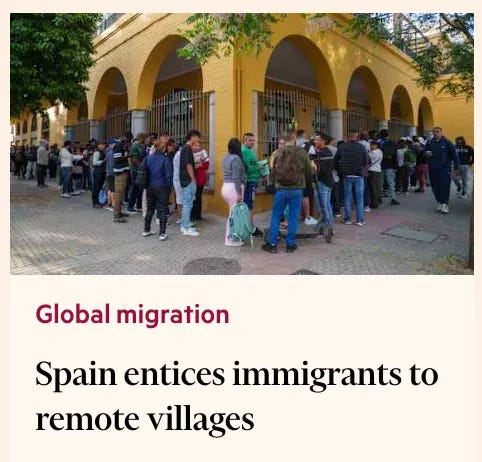
“The only way to maintain sustainable population pyramids in rural areas is by bringing new settlers.”
Not tourists. Not temporary campaigns. Not influencers filming cinematic reels in abandoned piazzas. Settlers. Residents. People who stay.
The article explains how Spain’s left-wing government is openly encouraging immigrants to move into declining rural areas as part of a national demographic strategy. The logic is brutally simple: without new people, many villages will die.
Spain today has one of the lowest birth rates in Europe — 1.1 births per woman — combined with one of the highest life expectancies. Entire inland regions have been emptying for decades while economic growth, jobs, infrastructure and migration flows concentrated in cities like Madrid and Barcelona.
At the same time, immigration has become central to Spain’s economy. In less than twenty-five years, the foreign-born population has gone from one in twenty residents to almost one in five. According to the FT piece, Spain’s recent economic growth has been heavily supported by immigrant labour, particularly from Latin America.
But growth creates pressure.
Housing costs rise. Public services become strained. Political polarisation intensifies. The far-right Vox party is increasingly exploiting urban frustrations linked to migration and cost of living pressures. So Madrid is trying something unusual: instead of discussing immigration only as a border issue or an emergency issue, it is treating it as a territorial issue.
The government’s argument is that immigration could partially rebalance the country geographically.
Not through forced relocation — Francesc Boya, the Spanish official leading demographic policy, explicitly says that would “sound like a dictatorship” — but through incentives, support systems and rural integration programs.
The strategy includes public funding for municipalities, companies and non-profits that help newcomers with language courses, bureaucracy, schools, healthcare access and job placement. One example mentioned in the article is Villagatón, a village of roughly 600 residents where a local factory workforce is now 80% immigrants from Senegal, Gambia and Colombia.
Other programs help migrants take over bakeries, bars and supermarkets that would otherwise disappear as ageing owners retire. Some initiatives specifically target young vulnerable migrants from urban reception centres and attempt to relocate them into smaller communities with employment opportunities.
The interesting part is not simply the policy itself.
It is that Spain has decided to publicly acknowledge something that many European countries still avoid saying clearly: depopulation is no longer a theoretical future problem. It is happening now. And in many rural areas, there simply are not enough local young people left to sustain economic continuity.
Italy understands this perfectly well. It simply struggles to admit it honestly.
Because if Spain has “España vaciada”, Italy has entire provinces entering demographic slow motion.
Thousands of small municipalities continue losing population year after year. Schools close. Public transport weakens. Medical services disappear. Businesses shut down not because they failed, but because their owners retire without successors. Entire real estate markets are becoming inheritance problems more than economic assets.
And yet the Italian conversation around rural regeneration remains trapped in a strange mixture of nostalgia, tourism marketing and ideological fear.
On one side there is the fantasy version of rural Italy: one-euro homes, foreign TV shows, romantic headlines about abandoned villages waiting to be “rediscovered”. On the other side there is the immigration debate, often reduced to urban tension, emergency management and political symbolism.
Rarely are the two conversations connected in a serious way.
And when they are connected, panic immediately enters the room.
Because there is another uncomfortable truth hidden beneath all this: many people who speak enthusiastically about “bringing people back to villages” do not actually mean all people.
What many local administrations really dream about are affluent Northern Europeans, Americans, remote workers, retirees with pensions, entrepreneurs, investors. Preferably educated, financially stable, culturally compatible and capable of renovating beautiful stone houses while drinking local wine and opening artisanal cafés.
In other words: “good migration”.
But then comes the obvious question nobody likes asking.
What exactly are these territories doing to attract those people?
Because privileged migrants do not move somewhere out of charity. They move where there are functioning services, healthcare, infrastructure, schools, digital connectivity, decent mobility, legal clarity and quality housing.
They move where life is workable.
And this is where the contradiction becomes impossible to ignore.
Many small towns simultaneously reject large-scale migration, fear cultural transformation, complain about depopulation and also fail to create the conditions capable of attracting the kind of international residents they claim to want.
You cannot spend years dismantling services, blocking innovation, resisting change, underinvesting in infrastructure and then expect wealthy global professionals to relocate simply because a village is picturesque.
Beauty helps. It is not enough.
At the same time, the opposite extreme is equally dangerous.
Small villages cannot become invisible overflow containers for poorly managed migration systems. Rural Italy is not a carpet under which larger cities hide the consequences of national immigration failures. Many villages are fragile social ecosystems with ageing populations, weak services and limited institutional capacity.
And despite the romantic rhetoric often used internationally, rural communities are not automatically welcoming by nature. Some are extraordinarily open and intelligent. Others are deeply resistant to outsiders, even when demographic decline is obvious.
This matters because integration in small communities is radically different from integration in large cities.
In a metropolis, anonymity absorbs diversity. In a village, every change becomes visible immediately.
Which means that successful rural repopulation — whether through Italians returning, international residents, digital nomads or immigrants — requires something much more complex than simply moving people geographically.
It requires mediation. Infrastructure. Long-term planning. Local participation. Economic logic. Social balance.
And this is probably the part Europe still underestimates.
Because demographics alone do not build communities.
At ITS ITALY, this is precisely where we see both the opportunity and the limit of the current conversation around rural regeneration. Over the years we have worked to attract international professionals, remote workers, entrepreneurs and location-flexible residents into smaller Italian territories. And yes, in some places it works surprisingly well. Certain villages can absolutely become attractive to a global audience looking for slower lifestyles, authenticity, affordability and human-scale living.
But it is not enough.
A few digital nomads, some remote workers and a handful of international buyers will not reverse national demographic collapse. They may help specific local economies. They may reactivate abandoned properties. They may create visibility, confidence and small ecosystems of renewal. But they cannot alone replace entire generations disappearing from rural Europe.
This is why the Spanish debate matters.
Because for the first time, a major European country is trying to speak openly about the real scale of the demographic problem — and about the uncomfortable trade-offs involved.
There are no easy answers here.
Only difficult realities that Europe has postponed discussing honestly for too long.
I’d love to learn more about your projects in Italy. Do you have any write ups on the work you’ve done?