


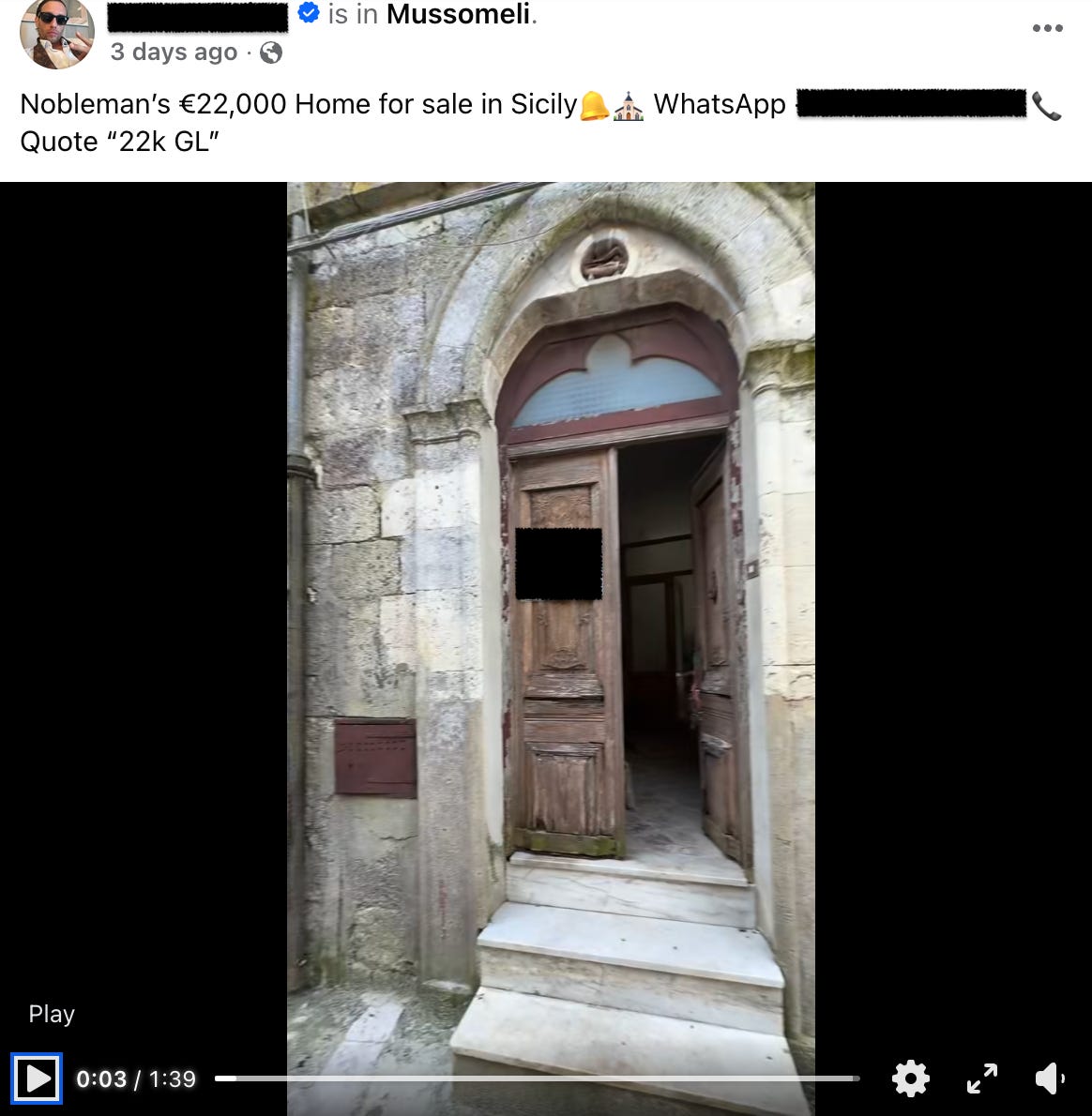
A few days ago, something happened that genuinely disturbed me, not because it was particularly dramatic in itself, but because it was revealing of a much broader dynamic. I discovered that some properties belonging to ITS ITALY in Mussomeli, ‘entrusted’ to a local real estate agency with which we work, were being promoted online by someone with whom we have no relationship, using specific property codes, prices and direct calls to contact someone for further information. There is, of course, nothing wrong with promoting a house, just as there is nothing wrong with building an audience around your own property story, but the situation becomes rather different when the property is not yours, when the owner has not been informed that it is being promoted through someone else’s commercial channels, and when that property ends up inside a model of promotion and monetisation that is very far from the one with which you want your own work to be associated.
That relatively small episode (which we are now investigating) brought me back to a question I have been asking myself for years: why do we work so rarely with influencers, and why are we increasingly cautious even with property operators and agencies whose role seems to begin and end with putting something online, packaging it attractively and waiting for the story to do the rest? Perhaps we are the strange ones, or perhaps they are simply cleverer than we are, because we have chosen the least glamorous part of the property business: we walk into houses, look at roofs, compare plans, ask what renovation will really cost, handle the project, check whether the numbers still make sense after furniture, utilities, professionals, taxes, delays and inevitable surprises, and then ask who will actually rent the property, who might buy it later, whether there is long-term demand, whether the place works for the person rather than just for the camera, and whether an operation that looks brilliant on day one will still look intelligent two years later.
There is another important difference, and it is one we have built into our model deliberately. When we source properties for our own clients, we normally do not work through estate agents in the conventional sense. The reason is quite simple: we want to avoid precisely the dynamic in which somebody’s incentive is to sell a property because selling the property is the transaction they are paid for. We prefer to remain on the same side of the table as the person we are working for, to look at whether that house is actually suitable, whether the numbers make sense, whether the location works for that particular person and whether there is a reason to proceed beyond the fact that somebody would quite like to close a sale.
That does not mean we never use agencies. We do, but usually in a very different situation. When a property is no longer functional to our work, no longer requires our direct involvement, or simply sits outside the type of operation we want to build, we detach it from our active model and give a local agency a mandate to sell it in the ordinary way. At that point the property becomes, quite legitimately, a conventional property sale rather than part of a broader programme involving us, a client and a territorial project. The trust is that the agency will then do what an agency is supposed to do: represent the property correctly, deal transparently with the owner, agree the price, understand who is promoting it, and not quietly insert it into commercial channels, influencer funnels or third-party propositions of which the owner knows nothing. This latest episode has made me reconsider that trust too.
The more you know about a property, the harder it becomes to sell it as magic. A €20,000 house can be a wonderful opportunity, but it can also become a €70,000 problem; a €1 house can be the beginning of a remarkable personal story, but it can also require years, capital, patience, professional support and a tolerance for complexity that not everyone has; a small Italian town can be perfect for one person and entirely wrong for another. None of that performs particularly well on social media, where what works much better is the opposite: look at this house, look at this price, look at what you could buy, look at what everyone else has somehow failed to notice.
And perhaps this is the most interesting part of all. A surprising number of prospective buyers do not seem particularly concerned about entering someone else’s funnel; quite the opposite, they often enjoy the feeling that they have discovered something before the rest of the market has understood it. They see a €1 house, a €20,000 townhouse or a ruin with a terrace in Sicily, and suddenly they are no longer simply looking at a property: in their heads they are already property developers, they have found the opportunity that everyone else missed, the loophole in the market, the place where ordinary economic rules have apparently stopped working just for them.
It is a psychology that the online property world has learned to monetise extraordinarily well. The house becomes content, the content becomes followers, the followers become a guide, the guide becomes a consultation, the consultation becomes property sourcing, and from there it is not difficult to move into private groups, early-access clubs, masterclasses, preferred listings, direct introductions, subscription models and all the usual layers of monetisation. At that point the language also becomes strangely familiar. There will often be promises of practical knowledge, insider access, “real” experience, no nonsense, no theory, no fluff - which is always slightly amusing, because “no fluff” has itself become one of the great pieces of fluff in the online guru economy.
The format changes, but the structure is recognisable. In one industry it is a course explaining how to build your business from Dubai, in another it is a guide explaining how to buy the cheap house nobody else has spotted, somewhere else it is a masterclass on freedom, investing, Airbnb, relocation or passive income. The implied proposition is always similar: I have understood the system, I have lived the transformation, I now have access that you do not have, and I can shorten your route to the same result.
Again, none of this is automatically wrong. People are perfectly entitled to sell knowledge, courses, guides, consulting or access. Some of those products may even be genuinely useful. The problem begins when the authority being sold becomes stronger than the underlying experience, when other people’s assets are absorbed into that authority, or when the line between documenting one’s own experience and commercially positioning oneself as a property operator becomes so blurred that nobody quite knows anymore who represents whom.
It is also where the buyer’s own desire to believe becomes part of the machinery. Once somebody has convinced themselves that they are about to make a brilliant move, caution becomes irritating. The surveyor who points out a structural problem is too negative, the person who says the renovation budget is unrealistic “doesn’t understand the potential”, and the one who asks who will actually rent the property for twelve months rather than three nights is ruining the fun. The person selling the opportunity, on the other hand, is reinforcing something much more emotionally satisfying: yes, you have spotted it; yes, you are early; yes, everybody else is overpaying while you have found the smart way in.
The influencer, the property promoter, the agent and the wannabe guru therefore have one extraordinary advantage over the people doing the actual work: they can stop the story earlier. They can stop at the moment when the house looks exciting, at the price, at the promise, at the transformation that exists mostly in somebody’s head. We, unfortunately, have to see what happens afterwards.
And that distinction matters because the business model around some destinations has changed. We are not interested in convincing somebody that they should move to Mussomeli, or Sambuca, or Ollolai, or Petralia, or anywhere else. We are interested in understanding for whom a place can actually work, under what conditions, with what budget, with what degree of risk and, above all, with what chance that the person will still be happy with the decision once the novelty has disappeared. Those are very different questions, and sometimes the most useful thing we can tell someone is that a particular house, or even a particular destination, is probably not right for them.
That is a terrible influencer strategy. It may, however, be quite a good territorial strategy.
Because if somebody buys, renovates badly, becomes disappointed and leaves six months later, what exactly have we achieved? One more sale, one more video, one more “success story” for a few weeks, but no real new resident, no stable economic activity, no long-term use and no meaningful impact.
Mussomeli is particularly interesting in this respect because it has been, and remains, one of the most effective destinations in the world at generating attention around low-cost property and €1 homes. It has attracted television crews, international newspapers, foreign buyers, investors, visitors and people who genuinely chose to spend meaningful periods of their lives there, and it would be absurd to deny the value of that visibility. The problem begins when the story becomes stronger than the place itself, when the local ecosystem starts revolving less around whether people remain and more around keeping the attention machine moving: the next international buyer, the next cheap house, the next dramatic before-and-after, the next social post, the next guide, the next consultation, the next “exclusive opportunity”.
That kind of ecosystem can work extremely well for some operators. It can work for agencies, it can work for creators, and it can work for people selling services around the dream. For us, it becomes less interesting if what we are trying to build requires continuity, coherence, repeatable economics, long-term occupation and people who are still there after the cameras have gone.
This is also one of the reasons why we are now liquidating some of our own properties in Mussomeli. Not because the properties are somehow “bad”, and not because Mussomeli has no value, but because some of those assets are no longer functional to the work we want to do and, more broadly, because we have come to realise that our model is becoming difficult to grow there. Once a property is no longer part of that model, we are perfectly happy for it to be sold in the conventional market; what we do not want is for it to be silently absorbed into a commercial narrative, a platform or a proposition we have never chosen and with which we do not wish to be associated.
Our model requires control, selection, time and a very close match between property, person and place. It requires being able to say no: no, this house does not work; no, that renovation budget is not realistic; no, that purchase price does not make sense; no, this destination is probably not right for you. The market of hype works much better with yes: yes, you can do it; yes, it is a bargain; yes, you are early; yes, this is your opportunity.
Perhaps that is why we often seem less clever. While others sell possibility, we keep looking at outcomes; while others sell the dream of becoming a property developer, we keep asking whether the development actually works; while others optimise for the moment somebody says, “I can’t believe this house is so cheap”, we are far more interested in whether, two years later, that same person would still say, “I would do it again”.
This is also at the heart of Debunking Italy’s €1 House Effect (it’s not a course, it’s a boring research, packed with real data - and it’s free for our subscribers). The point was never to say that €1 houses are nonsense, because they are not. In many places they have been an extraordinary territorial marketing idea, capable of putting small Italian towns on international television, into newspapers and into conversations that would never otherwise have happened. But attention and transformation are not the same thing. A place can become famous without becoming more liveable, it can receive thousands of enquiries without generating thousands of new residents, it can sell dozens of houses without creating a functioning residential market, and it can produce millions of views without producing a stable local ecosystem.
Somewhere between attention and transformation, a new commercial layer has emerged: the business of selling the idea that everyone can reproduce the story. Buy the guide, join the group, book the call, find the house, change your life. It is a beautifully efficient funnel, and almost inevitably it will be described as practical, authentic and, naturally, “no fluff”.
Real life is usually less cooperative. It includes paperwork, builders, title checks, delays, cost overruns, utilities, different tax systems, different legal assumptions, different ideas of what “renovated” means, different ideas of what something is worth, and one particularly inconvenient fact: eventually, the market sends the bill.
This is why we are cautious not only with influencers but also with agencies and operators whose role is primarily promotional. We need to know what happens after the lead, after the viewing, after the signature, after the renovation starts, after the first winter and after the excitement disappears, because that is the least glamorous part, but it is also the only part that ultimately tells you whether the operation was good.
The recent discovery that some of our own Mussomeli properties were being promoted through channels and commercial mechanisms we had never discussed made this unusually tangible. It was uncomfortable, particularly because some of those properties are precisely the ones we are considering disposing of as they no longer fit the direction of our work. There is a certain irony in that: someone else may be able to market them more enthusiastically than we can, perhaps because we know them too well. We know the costs, the context, the limitations, what worked, what did not and why some assets that once made sense no longer fit the model we are trying to build. That makes for worse hype, but hopefully for better decisions.
And perhaps this is ultimately the real difference between the two worlds. Some people are selling the dream of becoming a property developer, sometimes packaged as a guide, a masterclass or a supposedly no-nonsense shortcut to the market; we are trying to understand whether the development actually works. Some are selling access, while we are trying to build something repeatable. Some are selling the thrill of discovering a place before everyone else, while we are trying to understand what remains when everyone else eventually arrives.
Perhaps we are less good at creating FOMO because we spend too much time seeing what happens when the FOMO wears off.
But that, increasingly, is exactly the part of the job that interests us.