

A renovated house can be unveiled on a Saturday. Monday is a better day to find out whether you can live there. What time does the first bus leave? How far away is a specialist appointment? If two people in the household need jobs, what can the second person do? These are the questions a family has to answer before a house becomes a viable home.
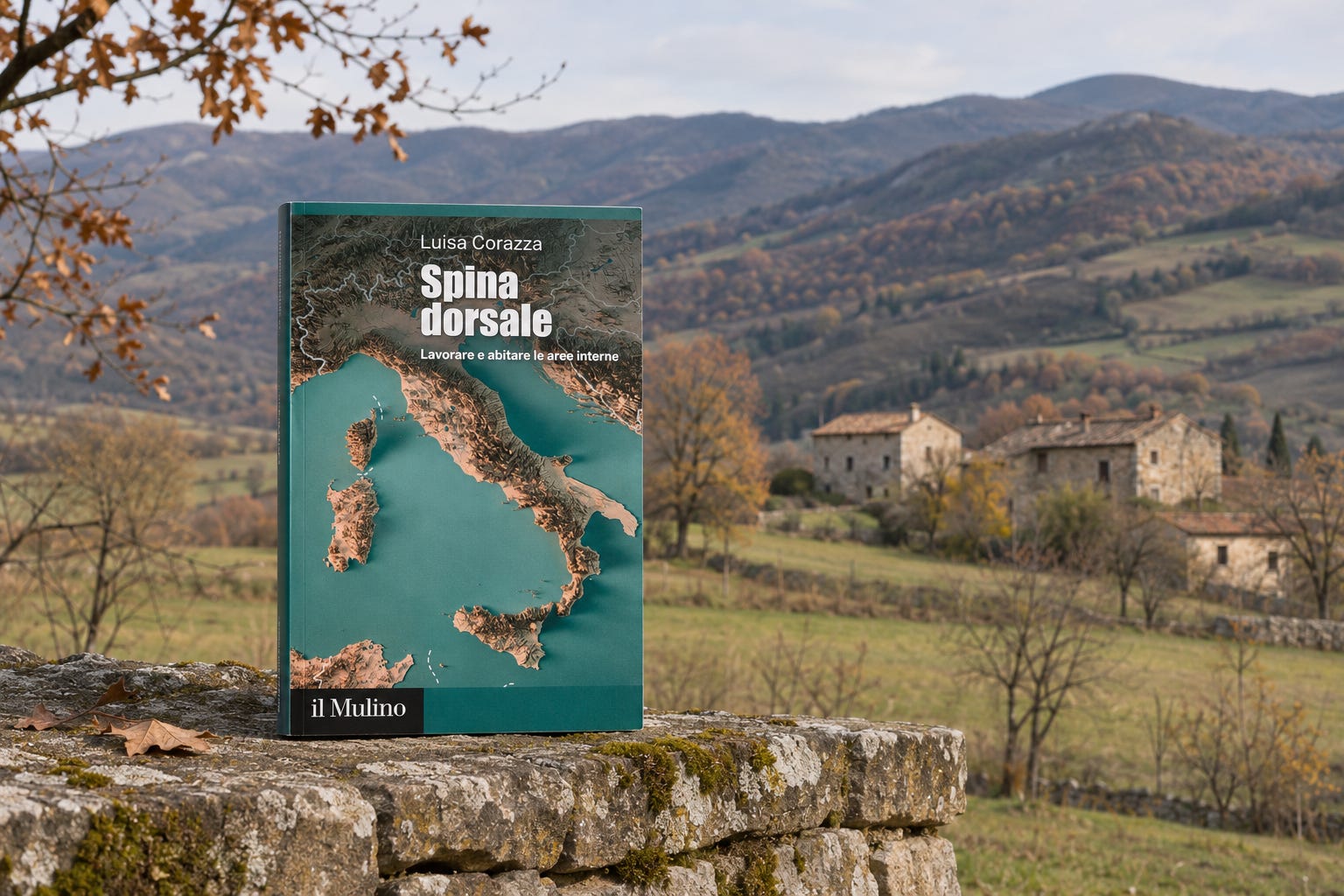
Luisa Corazza puts two verbs side by side in the subtitle of her new book, Spina dorsale. Lavorare e abitare le aree interne, published by il Mulino on 20 November. To work and to live. The book’s public description places the depopulation of inland areas within a longer European history of industrial change and urban growth. It gives us a starting point for asking what happens after an empty house goes back on the market.
What does an ordinary week cost?
Around 13.3 million people lived in Italy’s officially classified inner areas at the beginning of 2025. The classification is based on distance from centres that provide essential services, including healthcare, education and transport. Two towns with a similar population and equally appealing houses can offer very different conditions for everyday life.
Consider a couple weighing up a move. One can work remotely. The other needs to find a job locally. The mortgage might be manageable, but can they run the household on one income while the second person looks for work? Would a second car become necessary? Can either of them make a hospital appointment and get home the same morning? Those answers can change the calculation more than a small difference in the asking price.
For people returning to a place they know, the questions are just as practical. The bus route they remember may have changed. The relatives they used to rely on may now need help themselves. Knowing the place is a real advantage, and it is worth finding out how it works today.
Give people the timetable
A municipality that wants to welcome new residents could describe an ordinary week as carefully as it promotes its summer festival. Where do children go to school? Which buses are useful for a shift worker? Where can someone get advice about a local job or register with a doctor? Who can answer when the information online is incomplete?
That would give prospective residents a way to see how work, housing and services fit together. It would also give the people who already live there an opportunity to say where the gaps are. A village may have a bus stop. What matters to the person finishing work at seven is whether there is a bus home.
Before deciding on a move, spend a week there while keeping your usual commitments. Work your normal hours. Do the shopping when you actually need it. Make the journeys you would have to make if you lived there. By Friday, you may know something about the place that a dozen photographs could never tell you.