




New data show where they actually live - and RELOCALS is about to reveal why that matters.
It is not only Helen Mirren.
She may be the perfect symbol of the phenomenon. The Oscar-winning Dame who portrayed Queen Elizabeth II has gradually become one of Salento’s most enthusiastic unofficial ambassadors. She owns a masseria in Tiggiano with her husband, director Taylor Hackford; has campaigned for Puglia’s olive trees; danced alongside Checco Zalone in La Vacinada (picture above); and regularly declares her love for the place she calls her “home of the heart”.
Then came the latest transformation. Appearing on The Tonight Show, Mirren interrupted Jimmy Fallon’s joke about the allegedly foul-mouthed supporters of the New York Giants to defend a different tribe. She announced that she was a diehard supporter of the Italian football club Lecce, shouted “Forza Lecce!” and jokingly claimed its fans were even more foul-mouthed. For a few minutes, the grande dame of British cinema became a giallorossa hooligan on American television.
Mirren is unusually famous, but she is not alone. There are tens of thousands of less celebrated British, American, Canadian, Australian and New Zealand-born residents who have built a life in Italy. Together they number 169,731. That may sound substantial, yet it represents only 0.29% of Italy’s resident population.
And still, they seem to be everywhere - perhaps ten times more numerous than they really are.
Why?
Partly because visibility is not the same as demographic weight. English-speaking newcomers are highly visible in international media, property programmes, relocation groups, newsletters and social platforms. They tell stories about Italy, in English, to global audiences. Their house purchases and renovations become content; their frustrations with bureaucracy become content; their discoveries of a village, a bar or a local tradition are amplified far beyond the place itself.
A celebrity such as Mirren multiplies that effect, but thousands of ordinary residents and property owners reproduce it on a smaller scale every day.
Geography matters too. A few dozen newcomers disappear statistically inside Rome or Milan. In a municipality of 1,000 or 2,000 people, the same number can become a recognisable community, affect the housing market and local businesses, and change how the town presents itself to the outside world.
So where do these residents actually live?
A new analysis by Andrea Mammoliti for The Italy Project provides an unexpectedly revealing answer.

And with RELOCALS, ITS ITALY, We the Italians and Nomag Media Research have immersed themselves in the next part of the question: who these people are, what brought them to Italy and what happens when arrival begins to turn into belonging.
Mammoliti examined where people born in the United States, United Kingdom, Canada, Australia and New Zealand live as registered residents in Italy. Using ISTAT data for 1 January 2025, he counted 169,731 residents born in those five countries.
It is a tiny national share. Yet national averages conceal the geography that matters.
Mammoliti’s most striking finding is that 65.18% of these residents live in municipalities with fewer than 50,000 inhabitants. The proportion rises to 74.79% among Canadian-born residents and 72.28% among those born in Australia. Even US-born residents - the least dispersed of the five groups - record a majority of 57.90%.
In other words, this is not simply a story about international populations clustering in Italy’s best-known cities. A substantial part of it is unfolding across small and medium-sized municipalities, including places that rarely appear on the conventional map of foreign life in Italy.
Rome wins the totals. Small places change the meaning
In absolute numbers, the hierarchy looks familiar. Rome ranks first for residents born in all five countries, Milan second, while Florence appears consistently among the leading municipalities.
Scale matters: large cities offer jobs, universities, international companies, transport links, consular services and established social networks.
But Mammoliti then changes the question. Instead of asking where the largest numbers live, he asks where these residents have the greatest local weight.
That produces a very different map.
British-born residents account for 5.94% of the population of Vallerotonda, 5.36% in Busso and 5.16% in Bardi. Among US-born residents, Palermiti leads with 3.55%, followed by Introdacqua at 2.59% and Monte di Procida at 2.53%.
There are other unexpected concentrations. Trieste is the third Italian municipality by number of Australian-born residents, with 393. Pachino, in south-eastern Sicily, is third for Canadian-born residents, with 301.
These figures are more than statistical curiosities. In a large city, a few hundred foreign-born residents may remain almost invisible within the urban population. In a small municipality, a few dozen people can affect the housing market, local consumption, school enrolment, voluntary organisations, social networks and even the way a place is perceived abroad.
Small numbers can produce a disproportionate local effect.
This is where RELOCALS enters the picture
At ITS ITALY, We the Italians and Nomag Media, we have spent the past months immersed in precisely this territory through RELOCALS: people who do not fit comfortably into the usual categories of tourist, expat or digital nomad because they are trying - with different degrees of permanence and success - to establish a real relationship with a place.
Mammoliti’s analysis helps us see where part of that phenomenon may be happening. RELOCALS asks what happens after the dot appears on the map.
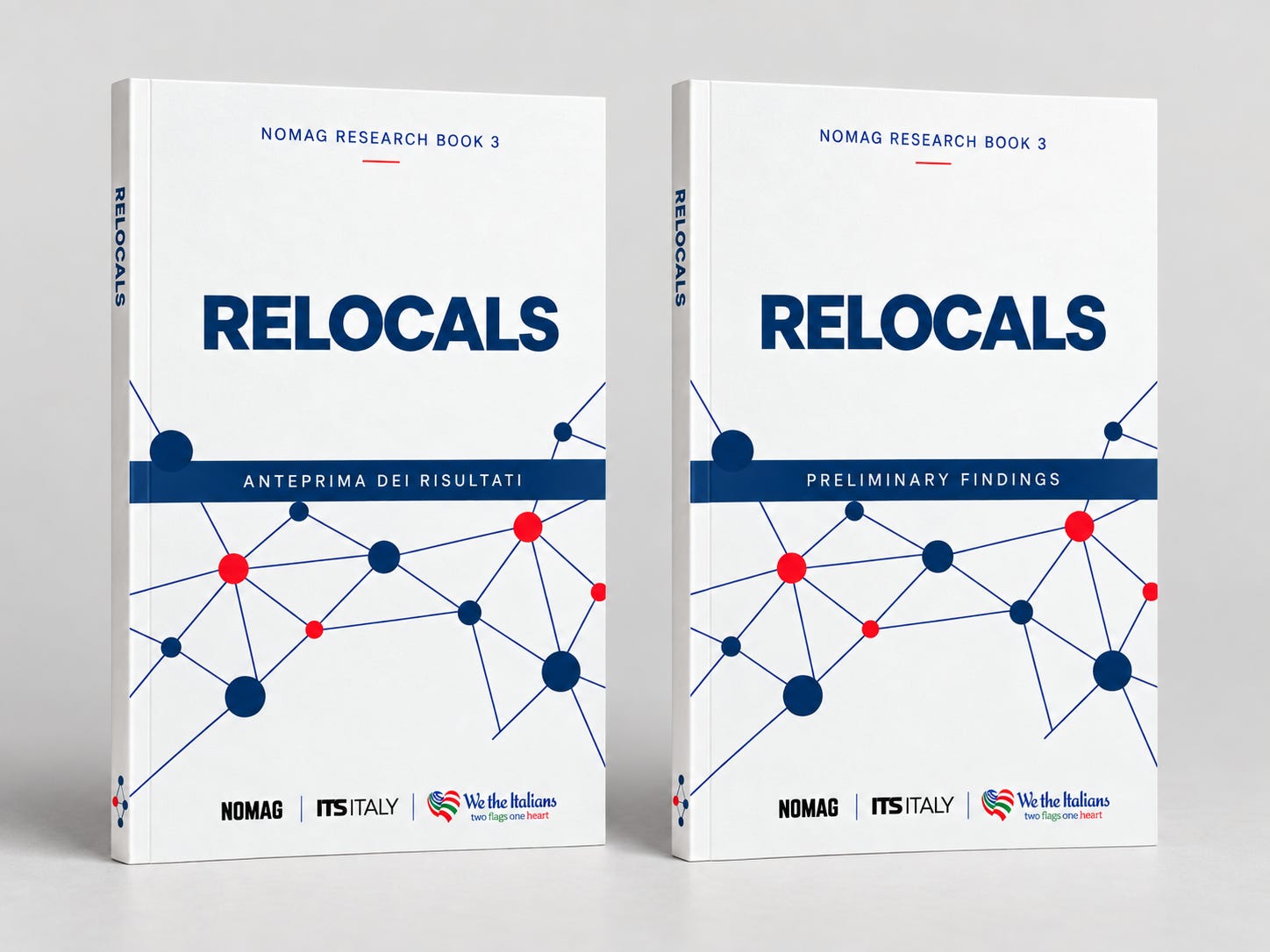
Why did someone choose that municipality? Was the decision driven by ancestry, affection, property prices, remote work, retirement, family formation or pure accident? Did they restore a home, start a business, move their official residence or spend only part of the year there? Do they speak Italian? Have they built relationships with local residents? Do they intend to remain? And, crucially, does their presence create new life in the community or merely a new form of seasonal occupancy?
Administrative data cannot answer those questions. They were not designed to do so. But they can identify places in which those questions deserve to be asked.
The choice to analyse country of birth rather than citizenship is particularly useful, but it also requires care. A person born in the United Kingdom may be an Italian citizen who returned to a family town. An American-born resident may have acquired Italian citizenship through descent. Conversely, a British or Canadian citizen born elsewhere will not appear in the corresponding group.
“Born abroad” and “foreign” are not synonyms, just as registration and everyday presence are not the same thing.
There is also a large population the figures do not capture: people who divide their time between countries, own a home in Italy without registering as residents, remain for extended periods, or are still testing whether a temporary move can become permanent.
That invisible or semi-visible group is especially relevant for smaller towns. Relocation is often a process, not a single event. It can begin with repeated visits, continue with the purchase and renovation of a property, and only later result in formal residency - or never do so at all.
What the 65% does - and does not - prove
The figure showing that almost two-thirds live in municipalities below 50,000 inhabitants is powerful, but it should not be stretched beyond what the data support.
The category includes provincial towns as well as very small villages. It does not, by itself, prove that English-speaking residents are disproportionately attracted to remote or depopulating areas.
To establish that, we would need to compare their distribution with that of Italy’s population as a whole and distinguish metropolitan belts, tourist centres, accessible provincial towns and genuinely peripheral municipalities.
Nor can concentration establish causation. A cluster may reflect a historical migration connection, military presence, marriage patterns, return migration, a local employer, an active estate agent, word of mouth or a few pioneering households whose experience attracted others.
These are not objections to the analysis. They show why it is a valuable beginning rather than a final answer.
From residents to local actors
For municipalities facing ageing, empty housing and declining services, the relevant question is not simply how many foreigners arrive. It is what kind of relationship they build with the territory.
A registered resident who spends little time locally may have less impact than a non-resident who restores a house, employs local tradespeople, uses local services and participates in community life. Equally, attracting new owners without creating integration can push up expectations and property prices without rebuilding the social fabric.
This is why the distinction between attraction and retention matters.
Visibility can put a town on the map. Affordable property can generate enquiries. A successful relocation story can bring the next household. But turning interest into stable local presence requires housing that is actually habitable, accessible services, reliable connectivity, administrative support and opportunities to form relationships beyond the international bubble.
The most revealing result of Mammoliti’s work may therefore be not that 169,731 residents represent only 0.29% of Italy’s population. It is that a population can be nationally marginal yet locally meaningful.
Italy does not necessarily need a “Little Britain” or a “Little America” in reverse. Its more distinctive possibility may be a dispersed network of people becoming, slowly and imperfectly, local in hundreds of different places.
The map now shows us where some of them are. The next task - and the one into which we have immersed ourselves with RELOCALS - is to understand who they are, why they stay and what changes when they begin to call an Italian town home.
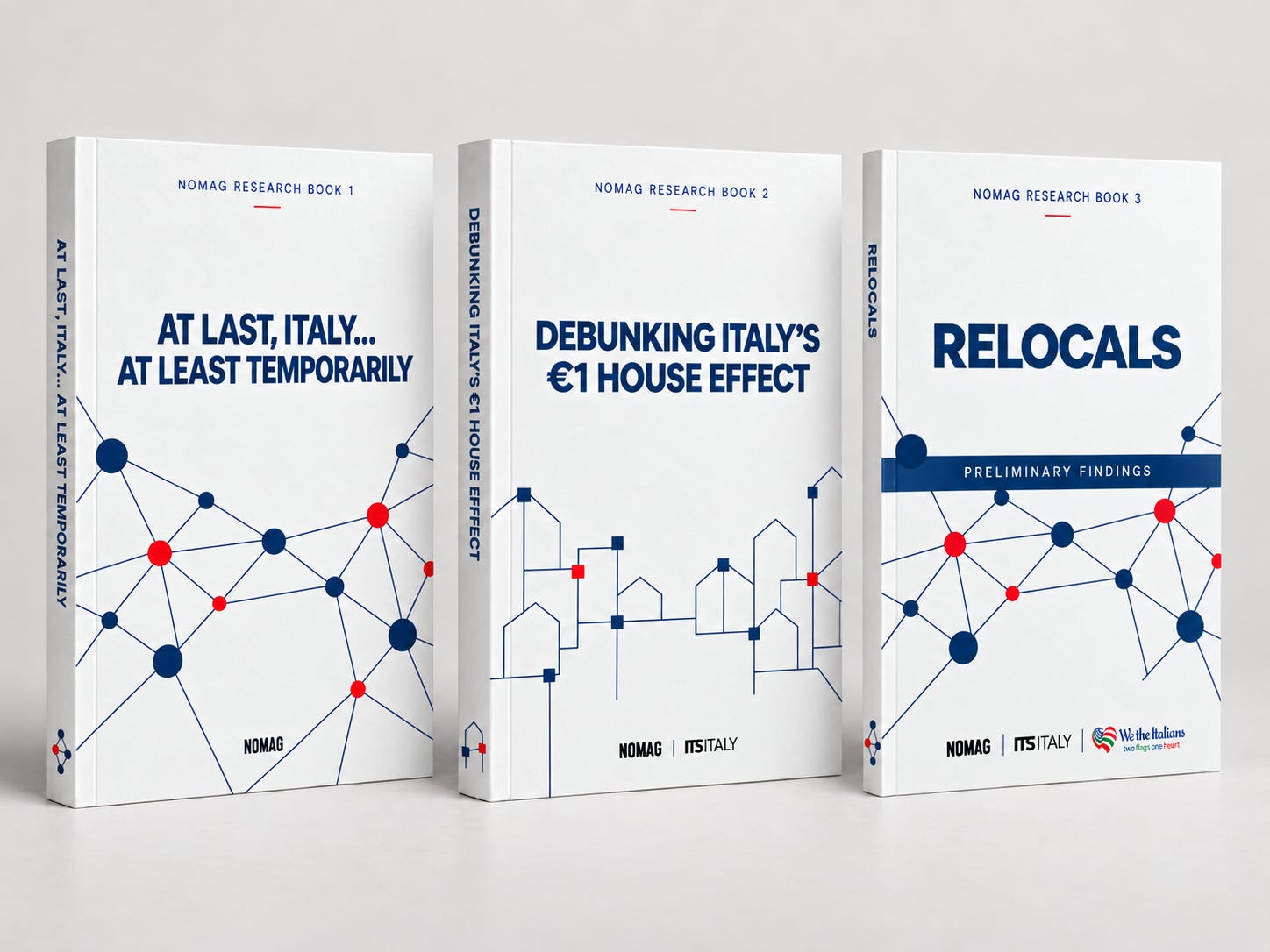
We will discuss them on 24 September in Rome, at the Center for American Studies, during the presentation of the complete NOMAG Research series: three studies exploring digital nomads, the real impact of Italy’s €1 house programmes and the emerging world of RELOCALS.
Join us for a data-led discussion about who is really choosing Italy, where they are settling and what their presence could mean for the country’s communities.
Source: Andrea Mammoliti, “Where Do People Born in English-Speaking Countries Live in Italy?”, The Italy Project, 20 September 2026. Data: ISTAT resident population by country of birth, 1 January 2025.