

Choosing a country does not require agreeing with its promotional material. People can love living in Italy and still find its housing market difficult, its administration exhausting or its transport inadequate. From a distance, those positions are sometimes treated as contradictory. From inside an ordinary week, they can be perfectly compatible. Attachment does not remove the need to find a home, earn a living or reach an appointment.
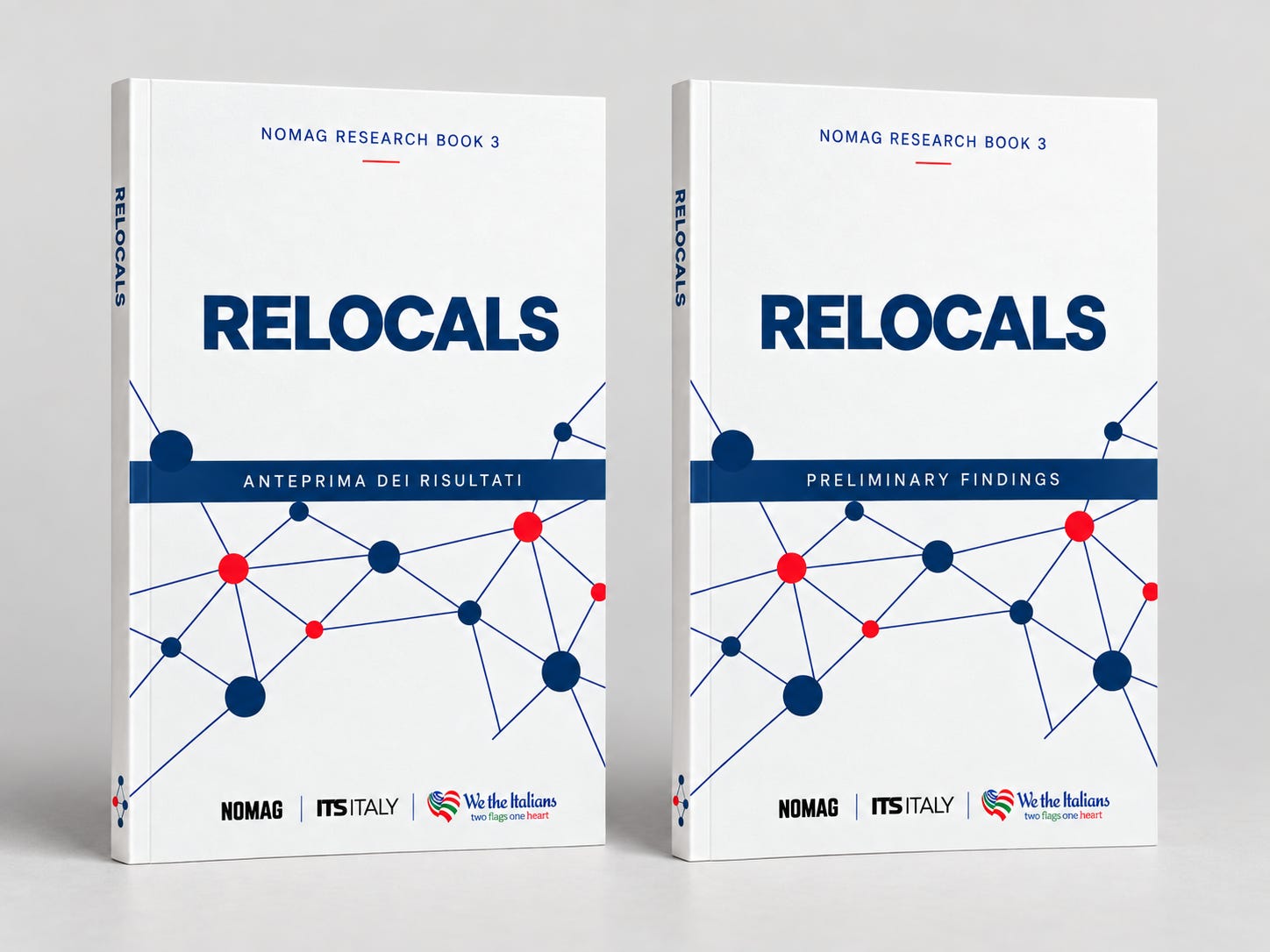
RELOCALS begins with that lived perspective. Developed by NOMAG, ITS Italy and We the Italians, the project focuses on people born abroad who have chosen to live in Italy and who continue to interpret it through international experience. The name combines relocate and local. The first research publication, RELOCALS - Preliminary Findings: The First 103, examines what changes after a destination becomes home.
A choice that can deepen after arrival
Of the first 103 participants, 64.1% did not originally expect to remain in Italy for so long. The finding suggests that the relationship can develop after arrival rather than follow a fully formed relocation plan. It does not identify a single reason for staying, nor does it describe everyone who moves to Italy. It does make duration itself a useful subject of enquiry: how does an initial decision become a longer commitment?
The group is professionally active rather than predominantly retired. 66.0% are aged 35 to 54, only two participants are pensioners, and 86.4% live with a partner or family. Meanwhile, 63.1% generate their income mainly outside Italy. This is not enough to calculate their local economic contribution, but it identifies a relationship between the place where income is generated and the place where everyday life is organised.
Experience changes the account of the country
75.7% say living in Italy has changed the way they describe it. The sample includes 43 people who explicitly identify as creators, journalists or storytellers, and 86.4% communicate in English. Their accounts may reach people who are considering a visit, a move or an investment. The research keeps self-reported audience contacts distinct from unique individuals and actual reach: a communication network is not a guaranteed marketing result.
Its value may lie precisely in not being a marketing instrument. Human relationships, nature, culture and beauty appear among the perceived advantages, while work and housing are each identified as problems by 78.6%, bureaucracy by 76.7% and transport by 74.8%. 84.5% see the idea of Italy as a permanent holiday as a major misconception. A credible account has room for both attraction and difficulty.
Being present is not the same as being involved
77.7% report at least some involvement in their local community. Yet 65.0% have never been invited by local authorities, organisations or Italian businesses to contribute their perspective, skills or audience. Those are different forms of participation, so the figures are not contradictory. Someone may have neighbours, associations and everyday relationships without being recognised as a potential professional or civic interlocutor.
The implication is not to turn every international resident into a destination ambassador. A local authority might learn more by asking what makes a process difficult; a business might test whether its information makes sense to someone arriving from another system. Such possibilities should be built around actual skills and willing participation. Critical feedback is part of the contribution, not a defect to be edited out.
The first findings are a starting point
The study uses 50 questions, an additional income indicator and open qualitative responses. Recruitment was purposive, and the initial group is strongly Anglo-international, with the United States and United Kingdom together accounting for 44.7%. It is not statistically representative of all foreign-born residents in Italy. Its findings identify questions and experiences to investigate, rather than national prevalence estimates.
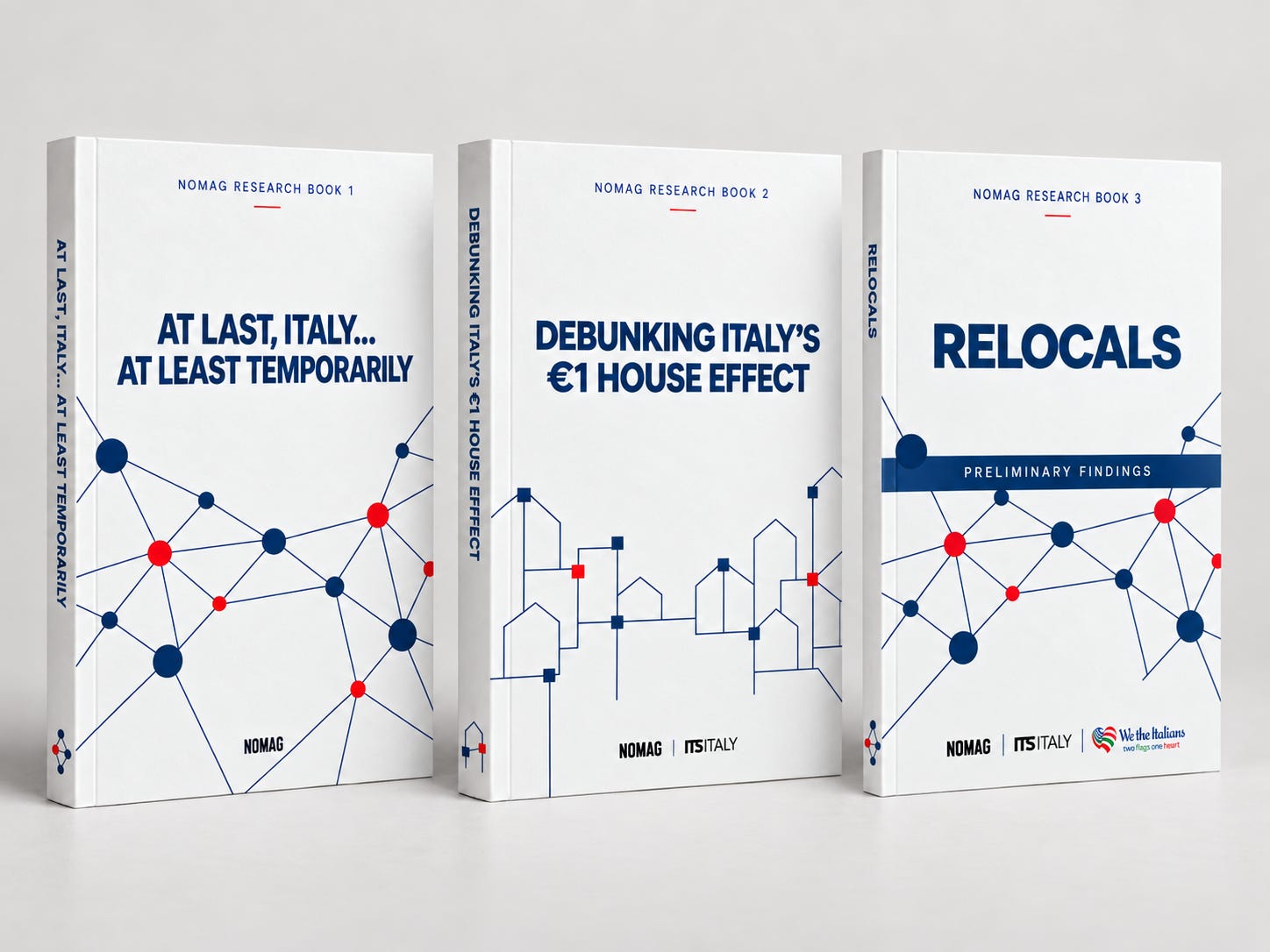
The Rome presentation takes place on 24 September, with the preliminary report available free in Italian and English afterwards. A roadshow of at least twelve Italian stops is planned for 2027 to gather further data and cases. For places hoping to understand international residents, the invitation is to move beyond asking whether they like Italy. Ask what they have learned about it, what has changed their mind and what would make it work better. The answers may be less flattering than a campaign. They could also be considerably more useful.
Join the presentation in Rome
24 September 2026, 5 pm · Centro Studi Americani, Via Michelangelo Caetani 32, Rome. The event presents the first RELOCALS findings and the NOMAG Research series.