
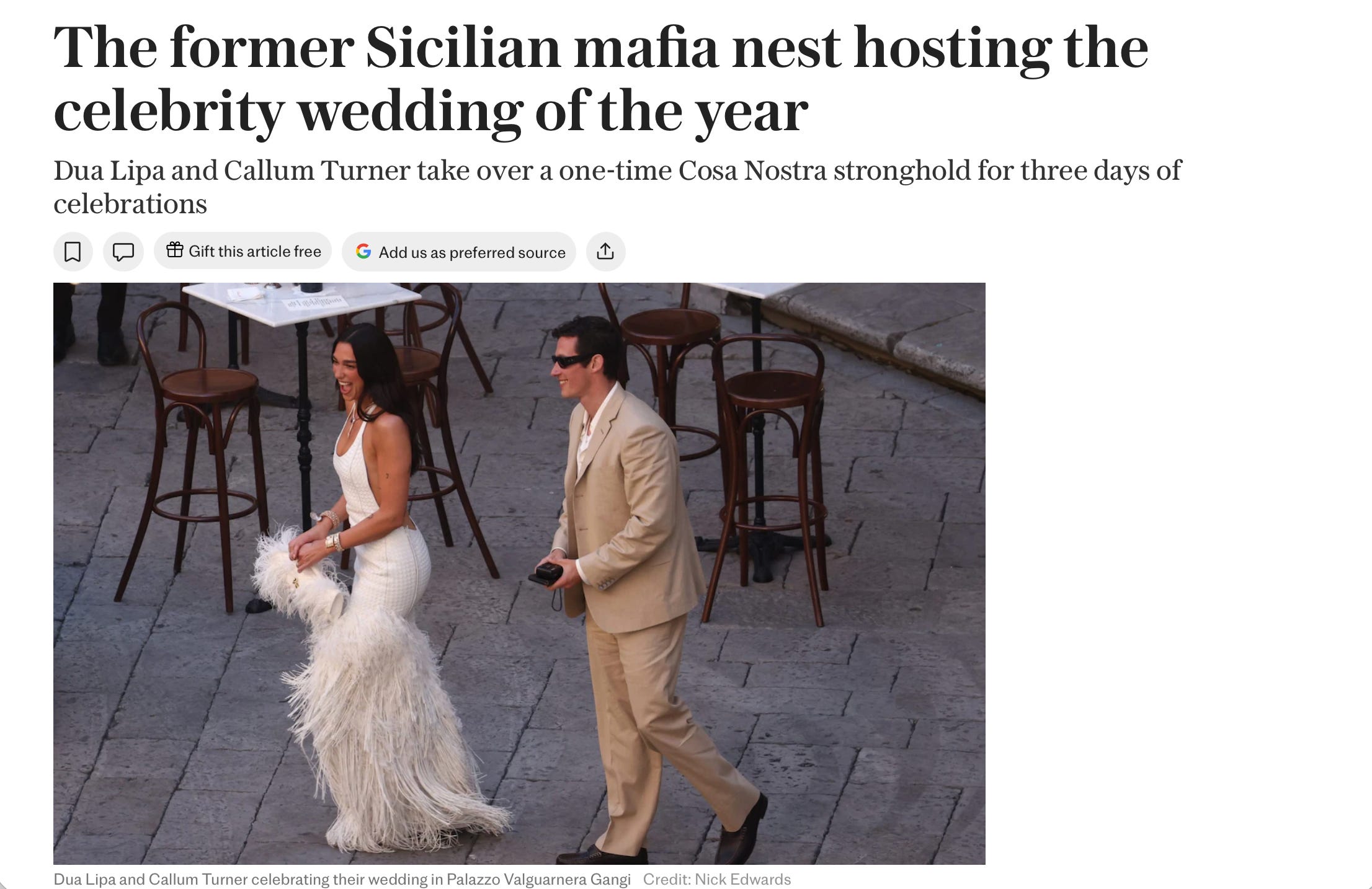
Villa Valguarnera, Bagheria, Palermo and That British Habit of Calling Everything Mafia
You can find the, original, Italian article by Matteo Cerri on Esco quando voglio 👇
Before even talking about Dua Lipa — whom I confess I continue to ignore much like any other name floating through the sweltering cultural atmosphere of recent weeks — we should begin with this photograph. Not with the bride, not with the guests, not with the inevitable parade of stylists, wedding planners, security teams, onlookers, paparazzi, tourists and locals pretending to be annoyed while photographing everything anyway. We should begin with Villa Valguarnera, in Bagheria, because within that image lies almost the entire story that The Telegraph’s headline failed, or perhaps refused, to tell.
Villa Valguarnera is not a “nest.” It is one of the great monuments of Sicilian aristocratic history, an eighteenth-century residence tied to the story of the Princes Alliata di Villafranca, built in an area that for centuries served as the summer retreat of Palermo’s nobility. Bagheria was the city of villas, not a ready-made extension of The Godfather created for the benefit of London headline writers. Official sources describe the villa as one of Italy’s great historic landmarks, with monumental architecture, gardens and a family story that stretches across literature, cinema, aristocratic splendour, decline, restoration and sheer private determination.
It is also, not insignificantly, the home of Princess Vittoria Alliata di Villafranca, writer, journalist and translator, best known internationally for producing the first Italian translation of The Lord of the Rings. Hardly the profile one expects to find in the tired old Sicilian narrative of flat caps, luparas and omertà. Yet that is precisely what Sicily is: not a simple postcard, but an almost unmanageable layering of beauty, violence, culture, neglect, rebirth, genius, bureaucracy, tragedy and theatre. The problem is that telling such a story requires effort. And effort, evidently, does not always make it as far as the headline desk.
The Telegraph recently published an article about Dua Lipa and Callum Turner’s Sicilian wedding celebrations, written by its Italy correspondent Nick Squires. The piece itself is not bad at all. It tells the story of Bagheria, its Mafia past, its transformation, the words of Mayor Filippo Tripoli, the growth of tourism and the evolution of a place once associated with violence into a destination capable of attracting an international event. It also recalls how the anti-Mafia reaction that followed the 1992 assassinations marked a profound turning point for Palermo, Bagheria and Sicily as a whole.
Then comes the headline:
“Sicily’s Mafia Nest Hosting the Celebrity Wedding of the Year.”
And there we are again.
Not Palermo. Not Bagheria. Not Villa Valguarnera. Not a region trying, despite all its contradictions, to tell a different story about itself. No. “Mafia nest.” Because in the end, whenever Sicily is involved, the old reflex of the average Anglo-Saxon newspaper remains useful. It creates atmosphere. It generates clicks. And above all it reassures the reader: the world is still exactly as we had imagined it, even when we know very little about it.
According to reports, Nick Squires later told the Italian news agency AGI: “I didn’t write the title.” Frankly, one is inclined to believe him, because the article itself contains far more nuance than the headline attached to it. But that is precisely the point. A headline is not a technical detail. It is not an innocent editorial accessory. It is not decoration. The headline is what most readers remember, and often the only thing they actually read. If the headline reduces Sicily to a “Mafia nest”, everything else, however balanced, becomes contaminated at source.
I am not Sicilian. I cannot appropriate a wound that is not mine. I cannot claim I was there when Palermo lived through the years of terror, when Falcone and Borsellino were murdered, when an entire city had to decide whether to remain bent over or stand up. But over the last few years, through my work with Its Italy, I have come to know a substantial part of Sicily, enough at least to recognise that these narratives are not merely unfair: they are old, tired and provincial.
I have many Sicilian friends. We have helped dozens of people from around the world relocate to this region, buy homes here and build lives here — not as distracted tourists but as residents, with all the beauty and all the frustrations that entails. Anyone who truly knows Sicily understands that it cannot be defended through simplistic slogans. It is not “all wonderful.” Nor is it “all Mafia.” It is far more complicated than either, which is precisely what makes it so fascinating.
The Mafia existed. Of course it did. It killed, controlled, intimidated and devastated families, businesses, towns, institutions and trust itself. Pretending otherwise would be ridiculous. It would also be deeply disrespectful to those who fought it, often at the cost of their own lives. But Sicily is also one of the few places in Europe where an entire society has had to confront a monstrous part of its own history publicly, painfully and continuously. It has not solved it once and for all — social diseases do not disappear because of a successful tourist season or a government press release. But it has faced it. It continues to face it. In schools, courts, town halls, businesses, associations, families and in the ordinary decisions of ordinary people who refuse to bow their heads.
And so no, it is not the same thing to describe Bagheria as a place that once had a Mafia history and to describe it as a “Mafia nest.”
The first is information.
The second is laziness disguised as journalism.
Especially because, for once, the international spotlight is not falling on Lake Como, Tuscany, Venice, Portofino or the Amalfi Coast, but on Palermo, Bagheria and Villa Valguarnera. Perhaps we should be capable of seeing that as something interesting. Perhaps we should be pleased that a globally recognised celebrity has chosen a place that does not belong to the standard catalogue of pre-packaged Italian luxury destinations designed for wealthy foreigners. Perhaps we should ask ourselves why an international couple with unlimited means and endless options chose Sicily for such a personal occasion.
Perhaps because Sicily, with all its disorder and all its glory, still possesses something many luxury destinations have lost:
Character.
Sicily is not smooth. It is not sterilised. It is not always comfortable. It is not always efficient. It refuses to be consumed without friction. Yet it possesses depth. Memory. An almost physical understanding of beauty. Its cuisine is not a trend but an archive of civilisations. Its cities bear the real traces of Arabs, Normans, Spaniards, French, Jews, Greeks, Romans, Bourbons and Italians — not simply tourist brochures. It possesses a form of popular intelligence capable of being brutally sharp and extraordinarily generous within the same afternoon. It has the rare gift of making you feel inside history rather than standing in front of a stage set.
Those who visit Sicily expecting only sea and cannoli understand very little.
Those who arrive expecting only Mafia understand even less.
Those who stay longer discover something that escapes the headlines: Sicily does not ask to be absolved. It asks to be understood.
And here lies the difference between journalism and caricature.
Journalism should take a complex place and return it to the reader with greater understanding. Caricature takes a complex place and hands it back in the simplest form possible, so that nobody has to disturb their assumptions. In Sicily’s case, the shortcut is always the same: Mafia.
It has worked for decades.
It is immediate. Dirty enough. Exotic enough. It gives the reader a small thrill while allowing a certain British audience — particularly a Telegraph audience — to feel superior for a few moments between unaffordable mortgages, a crumbling rail network and a political system that increasingly resembles a script rejected for being too cynical even by Netflix.
And here, perhaps, a little provocation is justified.
Because there is something darkly amusing about a certain branch of British journalism continuing to look down on places that are at least trying to rebuild themselves, while struggling to recognise its own decline. There is something almost comic about a heritage media institution of a collapsed empire — often read by the most nostalgic and resentful section of Britain — continuing to hand out certificates of civilisation to everyone else.
Sicily may have many problems.
At least it does not have to pretend it is still the centre of the world in order to sell subscriptions to people mourning a past that was glorious primarily for those who ruled it.
That does not mean responding to one stereotype with another. It would be far too easy to say that all Britons are like this. They are not. Many British people love Sicily with a depth that many Italians never reach. They visit it, study it, buy homes there, return year after year, accept its flaws and fall in love with its villages, markets, tired palaces, countryside and silences. Some understand it extraordinarily well. Often better than we do.
The problem is not “the British.”
The problem is that specific form of cultural laziness that survives in editorial rooms, headline desks and ready-made narratives that nobody bothers to challenge because, after all, they still seem to work.
That is how stereotypes survive.
Not always through malice.
Far more often through convenience.
You do not need to hate Sicily to offend it.
You simply need to refuse to update the story you tell about it.
It is the same mechanism through which Italy abroad remains pizza, mandolins, gelato, passion, corruption and hand gestures. Some of those clichés contain a grain of truth. But the problem with stereotypes is not that they are always completely false. The problem is that they become prisons. They take a fragment and turn it into destiny. They take a wound and turn it into identity. They take a story of recovery and headline it as though the recovery never happened.
From this perspective, Villa Valguarnera is almost a perfect symbol. Not because it is immaculate. Not because it emerged from an innocent world. Not because Sicilian aristocracy was some fairy tale without shadows. Quite the opposite. It is perfect precisely because it contains everything: privilege, beauty, decline, memory, restoration, the risk of abandonment and the determination to rebuild what seemed lost.
And so, if we really want to use a strong expression, Villa Valguarnera is not the backdrop to a “Mafia nest.”
It is, rather, one of the places that demonstrates how Sicily can be larger than its wounds.
Bagheria does not need to be sanctified. It has known terrible chapters. The Telegraph article recalls the so-called Triangle of Death, the power of Cosa Nostra, the violence and the criminal history. But it also describes a city that today hosts weddings, film productions, tourists and businesses, and whose mayor speaks openly about a profound transformation achieved through decades of anti-Mafia efforts.
If you tell both stories, you are doing journalism.
If only the Mafia survives into the headline, you are marketing prejudice.
The most interesting thing, however, is that Sicilians themselves do not need anti-Mafia lessons from anyone. Palermo knows perfectly well what the Mafia was. Bagheria knows. Sicily knows. Families know. Shopkeepers know. Teachers know. Magistrates know. The young people who study Falcone and Borsellino not as ceremonial figures but as part of a living civic memory know.
And many of those who become angry when Sicily is reduced to Mafia are not trying to hide that history. They are simply tired of watching the world pay attention to Sicily only when it can use the island’s scars as spectacle.
It is an understandable exhaustion.
Imagine, for a moment, if London were described only through colonialism, royal scandals, child poverty, gang violence, institutional racism, Brexit, oligarchs, empty luxury property investments and governments collapsing with all the dignity of a pub crawl gone wrong.
All of those things contain elements of truth.
But is London only that?
Of course not.
It would be a miserable narrative, even when built upon facts.
Yet Sicily is subjected to precisely this treatment again and again.
And somehow many people still consider it normal.
It is not.
Especially not today, when the region is experiencing a new phase of international attention. I am not speaking only about tourism, which can be either a blessing or a curse depending on how it is managed. I am speaking about people relocating, investing, restoring homes, starting businesses, working remotely and choosing a different quality of life. Through Its Italy, we see it constantly and tell these stories every day. Sicily attracts people precisely because it is not a lesser version of Tuscany. It is something entirely different: rougher, more theatrical, more extreme, harder to explain and therefore more powerful.
People who come here are not merely searching for beauty.
They are searching for belonging.
They are searching for a home with context.
They are searching for a place that has not been entirely neutralised by the global luxury market.
And if a celebrity such as Dua Lipa chooses Villa Valguarnera and Palermo, the point is not celebrity gossip.
The point is that Sicily once again enters the global imagination.
Not as a criminal periphery.
But as a cultural, aesthetic and emotional centre.
As for the wedding itself, I honestly care very little. But by choosing Palermo, Dua Lipa has displayed more taste and imagination than many celebrities before her.
What interests me is that places such as Villa Valguarnera, Bagheria and Sicily are finally seen for what they are: living, complicated, wounded and magnificent places, not criminal backdrops waiting to be recycled into historical-sounding tabloid headlines.
Sicily does not ask for indulgence.
It asks for accuracy.
And perhaps a little respect.
Because accuracy is what separates journalism from prejudice.


