What if the Italian language is the real passport to the “Italian dream”?
By: Barbara Bassi
Living in Italy is the dream of many who were not born there. And when that dream finally comes true - after overcoming bureaucratic, fiscal and legal hurdles - one must then reckon with the language barrier.

Those who move to a big Italian city such as Milan, Turin, Florence or Rome do not notice it at first. The fascination with novelty and those small cultural shocks that make one smile fill the days, which pass quickly and lead into evenings full of satisfaction for one’s new Italian life, perhaps after a stroll along the Navigli or a dinner in Trastevere.
And when the excitement of newcomers gives way to a desire for connection, it is not difficult to seek out local events that attract similar people: digital nomads, expats, mobile workers. They all love Italy, yet none of them speaks Italian.
Without even realising it, one enters the circle of “foreigners in the city”, who begin arranging to meet for a coffee, a museum visit, or a film at the cinema that on Tuesdays offers screenings with English subtitles (if one is lucky). Sometimes new and valuable friendships are formed, which, after a few months or years, will not include a single local person. Not one Italian man, not one Italian woman.
This situation is not unique to Italy, but rather what happens to expatriates everywhere, in every major European city. As the protagonist of Ayşegül Savaş’s novel The Anthropologists suspects, “natives” live in a world that is inaccessible to those who are not native. Thus Asya speaks of her precious friend Lena, the only local friend she has:
“I had an idea that Lena had a real life outside of our friendship, one in which she was a native in ways I could never understand. What did they do on a Friday night? What did they consider cool or weird?”
Throughout the novel, neither the different nationalities of the protagonists, Asya and Manu, nor the city in which they live as expats is ever revealed. It could be Paris, London, Berlin or Milan. It does not matter. Their integration into the city struggles to go beyond the level of gentrified neighbourhoods, chains where shop assistants speak English, and international parties in nightclubs. They would like to be invited into local people’s homes, to see how they truly live, to hear their stories. But they cannot, because they have never managed to speak to them. They would not understand them.
Different, yet with a similar outcome, is the case of those who deliberately choose to avoid big cities, creating a nest in a sparkling valley somewhere in the marvellous Italian countryside. Once the renovation of a ruin or an abandoned villa is complete, the moment finally arrives to settle into the new home, where days pass to the rhythm of a walk to the greengrocer’s, and silence is broken only by the chirping of sparrows and the tolling of bells.
However, as Matteo Cerri recently wrote on Nomag Media, at a certain point isolation from the frenetic life of the metropolis turns into loneliness:
“Isolation looks poetic for three weeks. After three months, you need peers. Professional ecosystem. Infrastructure. Airports. Trains. Cultural density. Other people who understand what you do for a living. [...] Because mobility without an ecosystem is romantic but fragile.”
How does one learn a language like Italian?
In both cases there is a “glass wall” that seems impossible to overcome because it is invisible to the naked eye: the language barrier. Before leaving, few people realise just how problematic this obstacle can be, and how much it can affect their new Italian adventure.
It is often mistakenly assumed that, more or less, everyone nowadays speaks English, even in Italy. Certainly, there are significant differences between large cities - where the average age is lower and English is often the language of work - and small towns inhabited by older generations, accustomed to using dialect in everyday life. Italians will nevertheless try to accommodate newcomers with their somewhat improvised English, but without a real knowledge of Italian, all that cultural richness which so fascinates those who have long dreamed of Italy will remain inaccessible.
So how can one begin to learn Italian? How long does it take?
These are some of the questions asked by those who knock on the door of my school, OnlineItalianClasses.com. And I do not have a definitive answer, only one certainty: in order to learn a foreign language such as Italian, motivation is essential.
Everything depends on motivation, starting with timing. Certainly, there are many different aptitudes for learning, including language learning. Howard Gardner explained this well with his theory of multiple intelligences. But this concerns more the method - and therefore the tools - through which one undertakes the learning journey, rather than being “naturally gifted” at languages. One is not more or less suited to languages; one is more or less motivated to learn them.
So how can motivation be sustained? Motivation that comes solely from within requires a great deal of energy, especially to maintain over time - particularly if the goal is distant (for example, if the move to Italy is planned for one or two years ahead).
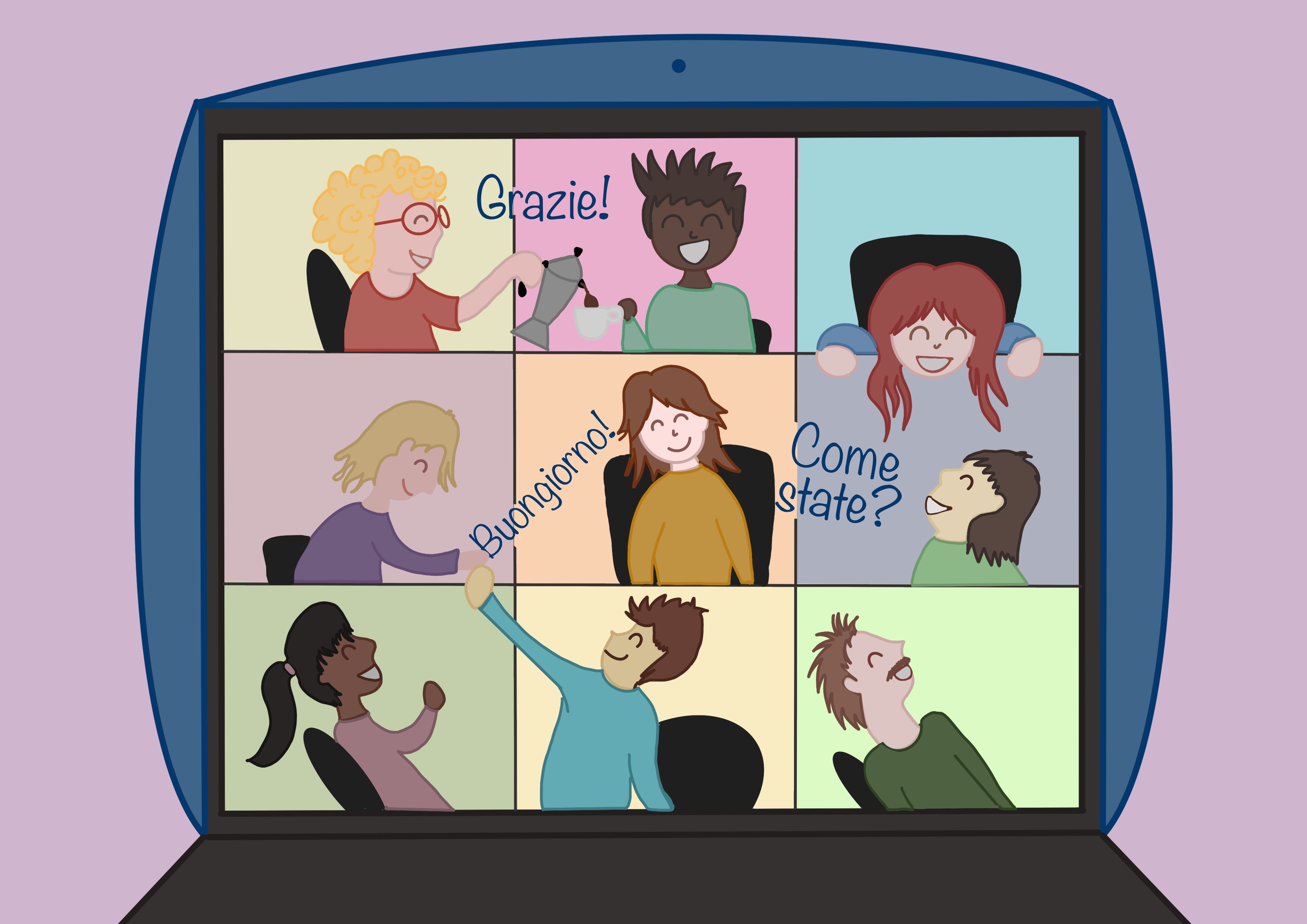
The school’s approach, which is entirely online and therefore accessible from anywhere in the world, is as follows: students usually meet once a week on Google Meet, at a day and time agreed together, with a native-speaking teacher who acts as a guide. Depending on the starting level, the teacher prepares a personalised lesson based on the student’s goals and interests, and assigns homework for the next session (the workload also depends on individual availability). The teachers’ aim is not to “fill boxes” with vocabulary and grammar, but to stimulate students so that they themselves begin to ask questions, request or seek out authentic materials (podcast episodes, YouTube videos), or use Duolingo every day.
The all-female team of native Italian teachers (Barbara, Elisa, Laura, Letizia, Sara, Silvia and Valentina) does not promise to transform students’ language level from beginner to advanced with a magic wand. Anyone making such promises - sounding like “learn Italian in a month effortlessly with so-and-so” - is running a scam. The team at OnlineItalianClasses.com, by contrast, provides the tools to succeed independently. The tools to finally get to know those new Italian neighbours.
***
Barbara Bassi was born in 1990 in Piacenza. She studied sociology and specialised in marketing and communication in Milan. In 2017 she became self-employed and began travelling: she lived for a year in Spain, some months in Poland and Croatia, and since 2022 has been living in London. In 2021 she founded an online school of Italian as a foreign language aimed at enthusiasts of Italian language and culture from all over the world. Each month she publishes the podcast ‘Italian Stories In Italian’, in which she tells the real Italian culture, beyond stereotypes.