
What School Lunch Says About a Country
Quello che la mensa scolastica dice di un Paese


Una madre americana trasferita a Bologna racconta lo stupore nel vedere cosa mangiano i suoi figli a scuola. Per molti italiani sembra quasi normale. Ma basta visitare alcune mense scolastiche all’estero per capire che dietro un semplice pranzo c’è molto di più: cultura, educazione alimentare e persino un’idea di società.
Per molti italiani la mensa scolastica non è mai stata un grande ricordo gastronomico. Pasta scotta, verdure un po’ tristi, il desiderio di tornare a casa per mangiare “come si deve”.
Eppure, vista dall’estero, la realtà può apparire sorprendentemente diversa.
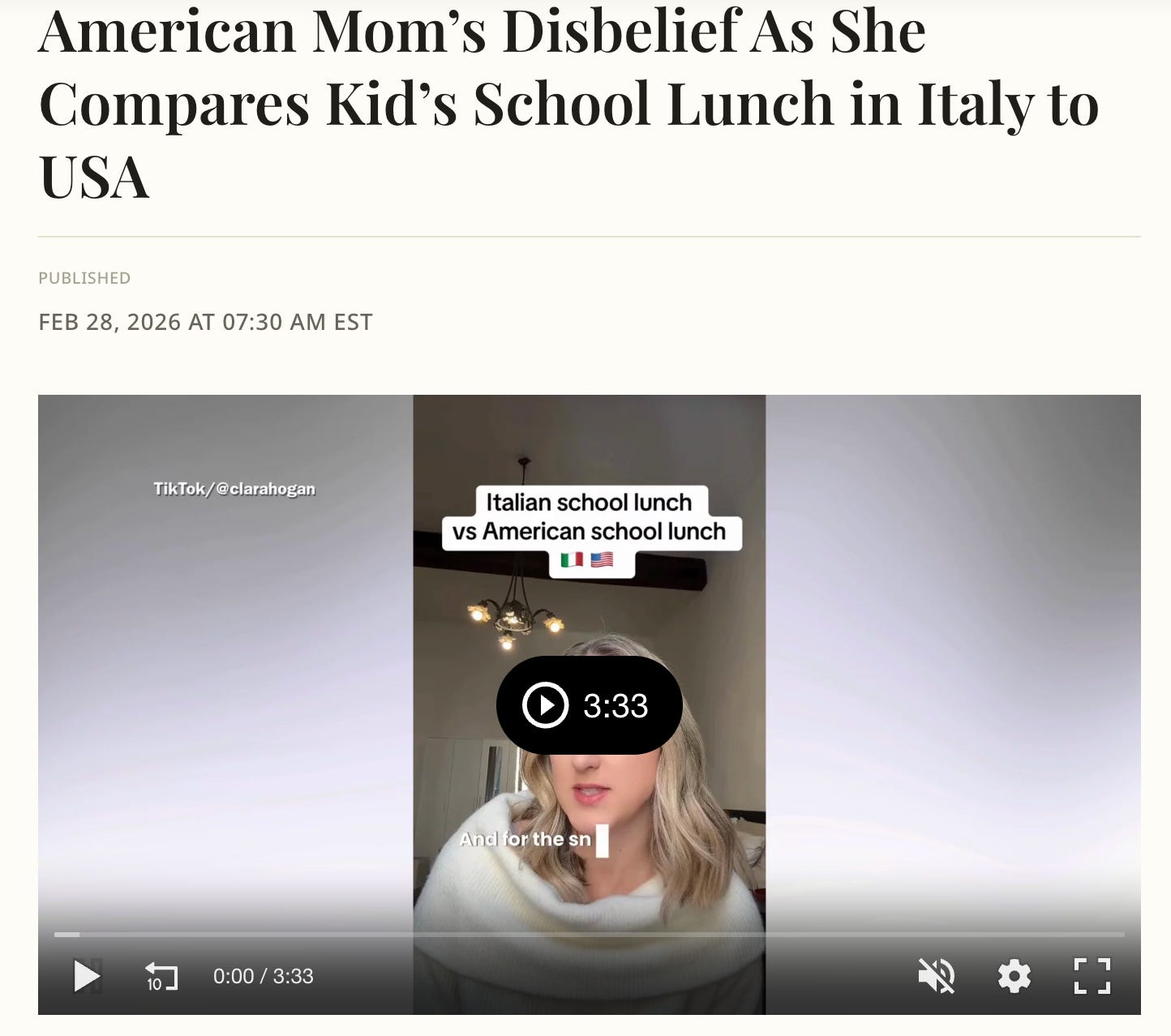
Un recente articolo pubblicato su Newsweek racconta la storia di Clara Hogan, una madre americana che si è trasferita a Bologna con il marito e i due figli piccoli. In un video su TikTok diventato virale, Hogan mostra cosa mangiano i suoi bambini a scuola: pasta al ragù come primo, polpette di cavolfiore con piselli come secondo, frutta fresca a chiudere il pasto.
Per molti italiani non sembra nulla di straordinario. Un pasto semplice, tutto sommato normale.
Ma per chi arriva da altri sistemi scolastici la differenza può essere notevole.
Hogan racconta che negli Stati Uniti il pranzo a scuola era soprattutto una questione di velocità e praticità: vassoi in fila, pochi minuti per mangiare, piatti spesso ultraprocessati. La famosa “pizza quadrata” delle mense americane è rimasta per molti millennials quasi un simbolo di quell’esperienza.
In Italia, invece, la mensa è spesso pensata come parte del percorso educativo. Non solo nutrire i bambini, ma insegnare loro cosa significa mangiare bene.
Questo non significa che il sistema sia perfetto. Gli stessi genitori italiani, racconta Hogan, spesso criticano la qualità delle mense scolastiche e chiedono menu migliori. Gli standard sono alti e il dibattito è continuo.
Eppure alcune caratteristiche restano evidenti: pasti strutturati in più portate, ingredienti relativamente freschi, e soprattutto il tempo per mangiare. In molte scuole italiane la pausa pranzo dura circa un’ora.
Può sembrare un dettaglio minore, ma non lo è.
Il modo in cui si mangia da bambini contribuisce a formare il rapporto con il cibo per tutta la vita. Imparare a riconoscere sapori diversi, a sedersi a tavola con calma, a considerare il pasto come un momento sociale e non solo funzionale.
In questo senso, la mensa scolastica racconta molto della cultura di un Paese.
In Italia il cibo è ancora percepito come parte dell’identità quotidiana, qualcosa che appartiene alla famiglia, al territorio e alla vita sociale.
Forse è anche per questo che, nonostante le inevitabili critiche, molti stranieri che arrivano qui restano sorpresi: perché scoprono che la cultura gastronomica italiana non passa solo dai ristoranti o dalle trattorie.
Inizia molto prima.
Spesso, semplicemente, a scuola.
An American mother who moved to Bologna went viral after showing what her children eat at school. For many Italians it may sound ordinary. Yet school lunches reveal something deeper about how societies teach children to relate to food.
For many Italians, school lunches were never exactly a culinary highlight.
Overcooked pasta, reluctant vegetables, and the comforting thought that dinner at home would be better.
And yet, seen from abroad, the picture can look surprisingly different.
A recent article published by Newsweek tells the story of Clara Hogan, an American mother who moved to Bologna with her husband and two young children. In a TikTok video that quickly went viral, Hogan showed what her kids eat during a typical school lunch.
On one day: gramigna pasta with traditional ragù as a first course, cauliflower meatballs with peas as a second course, and fresh fruit.
For most Italians, this sounds fairly ordinary. A simple, everyday meal.
But for someone coming from other school systems, the contrast can be striking.
Hogan recalls that school lunches in the United States often felt rushed and highly functional: students queued for trays, ate quickly, and meals frequently relied on heavily processed food. For many millennials, the iconic square cafeteria pizza remains a vivid memory.
In Italy, by contrast, school meals are often treated as part of the educational process. Not simply feeding children, but teaching them what food is supposed to be.
This does not mean the system is perfect. As Hogan notes, many Italian parents still complain about school lunches and would like to see improvements. Expectations are high and debates about menus are common.
Yet some differences remain clear: multi-course meals, relatively fresh ingredients, and perhaps most importantly, time.
In many Italian schools, children are given close to an hour for lunch.
That may seem like a small detail. It isn’t.
The way children eat shapes their relationship with food for the rest of their lives. Exposure to different flavours, the habit of sitting down and eating slowly, and the idea that meals are social moments rather than mere refuelling stops.
In that sense, school lunches say a great deal about a country.
In Italy, food is still widely seen as part of everyday identity—connected to family life, local traditions and social culture.
Perhaps that is why so many newcomers notice it immediately. The Italian food culture does not only exist in restaurants or famous dishes.
It often starts somewhere much simpler.
At school.