


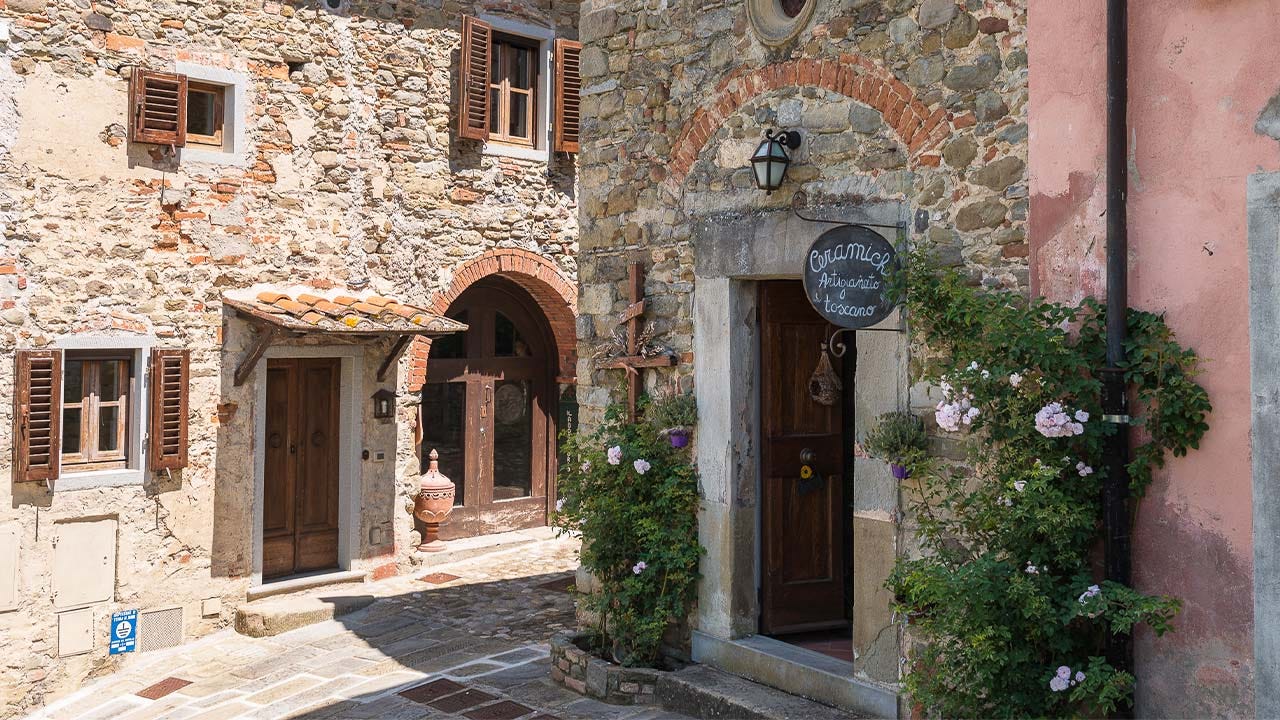
Il Sole 24 Ore (Paola Dezza) looks at the transformation of abandoned Italian villages into high-end tourism and real-estate destinations. It is often a beautiful and necessary path. But it is a very different story from that of the thousands of small Italian towns that are still inhabited, where the challenge is not to preserve a stage set, but to find a new way to live, settle and invest.
Read the original article in Italian here 👇

I read with interest an article published today by Il Sole 24 Ore, written by Paola Dezza, about Italian villages being reborn as “ecosystems” thanks to private capital: Castelfalfi, Il Borro, Castiglion del Bosco, Monteverdi, Sextantio, Monaci delle Terre Nere, Antognolla — and I could probably name another fifty or a hundred, given that this has effectively been part of my daily work for almost twenty years.
The starting point is correct: many places that had already lost their original function have been recovered through projects combining hospitality, real estate, agriculture, restaurants, wellness, events and, naturally, a not insignificant amount of private capital.
I know Castelfalfi particularly well. Around fifteen years ago — apparently enough time has now passed for me to start losing count — I was also involved in raising capital for TUI around that project. And it is precisely because I know it well that I would start there to make a distinction we continue to avoid whenever we talk about the “revival of villages”.
Castelfalfi is a good thing. Truly.
Taking a place that had largely lost its original function, restoring it, saving its buildings, landscape and heritage, and turning it into an international high-end destination is an entirely legitimate operation and, in many cases, an extraordinary one.
Buildings are saved. Heritage is prevented from falling into ruin. Enormous amounts of capital are invested. Jobs are created. Land and landscapes are maintained. A new economy is built.
Il Borro is beautiful. So is Castiglion del Bosco. Castelfalfi is impressive. Sextantio was among the first to show that even abandonment itself could become material for a project rather than merely material for another conference about depopulation.
So I have absolutely no problem with the idea that a house nobody wanted anymore might become a suite costing hundreds or thousands of euros a night — although there are also fundamentalists of the borgo who object even to that.
If the alternative is a bricked-up door, a collapsing roof and another thirty years of nostalgic photographs accompanied by the word “depopulation”, I will quite happily choose the suite.
The point is different.
What emerges in these cases is primarily a private tourism and real-estate product built within the physical form of an old village.
That is not criticism. It is a definition.
The place is regenerated, but for a new function — one that is largely private and often accessible to an economic group very different from the people who originally lived there.
And that is fine too.
Some places are dead. Others are dying. Not all of them can be resurrected in the form they had one hundred, or even fifty, years ago.
A rural settlement created at a time when one hundred pairs of hands were needed to cultivate land that today requires five will not magically return to one hundred families because we install fibre broadband and organise a village food festival.
If tourism is the new function that works, then let there be tourism. If it becomes a resort, I see no reason to be outraged in principle.
I would also avoid automatically applying the word “gentrification” to every real-estate regeneration project.
Gentrification is a serious problem when capital displaces an existing community.
It becomes a rather odd category when that community has virtually disappeared and capital arrives only after residents, services, shops and businesses abandoned the place decades earlier.
You cannot displace people who are no longer there.
You can certainly privatise space. You can change who can economically afford to access it. You can transform its function. Those are legitimate issues worth discussing.
But leaving twenty empty buildings to decay is not automatically a more advanced form of social justice.
Where I do begin to have some difficulty is when we place completely different phenomena inside the same large semantic container called borghi.
We city dwellers, it must be said, have developed a curious passion for the word.
Borgo sounds good. It is reassuring. It evokes stone walls, wood-fired bread, grandmothers who unfortunately are no longer with us, and children who — according to virtually every press release ever written on the subject — should soon be running through the narrow streets again.
We love villages enormously, preferably on Saturdays and Sundays, and we often look at them with the mixture of romanticism and mild paternalism — or maternalism, for the sake of equality — that leads us to imagine that every small town should preserve forever the function it once occupied in our imagination.
But alongside villages transformed into destinations, there is another Italy that is photographed far less and which, in my view, is far more interesting: the Italy of small towns that are still alive.
Places with hundreds or a few thousand inhabitants. A mayor. Perhaps a school. A bar. A handful of businesses. Elderly residents who remain. Young people who have left. And a few people trying to come back.
These are not stage sets waiting for an investor.
They are fragile communities, certainly. But they are still communities.
And there, the problem changes completely.
These places do not necessarily need to become Castelfalfi — and trying to do so would probably be a mistake.
They need to become contemporary places where it is possible to live in ways different from those of the twentieth century.
Tourism is part of the equation, but it cannot be the entire equation.
If we continue to believe that the destiny of every small Italian town is simply to attract more tourists, we will merely distribute a few more visitors across territories that will nevertheless continue losing residents, services and their everyday economies.
The interesting part today is much more hybrid.
Second homes that are actually used. Temporary residents. People who live between two or three places during the year. Independent workers. International professionals. Small entrepreneurs. Active retirees. Families who do not necessarily need or want to live in a city twelve months a year.
People who can become inhabitants without fitting the twentieth-century administrative definition of a permanent resident.
A sort of variable-geometry citizenship: someone might spend four months in Tuscany, three in London, two somewhere else, and then return.
They are not tourists in the traditional sense.
They use services. They renovate houses. They pay local professionals. They shop locally. They develop relationships. They invite other people. They invest and, occasionally, they open businesses.
This, in my view, is one of the missing pieces in the way we continue to discuss small towns.
We still think almost entirely in two categories: resident or tourist.
The world, meanwhile, has become considerably more complicated — and for once, that may actually be good news.
Because what small towns generally lack is not property.
They have far too much property already: empty, underused, inherited by five cousins living in four different cities, closed for twenty years, offered at apparently very low prices but often burdened by renovation costs that make the original purchase price almost irrelevant.
The one-euro houses produced excellent newspaper headlines.
But the problem was never finding a wall for one euro.
The problem is understanding why someone should invest another hundred thousand euros inside that wall.
And, above all, what they will find when they step outside the front door: services, relationships, accessibility, local authorities capable of supporting an investment, a community at least willing to engage with newcomers, and a reasonable prospect that the place will still have a function ten or twenty years from now.
The real infrastructure we need, even before fibre broadband, is trust.
Trust that the place has a future.
That it is accessible.
That it has minimum services.
That renovating a house will not turn into an initiation ritual involving an endless sequence of public offices.
That newcomers will not automatically be regarded as invaders.
That sellers have expectations compatible with the actual market.
And that the local administration has at least a reasonably clear idea of what it would like the place to become.
And this brings us to the less romantic part: without private capital, very little is likely to happen.
We can, of course, tell ourselves otherwise.
We can organise more conferences about the revival of Italy’s inner areas. Produce more renderings. Launch more working groups, observatories, steering committees and pilot projects.
But a territory becomes economically alive again when somebody risks something of their own.
Someone buys a house. Opens a business. Reactivates agricultural land. Finances a company. Brings customers. Restores a building. Employs someone. Creates demand.
The public sector can and should create the conditions. Private initiative often creates the reason why those conditions are actually used.
This does not mean handing small towns over to speculation — although some people inevitably argue that it does.
It means finally building an adult relationship between public administrations, communities and private capital, in which everyone has something to gain and something to contribute.
The problem is that this encounter is difficult.
From Rome, small towns are still too often treated as an essentially welfare-oriented category: territories to protect, subsidise and compensate.
At local level, sometimes the opposite happens, with ultimately the same result.
After decades of declining populations, disappearing businesses and broken promises, some communities understandably become defensive.
Outsiders are viewed with suspicion. Change becomes a threat. Every new initiative is judged first by what it might take away, and far less by what it might generate.
It is human. But it can become lethal. A town can die while defending itself perfectly.
And perhaps this is the question we should really be asking:
What exactly are we trying to save?
The buildings?
The exact population that lived there in 1951?
An idealised image of village life?
Or the possibility that the place might continue to have a function in the twenty-first century?
I would choose the last one.
And that function will vary from place to place.
A completely abandoned settlement may become a hotel.
Another may become a resort.
A small town that is still alive may attract new temporary and permanent residents.
Another may build a micro-economy combining agriculture, tourism, remote work, second homes, services and small businesses.
Some will not make it, and we should also have the courage to say so.
There is no law stating that every human settlement must return to its historical population peak.
Those that can have a future, however, deserve something better than a choice between abandonment and a five-star resort.
And this, as far as I am concerned, is where the real opportunity lies.
Not necessarily waiting for a billionaire to buy a thousand hectares, but building mechanisms through which tens or hundreds of small private investors can find it worthwhile to restore a dispersed heritage.
One house at a time.
One business at a time.
One family at a time.
One new inhabitant — even a temporary one — at a time.
It is less spectacular.
It does not look quite as impressive in the aerial photograph with the golf course and the swimming pool perfectly integrated into the landscape.
It probably does not deserve the huge glossy feature overflowing with the names of impossibly cool destinations.
But it can produce something that a resort, by its very nature, struggles to produce:
a town that remains a town.
The Sole 24 Ore article therefore tells a true, interesting and important story: that of borghi — or historic estates, or former rural settlements — transformed into destinations.
It is also a subject recently discussed at the latest ultra-high-end hospitality event organised by Medelhan, which I had the honour of moderating: the Hospitality Club International Summit.
But working every day around these same territories, I also see another possible story — not an alternative one.
It is the story of small towns that are not dead yet and perhaps have no need to be resurrected.
What they need is for us to stop celebrating them while they slowly disappear.
They need us to accept new ways of inhabiting them.
To allow people, ideas and capital to enter.
To let the public sector do what the public sector should do, and private actors do what private actors should do.
And above all, we need to abandon the slightly arrogant conviction that loving a place means forcing it to remain exactly as we remember it.
A living place changes.
That is one of the fundamental differences between a town and a stage set.
And many of the resorts mentioned above are magnificent, expensive stage sets for a production in which Italy is the author, an extra — but almost never the protagonist.