


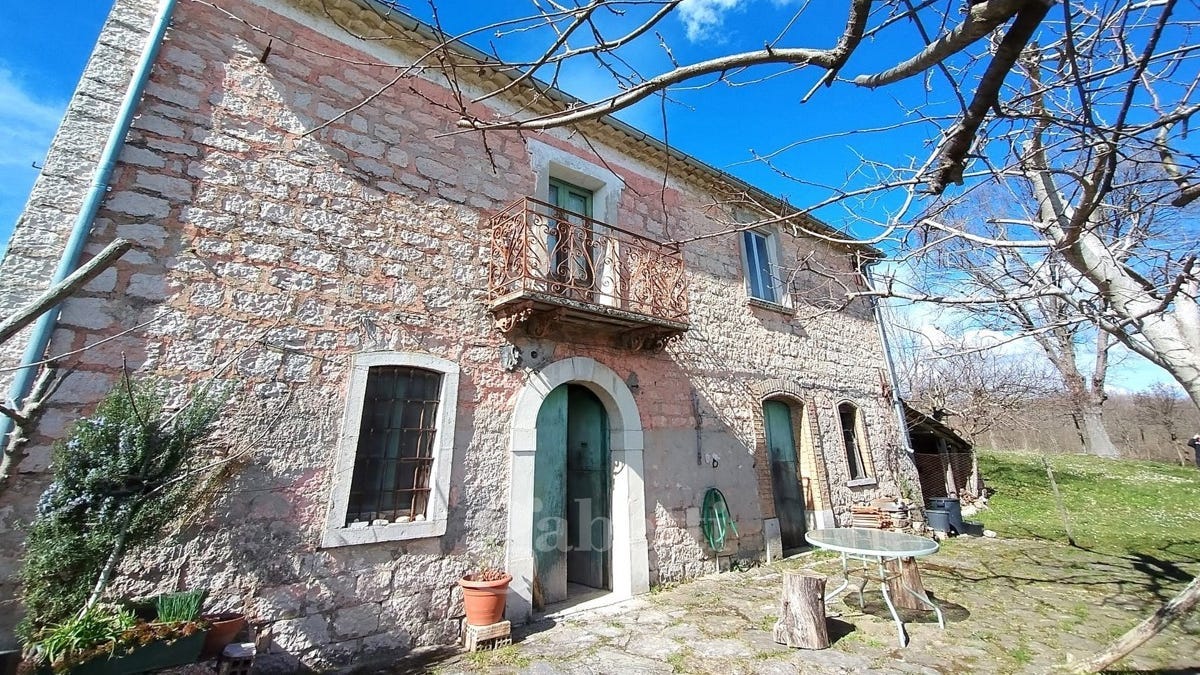
A house in an Italian town can cost far less than a garage in Milan. Online, that comparison often serves as the beginning of a dream: buy cheaply, renovate, move to Italy - or sell later for a profit.
But a low price is also a question. Why has the house remained on the market? Who else might want to live there? And what will it be worth once the renovation is complete?
An article by The Urban Studies, ‘La casa che costa troppo e non vale niente’, offers a useful way to think about those questions. It describes two sides of the Italian housing market. Where jobs, services and people concentrate, homes become increasingly difficult to afford. Where residents and opportunities have left, homes can become difficult to sell at almost any price.

The building has not disappeared. The demand around it has changed.
A cheap house does not exist in isolation
A property’s value is partly determined beyond its front door. A buyer is also choosing access to work, healthcare, schools, transport, shops and other people. When those things become harder to find, the pool of potential residents shrinks. Inherited homes sit empty. Some deteriorate. Their condition can affect neighbouring properties, making it harder for owners to justify spending money on maintenance.
This helps explain a puzzle familiar to anyone looking at homes in smaller Italian towns: a house may be inexpensive to buy but costly to make habitable, while its eventual resale price remains uncertain.
Sometimes even the asking price is less realistic than it first appears. An owner who has inherited a house may understandably attach a value to its history, or remember what the family once spent on it. A buyer, however, must add the cost of making it safe and comfortable to the purchase price. The gap between those two calculations can leave a property unsold for years.
That does not make it a bad place to live. A buyer may value the space, the landscape, the relationships or a way of life that the local property market barely recognises. But personal value and market value are different things. Anyone considering a purchase needs to understand both.
Nor does one explanation fit every town. Two places with similarly low asking prices can have very different prospects. One may be losing its last services; another may have an active community, reachable jobs and the beginnings of renewed demand. The listing price alone cannot tell us which is which.
Cheap for whom?
There is another contradiction in these markets. A town may be full of inexpensive houses while its own young people cannot find somewhere they can afford to live.
A low purchase price is of little help if the building needs extensive work, the buyer has limited savings and a mortgage is difficult to obtain. Local wages may be modest. Missing services create further costs in time, transport and childcare. A house advertised as a bargain can quickly become an impossible project for someone who would actually like to stay.
Renting is not always an alternative. In some smaller towns, very few suitable homes are available for long-term tenants. Owners may be reluctant to rent because they fear difficulties recovering the property. Others renovate and place their homes on the tourist market, hoping for a better return. Those decisions are understandable from each owner’s point of view, but together they can leave local workers and families with almost nowhere to go.
The result is a market that appears to have an abundance of houses and a shortage of homes at the same time.
This is one reason we are testing rent-to-buy arrangements in some of the places where we work. The idea is to create a possible route into a renovated home for people who cannot immediately purchase one, while giving the owner a clearer path towards a sale. These are local tests, shaped by the costs and needs of each property, rather than a universal solution. What we have seen so far gives us reason to keep working on them.
The danger of the easy flip
Cheap Italian houses have become a genre of online content. The formula is familiar: a dramatic purchase price, a beautiful renovation and an implied leap in value. What often goes missing is the final transaction. How much did the work actually cost? How long did it take? Was the house sold - and for how much?
Spending €80,000 renovating a property bought for €20,000 does not make it a €100,000 property. A buyer willing to pay that amount still has to exist. In a thin market, even an attractive, well-finished home can remain unsold for a long time.
There are good reasons to buy such a house. Someone may intend to live in it, work from it, use it regularly or keep it for the long term. But the promise of a quick profit because a property looks cheap on Instagram is a fragile reason. Some of these homes could remain illiquid indefinitely.
For those of us who introduce buyers to smaller towns, honesty about that risk is essential. If our role were simply to sell cheap houses as investments, we could be steering people towards properties whose low prices tell them something they have not yet understood.
The work that interests us most
Property services are the most visible part of what ITS ITALY does. A buyer needs to find a house, understand its condition and costs, and get through a transaction. We do that work. But the part that interests us most happens alongside it: working with people who are already trying to bring something back to life locally.
Regeneration - of buildings, communities and repopulation - needs a spark. It might be a business opening, a service returning, a group creating a reason to meet, or a resident determined to make something happen. We want to help those efforts where we can: introducing people, bringing useful skills and contacts, finding practical ways for newcomers to take part.
We do not do this for some abstract sense of virtue. We believe in these places, and we believe that a useful service or an active local initiative has social and economic value. It can make daily life easier for the people already there. It can make a town more liveable for someone considering a move. Over time, it can make staying - or returning - a more realistic choice.
We cannot restore a train service or reopen a school by selling a house. But we can listen to what local people are trying to build and use our work to support it. That is our small contribution to the communities in which we operate, and often to the lives of the people we have helped settle there. Some become involved themselves.
And, perhaps less surprisingly than it first seems, the houses become more interesting too.
Build the reason to stay
A house brought back into use matters. So does the builder employed to restore it, the shop that gains a customer and the relationship that persuades someone to return. Permanent residents, part-time residents and visitors contribute in different ways; we should understand those differences rather than count every sale as repopulation.
The goal is not to manufacture a higher price per square metre. It is to help strengthen the social and economic fabric that might, over time, make more people want to live in a place. If demand and property values then improve, they will reflect something more substantial than a successful marketing campaign.
The question “Why is this house so cheap?” deserves a serious answer. Sometimes the building needs extensive work. Sometimes the local market has very few buyers. Often, the answer lies in the longer story of a town: the services it has lost, the people who have left and the opportunities it is trying to create.
That is also, in part, what we have been examining in our own researches (see our recent articles). Looking at inexpensive homes and the initiatives that bring attention to them, we have tried to separate the purchase from the renovation, the new owner from the new resident, and an individual success story from a measurable change in a town.
A low price can be an opening. What happens around the house - and who gets the chance to live in it - tells us much more about a place’s future.