



There it is.
A stone house somewhere in Italy. Wooden beams, terracotta floors, a view stretching over vineyards and hills, and a price apparently borrowed from 1987.
The video lasts twenty-seven seconds.
By the end of it, you have mentally resigned from your job, packed the dog, opened a boutique guesthouse and developed a sudden interest in olive harvesting.
Seriously?
Do you genuinely believe that your investment - and, unless this is simply a holiday home, quite possibly your future life - can be assessed through an Instagram reel or a YouTube video?
Apparently, quite a few people do.
Perhaps not consciously. Nobody sits down and says: “I shall entrust my savings and the next ten years of my existence to a vertical video accompanied by Italian café music.”
And yet a remarkable number of small property transactions appear to begin precisely this way.
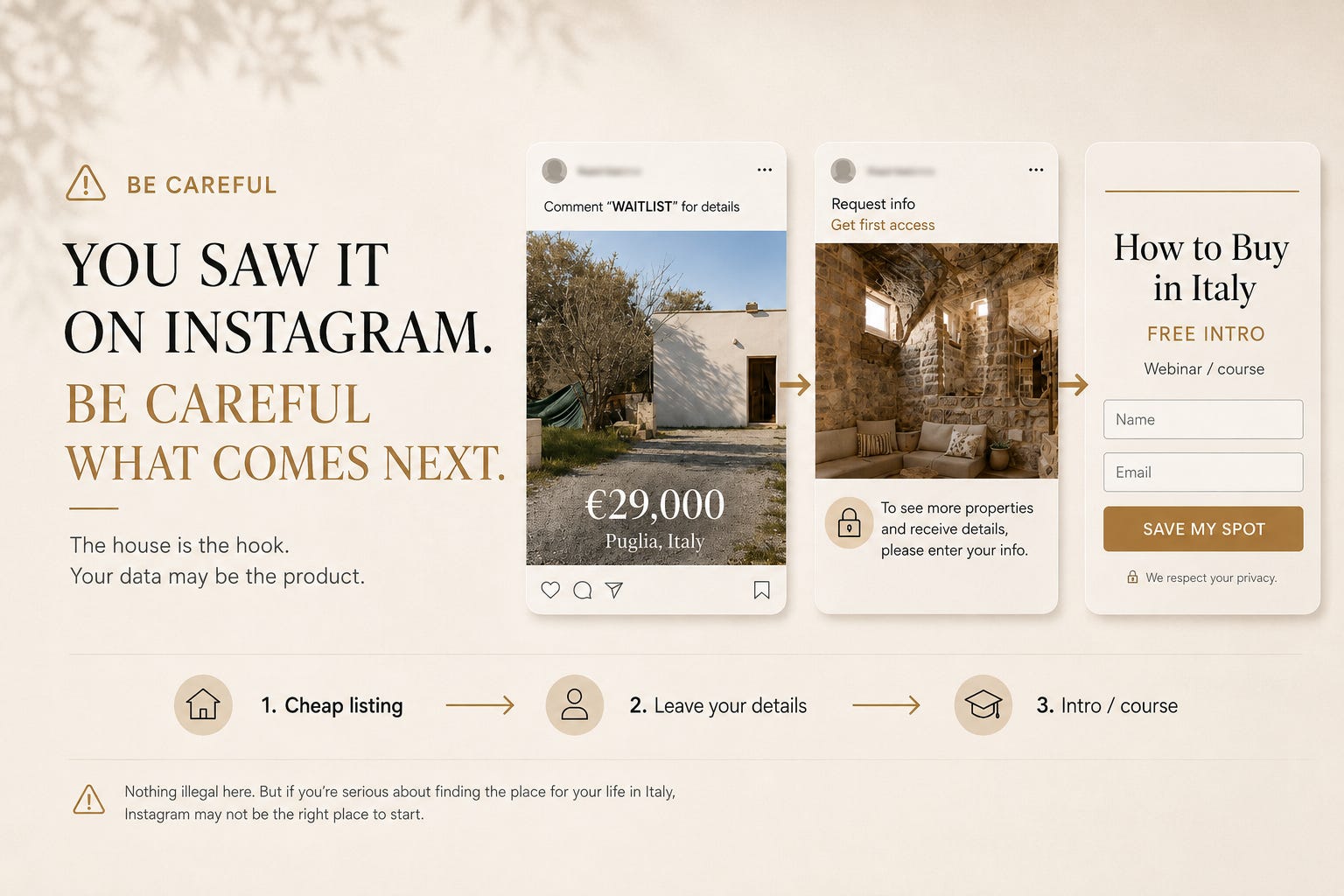
First comes the reel. Then the dream. Then the request for further information. Then the form asking for your name, email address, telephone number, budget, preferred region and possibly your blood type.
Finally, a link arrives. Sometimes it leads to a property. Sometimes to a webinar. Sometimes to a course explaining how to buy property in Italy. Sometimes to a paid community run by somebody whose principal experience of Italian real estate appears to consist of selling courses about Italian real estate.
And people still fall for it.
Everyone in the video wants something
Let us begin with an unfashionable question: who made the content, and why?
When the person presenting the property is trying to sell it, their interest is perfectly legitimate, but also perfectly obvious.
They want you to buy.
They are unlikely to dedicate the second episode to the irregular extension at the back, the roof “recently inspected” by the owner’s cousin, the municipal paperwork last updated during the first Berlusconi government or the fact that the nearest supermarket requires a forty-minute drive and a vehicle capable of handling roads last resurfaced by the Romans.
The reel is advertising. It may be honest advertising, but it remains advertising.
Then there is the adviser who does not sell houses but sells the method for buying houses: a course, membership, masterclass, relocation package or access to “exclusive off-market opportunities”.
Some of these services may be useful. Some may even be excellent.
But changing the product does not eliminate the sales incentive. The product may simply no longer be the house. It may be you.
Finally, there are the dream merchants: magnificent houses, extraordinary prices, carefully cropped photographs and a promise to reveal the location after registration.
Sometimes the property exists. Sometimes the price excludes nearly everything required to make it legally compliant, structurally sound or remotely habitable. Sometimes the house has already been sold, but continues to perform its more important function: persuading you to hand over your details.
Your Italian dream has entered a database.
A beautiful house is not necessarily a good investment
There is nothing wrong with falling in love with a house.
Houses are emotional objects. If they were purchased entirely through spreadsheets, nobody would ever buy a ruin, a listed building, a home with six staircases or anything located more than twenty metres from a functioning railway station.
But an emotional purchase and an investment are not the same thing.
A genuinely affordable holiday home may make perfect sense even if it never produces a significant financial return.
You use it. You enjoy it. You lend it to friends. You escape there for a few weeks every year and perhaps recover part of the cost by renting it occasionally.
Fine.
That is not necessarily an investment. It may simply be a lifestyle expense with walls.
Problems begin when the same property is described simultaneously as a bargain, a future home, a rental business, a retirement strategy and a guaranteed appreciating asset.
A house cannot become all of these things merely because the sunset looked impressive on Instagram.
If you intend to live there, you are not only buying square metres.
You are buying access to healthcare, transport, schools, shops, reliable internet, tradespeople, administrative services and some form of community.
You are buying winters as well as summers. Tuesday mornings as well as festival weekends. The road to the village when it is raining, rather than when it has been filmed by a drone.
If you intend to rent the property, you need demand rather than beauty alone.
You need to understand occupancy, seasonality, cleaning, maintenance, management, taxation, local regulations and how much money remains after everyone else has been paid.
And if you consider it an investment, you also need an exit.
Who might buy the property from you in five or ten years?
A local family?
Another foreign dreamer?
A developer?
Nobody?
Liquidity is considerably less photogenic than bougainvillea, but rather more relevant when your money is trapped in a house that attracts thousands of likes and no credible offers.
The algorithm does not know what lies behind the plaster
The principal problem with property content is not necessarily that it contains false information.
It is that it removes context. A camera shows what is visible. Due diligence is largely about what is not.
Ownership history. Mortgages. Easements. Rights of way. Planning compliance. Cadastral consistency. Structural problems. Boundaries. Shared access. Utilities. Outstanding charges. Restrictions on alterations. Inheritance complications.
And the legal status of that delightful little stone building in the garden which the seller describes as “a guest house” and the municipality may describe rather differently.
The preliminary contract is not a romantic promise made over lunch.
It is a real contract.
The notary performs essential checks and acts as an independent public official, but the notary does not replace the surveyor, architect, engineer, lawyer, accountant or tax adviser who may be required according to the property and the buyer’s circumstances.
Buying in Italy may require a small orchestra of professionals.
Instagram usually introduces you only to the lead singer.
Cheap is a price. Affordable is a calculation.
A house advertised for €60,000 does not cost €60,000.
It costs the purchase price, taxes, agency fees, notarial costs, technical checks, possible legal advice, renovation, furniture, utilities, travel, insurance, maintenance and the money you will inevitably spend after discovering that the previous owner’s definition of “fully renovated” meant “painted shortly before the photographs were taken”.
Then there is time. Time waiting for documents. Time obtaining estimates. Time coordinating builders from another country. Time discovering that the charming original floor must be lifted because the plumbing beneath it belongs in a museum.
Cheap properties can be wonderful purchases. They can also be financial sinkholes wearing geraniums. The difference rarely appears in the first video.
Use the reel. Do not let the reel use you.
None of this means that social media is useless.
Quite the opposite.
Instagram, YouTube and property portals can help buyers discover places they would never otherwise have considered. They can reveal architectural styles, introduce small villages, explain regional differences and allow people to follow renovation projects.
The danger begins when discovery quietly becomes validation.
Repeatedly seeing people buy homes in Italy does not prove that you should buy one. A thousand enthusiastic comments do not verify the paperwork. A creator’s large audience does not make them independent. And a beautifully edited renovation video rarely contains a full account of delays, mistakes, professional fees, additional works and the final cost per square metre.
Online property browsing has become entertainment and escapism as much as house hunting.
The property on the screen is no longer merely a building. It is an alternative life you can briefly inhabit without leaving the sofa.
That is harmless until the fantasy asks for a deposit.
There is another way to do this
This is also why, at ITS ITALY, we decided not to become another estate agency with a more attractive Instagram account.
We are not agents.
We do not begin with a catalogue of properties somebody needs to sell and then attempt to persuade buyers that one of them happens to contain their future.
We begin with places.
We select villages and territories where living can make sense, where the property opportunity is real and where bringing new residents, investment and activity may contribute to something larger than the commission generated by a transaction.
Then we look for properties within those places. Not every cheap house is an opportunity. Some houses are cheap for very good reasons.
Before even presenting a property, we examine ownership, documentation, planning status, cadastral consistency, access, utilities and realistic renovation requirements.
Where irregularities can be resolved, we work to resolve them.
Where they cannot, we say so.
We involve the technicians who must verify the building, the professionals who may carry out the work and the local people capable of managing that work.
We try to turn the purchase into one coordinated process, rather than introducing the buyer to an agent, three surveyors, two contractors, a notary, an accountant, the mayor’s cousin and fifteen distant relatives who each appear to own 4.7 per cent of the roof.
This does not make old Italian buildings magically predictable.
It does, however, eliminate a considerable amount of avoidable chaos.
The prices we present are intended to be real prices.
Not spectacular numbers created to produce clicks, followed by a quiet explanation that the roof, heating, bathroom, legal regularisation, furniture and access road are all additional.
Our properties may therefore not always look like the greatest bargain ever discovered by the internet.
That is rather the point.
First choose where to live
We also insist on something that sounds obvious but is curiously absent from much property content aimed at foreign buyers.
Before choosing a house, choose where you may actually want to live.
A beautiful building is not enough.
You need to understand the village, the landscape, the distances, the climate, the winter, the services and the rhythm of daily life.
Spend time there. Buy groceries. Drive the roads. Try to obtain a coffee on a rainy Tuesday in February. Discover whether the silence feels peaceful or slightly alarming after the fourth evening.
For this reason, ITS ITALY is developing something property sellers are rarely particularly enthusiastic about: test before you buy.
Selected properties can be rented for medium-term stays, giving prospective buyers an opportunity to experience the area before making a major commitment.
Because visiting somewhere for a weekend is not living there.
And falling in love with a place in August does not mean that you will enjoy it in January.
For properties purchased through us, we are also introducing a degree of flexibility that is unusual in the traditional market, including - within defined limits and conditions - the possibility of switching from one ITS Italy property to another.
Perhaps the house is right but the village is not.
Perhaps the village is perfect but your requirements change.
Perhaps, after six months, you discover that the idyllic isolation you requested would become considerably more idyllic with a pharmacy nearby.
Life changes.
A property model designed around people should at least attempt to recognise that.
Not just the house
Buying the building is only one part of moving to Italy.
There is taxation, legal structuring, immigration, residence permits, utilities, insurance, banking, property management and the thousand small administrative questions that nobody includes in the drone footage.
Who activates the electricity? Who arranges the internet? Who helps with the tax code, residency registration or residence permit? Who opens the property before you arrive, speaks to the plumber, receives the furniture and discovers why the boiler has chosen to display an error message in Italian at eleven o’clock at night?
These things are not glamorous. They are, however, the difference between buying a property in Italy and being able to live in one.
Our homes are therefore not conceived merely as empty buildings handed over with a set of keys and a sincere expression of encouragement.
Where appropriate, they can arrive ready to live in: furnished, equipped, connected and managed.
The cutlery is there. The internet is working. The lights come on.
Somebody knows where the water valve is.
You may wish to replace the bed linen, change the curtains or repaint the bedroom because the existing shade of green has begun to offend you personally.
But you should not need to spend the first three months discovering how to make the house function.
For many buyers, we have also added flexibility in how our services and the broader project can be paid for.
Not everyone moving country has the same financial structure, timing or liquidity. Pretending otherwise merely excludes people who may be perfectly suitable buyers and future residents.
Perhaps we should make more glamorous reels
Admittedly, this may not be the most efficient way to win the social-media game.
Perhaps we should film more sunsets.
Perhaps every property should be presented as a once-in-a-lifetime secret bargain, available only to the first seven people who enter their email address before midnight.
Perhaps we should stand inside a ruin, point enthusiastically at a collapsed ceiling and announce that, for less than the price of a garage in California, you too can own an authentic piece of Italy.
Perhaps we should sell a course teaching people how we purchased our own house, renovated it once and immediately transformed that single personal experience into universal expertise.
But buying one house does not make somebody an international property adviser. It means they bought one house.
They may have useful experience to share. They may be intelligent, honest and helpful.
But there is a considerable distance between describing your personal journey and possessing the technical, legal, fiscal and operational infrastructure required to manage somebody else’s.
Beyond that, there may be expertise. Or there may simply be smoke. Possibly from the barbecue in the garden of the house being used as the background for the next paid webinar.
The real opportunity is not the property that looks most extraordinary in a reel.
It is the property that still makes sense when the reel ends, the documents arrive, the technicians inspect it, the costs are calculated and you finally understand what living there would involve.
Instagram may help you discover Italy.
It should not be allowed to perform your due diligence.