


A recent Business Insider essay by Camellia Phillips is not, strictly speaking, aligned with the advice we would normally give to someone looking at property in Italy.
She and her husband bought a two-bedroom house in Melilli, Sicily, sight unseen, while living in New York. They paid €57,000, plus closing costs. They had not visited Sicily before completing the purchase. The decision was bold, personal and - by their own admission - risky.
It also worked.
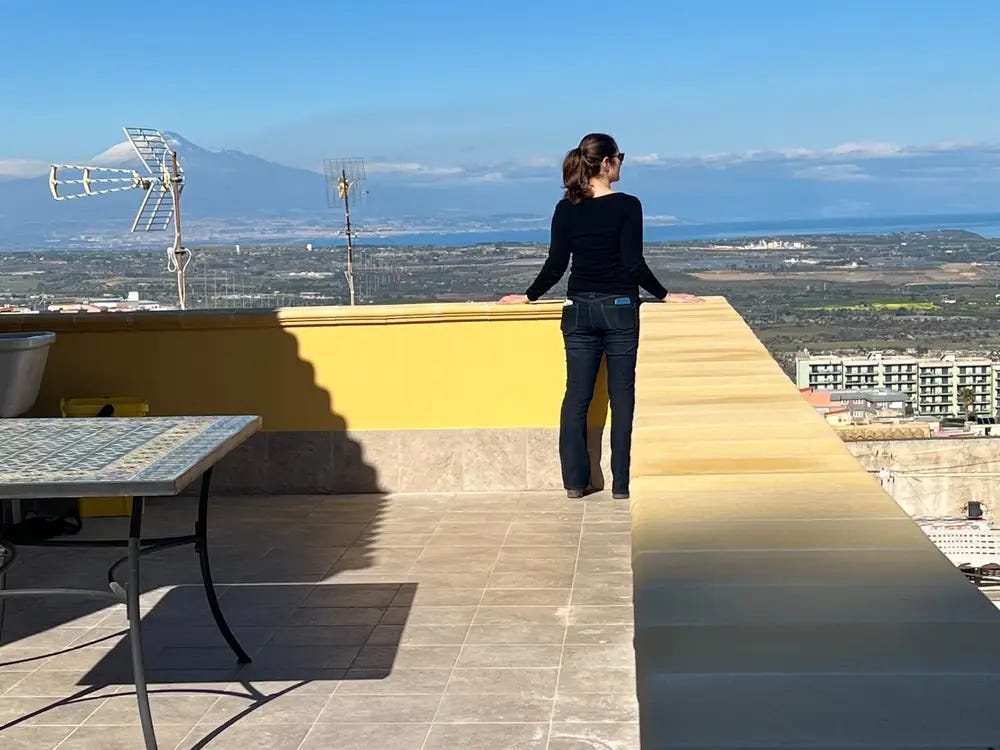
Five years later, that house is their full-time home. Camellia has left a 20-year career in nonprofit fundraising, built a consulting business, and describes a life shaped by neighbours, local produce, long stays, a rooftop view of Etna and the Mediterranean, and a different idea of what “home” can mean.
It would be easy to turn this into another Instagram-ready Italian property story: an inexpensive house, a picturesque village, a brave couple, a successful move. But that would miss precisely what makes it interesting.
The story is not that a €57,000 house in Sicily is a shortcut to happiness. It is not a template for buying remotely, nor evidence that every low-priced property represents an opportunity. In fact, Phillips makes an important point herself: homes in these areas can remain on the market for years. Money spent may not be quickly recoverable. A purchase may be emotionally right and financially sensible for one household, while being completely wrong for another.
That is much closer to the reality we are trying to describe in our work.
In the first findings of RELOCALS - our research project on foreign-born people who have chosen to live in Italy - we repeatedly encounter decisions that are not reducible to a price per square metre, a tax incentive or a glossy promise of “la dolce vita.” People arrive for relationships, family history, work, health, a slower rhythm, a specific town, or a moment in life when the old geography no longer makes sense.
Housing matters enormously. But it is rarely the whole story.
The most interesting relocations are not necessarily the most rational on a spreadsheet. They are the ones in which a person understands the risks, accepts that a house is not a liquid asset, finds trusted local people, and gradually builds a life around the place rather than merely consuming it.
Camellia and her husband were both courageous and fortunate. They had family connections to Melilli, found local property hunters they could trust, chose a house that was already habitable, and had circumstances that made extended stays and then a full move possible. Those conditions matter. They should not be edited out of the story.
Yet the story still tells us something important about Italy’s real property values.
In many smaller towns, the real value of a home is not visible in the listing price. It lies in the possibility of time: time to stay longer than a holiday allows; time to recover from a difficult journey; time to know the people on the street; time to make a professional life work in a different rhythm. It also lies in the physical reality of a place- its roofs, its stairs, its views, its inconveniences, its neighbours, its seasons.
That is why the reality is sometimes more compelling than the imagery sold online - and more physical, more human, more “carnal” than even a research report can fully capture.
At ITS Italy, we help people and places find each other. That means being honest about risk, costs, bureaucracy, resale limitations and the fact that relocation is never solved by a cheap house alone. But it also means paying attention when real lives reveal something that market narratives do not.
Camellia, if you are reading this: we would be delighted to continue this conversation with you.
Stories such as yours are not instructions. They are invitations to look more closely - at the people behind the move, at the places beyond the postcard, and at the forms of value that are not always recorded in a property portal.